
AI consulting can increase profitability, but only when the engagement targets a specific cost or revenue lever instead of installing generic automation tools. The gains show up fastest on the cost side — ticket routing, demand forecasting, cash flow forecasting — and slower on the revenue side, where lead scoring and retention projects take longer to compound. In 2026, the size of the profitability gain depends more on data readiness and change management inside the business than on which AI vendor gets picked.
- AI consulting can increase profitability when it targets a named cost or revenue lever, not generic automation.
- Cost-side projects like ticket routing and demand forecasting tend to hit the P&L before revenue-side projects.
- Avanti AI Partners ties every engagement to an operational outcome, not just a tool rollout.
- Profitability impact in 2026 depends on data readiness and change management as much as the AI itself.
Why this matters
Most businesses evaluating AI consulting ask the wrong first question — "what can AI do" instead of "which cost or revenue line moves if we fix this process." That framing gap is why some engagements produce a measurable profit swing and others produce a dashboard nobody opens. Understanding what an AI consulting firm actually does before signing a scope of work changes which questions get asked in the sales process.
Avanti AI Partners builds engagements around operational outcomes first — cost, satisfaction, revenue — and treats the AI implementation as the mechanism, not the deliverable. That distinction is the difference between a profitability project and a software project wearing an AI label.
Can AI consulting increase profitability?
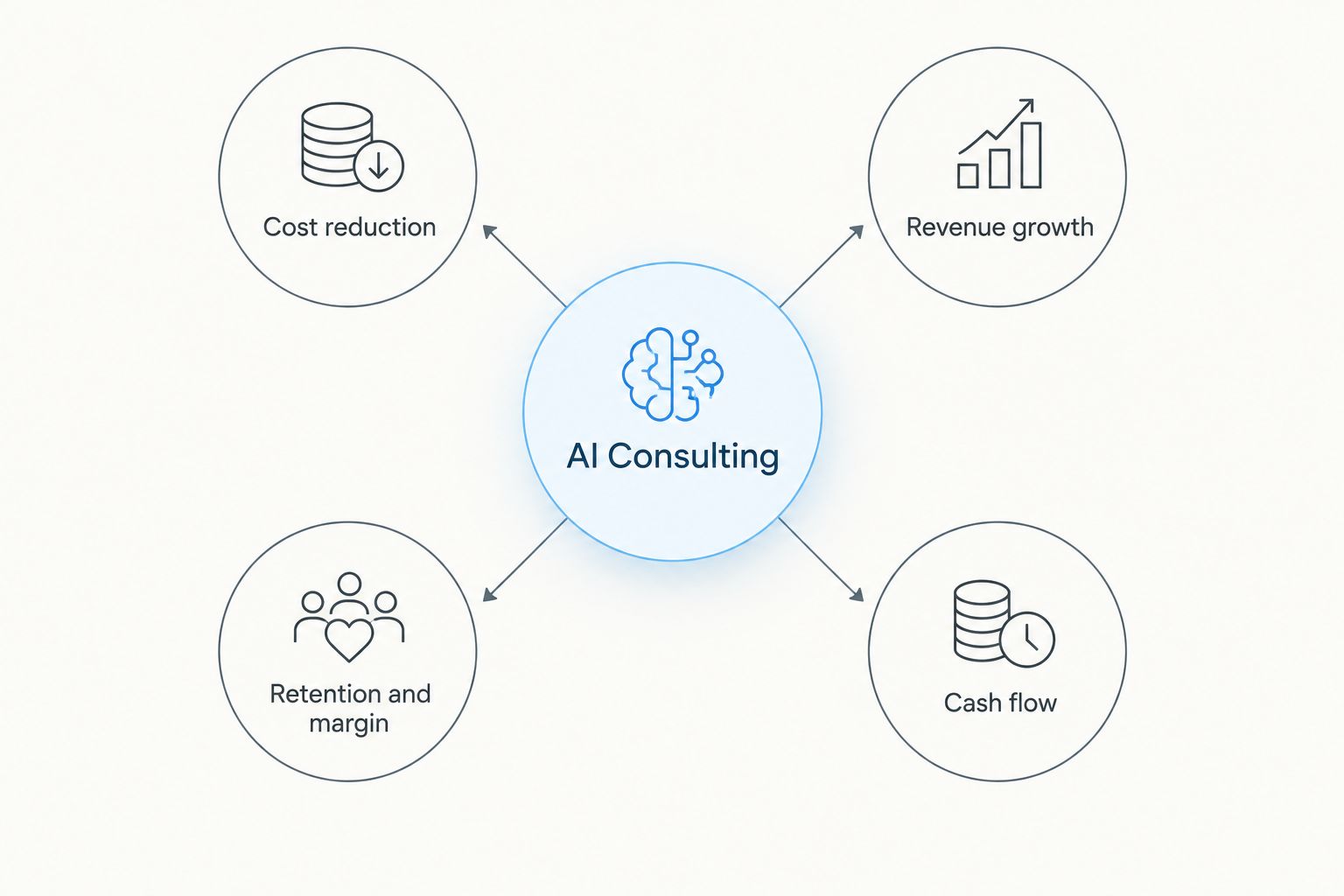
Profitability moves through four levers, and a well-scoped AI consulting engagement usually picks one or two rather than all four at once.
| Profitability lever | What the AI consulting engagement does | Where it shows up |
|---|---|---|
| Cost reduction | Automates repetitive steps in support, finance, or operations | Lower headcount cost per transaction, faster cycle time |
| Revenue growth | Scores leads, prioritizes pipeline, personalizes outreach | Higher conversion rate on existing traffic and leads |
| Retention and margin | Flags at-risk accounts before they churn | Fewer lost contracts, steadier recurring revenue |
| Cash flow | Forecasts demand and cash position ahead of need | Less capital tied up in excess inventory or float |
Cost reduction: the fastest lever to show up on the P&L
Cost-side projects tend to be the quickest to convert into measurable profitability because the baseline is already known — you can measure current cost per ticket or per order before touching anything. Routing support tickets to an AI assistant when call volume spikes is a concrete example of this: the cost per resolved ticket drops without adding headcount. Whether AI automation actually reduces operational costs in a given business depends on how much of the process is already standardized versus still handled case-by-case by judgment calls.
Revenue growth: converting more of the pipeline you already have
Revenue-side engagements — lead scoring, demand forecasting, personalized outreach — take longer to compound because they depend on a sales or marketing cycle playing out before the impact is visible. A lead-scoring model built on CRM data doesn't change close rates the day it ships; it changes them over the next two or three sales cycles as reps trust the score and prioritize accordingly. The payoff is real but it's a 2026 planning-cycle bet, not a 30-day win.
Retention and margin: protecting profit you already earned
Churn-detection work protects profitability rather than creating it outright — it stops a customer from leaving before the warning signs turn into a cancellation notice. This lever matters most in subscription and services businesses where the cost of replacing a lost account is higher than the cost of catching it early. It's the least glamorous of the four levers and often the one with the clearest dollar trail back to retained revenue.
“Profitability comes from removing the two or three costliest steps in a process, not from installing a chatbot.”
Why the profitability impact varies
The same AI consulting scope produces different profit outcomes across two businesses. The factors that explain the gap:
- Data readiness — clean, connected data in a CRM or ERP shortens the time to a working model; messy data adds months before any lever moves
- Process maturity — a standardized process automates cleanly; an ad hoc process needs redesign before AI touches it at all
- Change management — a scoring model or routing tool only pays off if staff actually use its output
- Engagement scope — a narrow, single-lever project shows results faster than a broad, multi-department rollout
- Existing tech stack — engagements that plug into tools already in place (Slack, HubSpot, QuickBooks, NetSuite) move faster than ones needing new infrastructure
- Industry — regulated industries like financial services and healthcare carry compliance steps that slow the timeline but don't remove the profitability upside
Find your profitability lever
Talk through which cost or revenue lever fits your business first.
Is AI consulting worth it for small businesses?
Whether AI consulting is worth it for small businesses comes down to whether the business has one process costing enough in labor or lost revenue to justify the engagement scope. A small business with a single high-volume, repetitive process — support tickets, invoice processing, lead follow-up — often sees the clearest and fastest return, because the baseline cost is easy to measure and the fix is narrow.
How much does AI consulting cost?
The cost of an AI consulting engagement in 2026 varies by scope, industry, and how much existing tech stack integration is required — current cost ranges are best checked against the specific project scope rather than a flat industry average. A narrow, single-lever project costs less and returns faster than a broad, multi-department transformation.
How long does an AI consulting engagement take before profitability shows up?
Cost-reduction projects tend to show measurable change within the first operating cycle after go-live, while revenue-side projects like lead scoring take longer because they depend on a full sales cycle playing out. Retention projects sit in between — the savings show up the moment a flagged account is saved rather than lost.
FAQ
Can AI consulting increase profitability?
Yes, when the engagement targets a named cost or revenue lever rather than a generic automation rollout. Cost-side projects like ticket routing tend to show up on the P&L faster than revenue-side projects like lead scoring.
Is AI consulting worth it for small businesses?
It's worth it when one process is costing enough in labor or lost revenue to justify the engagement scope. A single high-volume repetitive process is usually the clearest starting point.
How much does AI consulting cost in 2026?
Cost depends on scope, industry, and how much integration with existing tools like Slack, HubSpot, or NetSuite is required. A narrow single-lever project costs less than a multi-department rollout.
How long does an AI consulting engagement take?
Cost-reduction projects typically show change within the first operating cycle after go-live. Revenue-side projects take longer because they depend on a full sales cycle to prove out.
Can AI automation actually reduce operational costs?
Yes, most clearly in standardized, repetitive processes like support ticket routing or invoice processing. The reduction is smaller in processes still handled case-by-case by judgment calls.
How do I know if my business needs AI consulting?
The signal is a specific process with a measurable cost or revenue drag that hasn't improved with existing tools. Vague interest in "doing something with AI" without a named process is a sign the business isn't ready yet.
What does an AI consulting firm actually do?
It scopes a business outcome first, then builds or configures the AI workflow that produces it, rather than selling a generic software license. The work spans process audit, model or workflow build, and adoption support.
How do I choose an AI consulting firm?
Look for a firm that asks about your cost and revenue levers before mentioning any specific AI tool. A firm that leads with a tool demo instead of your P&L is leading with the wrong question.
One last thing
The businesses that see the clearest profitability gain from AI consulting in 2026 aren't the ones with the most data or the biggest budget — they're the ones that can name one process, in one sentence, that costs them money every month. If you can't name that process yet, that's the actual starting point, not the AI itself.