
An AI consulting engagement typically runs 3 to 4 months from kickoff to a working system in production, with the full range spanning 6 to 8 weeks for a narrow pilot up to 9 to 12 months for an enterprise-wide rollout in 2026. The number most firms quote upfront skips the discovery and data-readiness phase, which routinely adds 2 to 4 weeks before any build work even starts.
- A typical AI consulting engagement takes 3 to 4 months for a single workflow, 6-8 weeks for a pilot, 9-12 months for enterprise rollouts in 2026.
- Discovery and data-readiness work adds 2-4 weeks most vendors leave out of the headline timeline.
- Data quality and system integration complexity are the two biggest factors that stretch a timeline past the quoted range.
- Avanti AI Partners scopes phased engagements so you see a working result before committing to the full build.
Why this matters
A quoted timeline that only covers the build phase sets you up to miss your own launch date. If a vendor tells you "8 weeks" without naming what happens before week one, ask what discovery includes and whether your systems are already in scope.
Budget planning tracks the same logic as timeline planning — a longer engagement usually means a bigger AI consulting cost range, so the two numbers should get evaluated together, not separately. In 2026, most engagements that overrun their original timeline do so because of data access delays, not because the AI model itself takes longer to build.
How long does an AI consulting engagement take?
The honest answer depends on scope. Here's how duration breaks down by engagement type, based on aggregated patterns across AI consulting projects:
| Engagement type | Typical duration | Best for |
|---|---|---|
| Proof of concept / pilot | 6-8 weeks | Testing one workflow before committing budget |
| Single-workflow implementation | 3-4 months | Moving one AI system into production |
| Multi-department rollout | 5-7 months | Coordinating AI across several teams |
| Enterprise-wide transformation | 9-12 months | Large organizations with legacy systems and compliance review |
Verdict: a pilot in the 6-to-8-week range is the fastest path to a real answer on whether AI consulting pays off for your business — anything shorter usually skips the data validation step that makes the result trustworthy.
Pilot engagement: 6 to 8 weeks
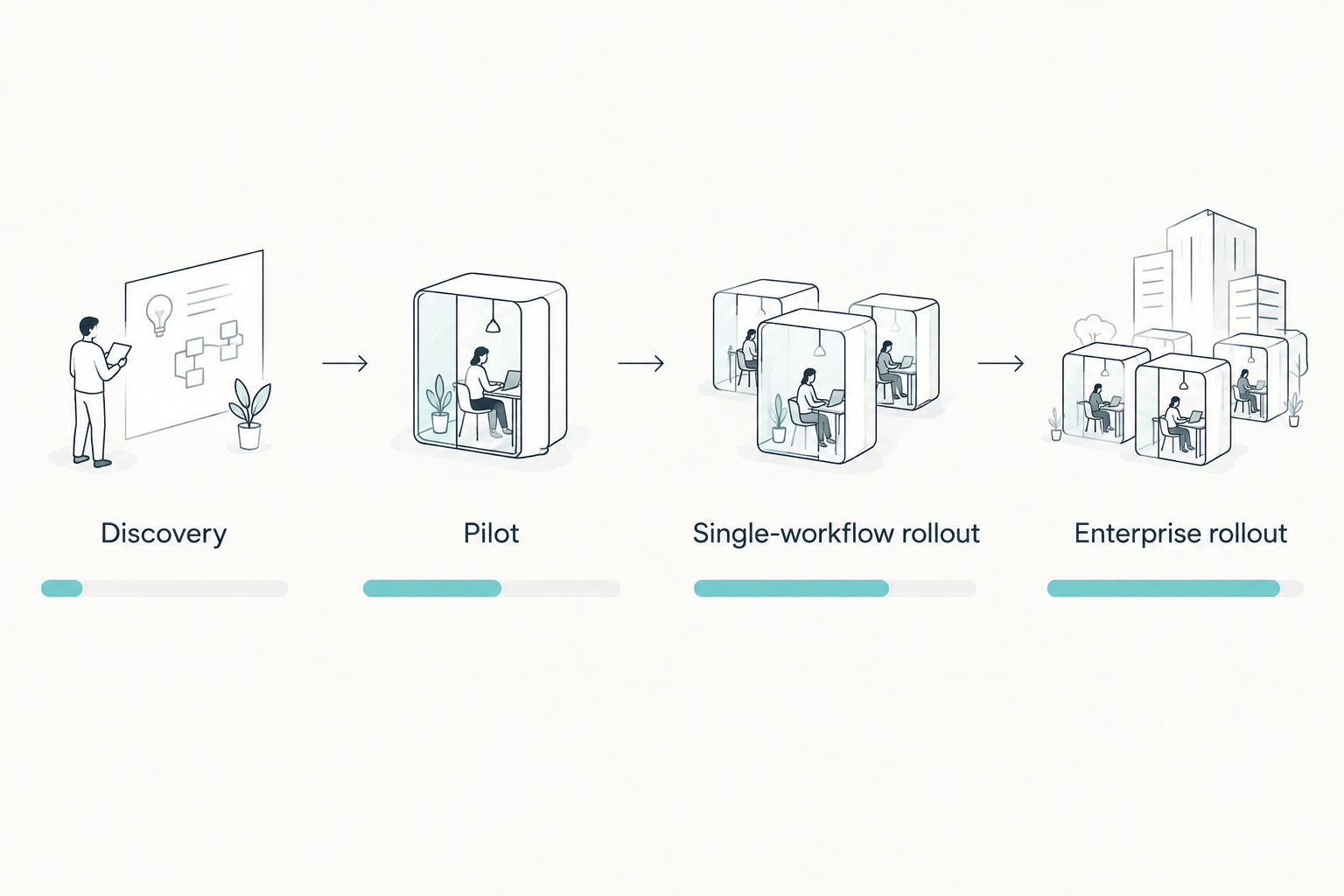
A pilot engagement runs 6 to 8 weeks and targets one workflow — a support ticket router, a lead-scoring model, one automated report. It's built to answer a single question: does this work with your data, in your systems, at your volume?
Best for: businesses that haven't used AI consulting before and want proof before a bigger commitment. Skip a pilot shorter than 6 weeks — that's rarely enough time to validate results against real data.
Single-workflow implementation: 3 to 4 months
A single-workflow implementation runs 3 to 4 months and moves a pilot's winning use case into full production with monitoring, error handling, and staff training built in. This is the most common engagement length among mid-size companies in 2026.
Best for: companies that already ran a pilot and want the workflow live for every customer, not just a test group.
Enterprise-wide rollout: 9 to 12 months
An enterprise-wide rollout runs 9 to 12 months and coordinates AI across multiple departments, systems, and often multiple business units. Compliance review, security sign-off, and change management across large teams are what stretch this timeline — not the AI build itself.
Best for: organizations with more than a few hundred employees or heavily regulated operations. Firms ranked by implementation speed tend to compress this phase by running workstreams in parallel instead of sequentially.
Why AI consulting timelines vary
- Data readiness — clean, accessible, well-labeled data cuts weeks off any engagement; messy data adds them back.
- System integration complexity — connecting to five platforms takes longer than connecting to one.
- Stakeholder alignment — engagements stall when department heads disagree on scope mid-project.
- Regulatory or compliance review — finance, healthcare, and legal work often add a formal review cycle.
- Internal team bandwidth — if your staff can only meet weekly instead of daily, timelines stretch proportionally.
- Scope discipline — a fixed-scope pilot finishes on schedule far more often than one with shifting requirements.
How long does an AI pilot take before you see results?
An AI pilot takes 6 to 8 weeks before you see a measurable result on the specific workflow it targets. That timeline assumes the data needed for the pilot already exists in an accessible format — if it doesn't, add the discovery phase on top.
Is a 3-month AI consulting engagement long enough?
Three months is long enough for a single-workflow implementation but too short for a multi-department rollout. Match the engagement length to the scope: one workflow fits in 3-4 months, several departments generally need 5 months or more.
Does a longer AI engagement mean a better outcome?
A longer engagement doesn't automatically mean a better outcome — it usually means a bigger scope, not a better model. The engagement length should match the number of workflows and systems involved, not get padded for its own sake.
One detail worth stating plainly: firms that scope engagements in phases — pilot first, then implementation, then rollout — tend to hit their stated timelines more often than firms that quote one long number upfront. Avanti AI Partners structures engagements this way specifically so you see a working result before signing off on the next phase.
Get a timeline scoped to your business
See what a pilot, implementation, or rollout would actually take for your systems.
FAQ
How long does an AI consulting engagement take in 2026?
Most AI consulting engagements take 3 to 4 months for a single workflow, with pilots finishing in 6 to 8 weeks and enterprise rollouts running 9 to 12 months in 2026. Scope, not the AI technology itself, is what sets the length.
What is the shortest AI consulting engagement?
A pilot or proof of concept is the shortest AI consulting engagement, typically 6 to 8 weeks. Anything shorter usually skips validating results against real data.
Why do AI consulting timelines get quoted shorter than reality?
Vendors often quote only the build phase and leave out discovery and data-readiness work, which adds 2 to 4 weeks before development starts. Ask what's included before comparing quotes.
Does industry affect how long an AI consulting engagement takes?
Yes — regulated industries like finance, healthcare, and legal add formal compliance review cycles that extend timelines beyond the base estimate. Less regulated businesses generally move through the same phases faster.
Can an AI consulting engagement be shortened?
An engagement can be shortened by having clean, accessible data ready before kickoff and keeping scope fixed instead of expanding mid-project. Both changes remove the two biggest sources of delay.
Is a longer AI consulting engagement better?
A longer engagement isn't inherently better — it typically reflects a bigger scope, not a higher-quality outcome. Match engagement length to the number of workflows and systems actually involved.
How long does an enterprise AI rollout take?
An enterprise-wide AI rollout takes 9 to 12 months on average, driven by coordination across departments and compliance sign-off rather than the AI build itself. Running workstreams in parallel can compress this.
One last thing
The fastest way to blow a timeline isn't a hard technical problem — it's waiting until week 3 to discover the data you need lives in three disconnected systems nobody flagged during scoping. Ask any AI consulting firm to walk through their data-access checklist before you sign, not after.