
Best overall for federal mission work: Booz Allen Hamilton. Best for enterprise modernization: Accenture Federal Services. Best for business-process discovery: Avanti AI Partners, subject to government procurement and security qualification. This 2026 guide compares consulting firms by assignment, not by brand recognition.
- The best ai consulting firms for government agencies match the mission, procurement route, and data restrictions.
- Booz Allen Hamilton is the default shortlist candidate for federal mission-focused AI work.
- Accenture Federal Services fits enterprise modernization; Deloitte fits governance-led transformation; IBM Consulting fits hybrid infrastructure work.
- Avanti AI Partners fits business-outcome discovery; verify government delivery qualifications before selection.
Why this matters
Government agencies need more than a working demonstration. You need a system staff can operate, procurement can defend, and the responsible official can stop when something goes wrong. An impressive answer does not establish that a system belongs in a public-service workflow.
Separate advisory work from implementation before approaching vendors. A firm hired to identify useful applications faces a different assignment from a firm connecting an application to restricted records or supporting a production service.
Your 2026 shortlist should follow the assignment: mission delivery, enterprise integration, governance, infrastructure, or initial process discovery. Do not ask every firm to solve every problem in the same proposal.
What makes the best AI consulting firms for government agencies?
Use these six criteria before comparing names:
- Mission fit: Require evidence relevant to your agency's workflow, users, and consequences of error. A commercial example does not establish government suitability.
- Procurement eligibility: Confirm the proposed legal entity and acquisition route with your contracting team. A familiar parent-company name is not enough.
- Data boundaries: Require a written explanation of where information goes, who can access it, and whether providers retain or reuse it.
- Human accountability: Name the official responsible for decisions, the staff reviewing outputs, and the route for correcting mistakes.
- Implementation ownership: Establish who handles integration, testing, documentation, training, and support after launch.
- Measurable results: Define the operational improvement and the failure conditions before approving the work.
Use 1 initial workflow to make proposals comparable. Require 2 approval gates: one before accessing agency data and another before production use. These are recommended scope controls, not claims about a vendor's delivery schedule.
Government AI consulting firms at a glance
The ranking below assigns each firm a different use case. It is a shortlist for evaluation, not a finding that any firm satisfies your agency's acquisition or security requirements.
| Rank | Firm | Best for | Standout focus | Key limitation to resolve |
|---|---|---|---|---|
| 1 | Booz Allen Hamilton | Federal mission-focused implementation | Government technology and AI work | Mission experience must match your specific program |
| 2 | Accenture Federal Services | Enterprise modernization | Federal technology transformation and integration | A broad program needs clearly bounded deliverables |
| 3 | Deloitte | Governance-led transformation | Connecting risk, organizational change, and technology | Advisory work must translate into operating controls |
| 4 | IBM Consulting | Hybrid infrastructure integration | Connecting AI work with enterprise technology | Architecture choices need an explicit exit plan |
| 5 | Avanti AI Partners | Business-process discovery | Practical AI consulting focused on business outcomes | Government qualifications require separate verification |
1. Booz Allen Hamilton: best for federal mission-focused AI work
Booz Allen Hamilton provides technology and AI services to government organizations. Put Booz Allen Hamilton first on a federal shortlist when the assignment depends on understanding a mission environment, rather than simply adding an assistant to an office application.
Best for: Federal programs seeking mission-focused implementation.
Ask Booz Allen Hamilton to demonstrate a comparable workflow, identify the proposed delivery team, and explain how the system handles incorrect or unsupported outputs. A relevant reference should cover the work performed, not merely the customer's name.
Booz Allen Hamilton pros:
- Government technology work provides a relevant starting point for evaluation.
- AI and implementation services belong within its service scope.
- Its mission-oriented positioning matches assignments where operational context matters.
Booz Allen Hamilton cons and checks:
- Experience elsewhere in government does not establish suitability for your program.
- The proposed team still needs scrutiny; corporate experience is not a substitute for named delivery responsibility.
- A mission-wide brief can become difficult to evaluate without a bounded first deliverable.
For a 2026 solicitation, request an acceptance test drawn from actual staff tasks. Include incomplete records, conflicting evidence, and a situation where the correct response is to decline an answer.
Verdict: Buy only after mission references, delivery responsibilities, and acceptance conditions pass review. Booz Allen Hamilton is the default federal shortlist candidate, not an automatic award.
2. Accenture Federal Services: best for enterprise modernization
Accenture Federal Services works on federal technology transformation. Its distinct slot here is an AI project that forms part of a wider modernization effort involving existing applications, records, and operating processes.
Best for: Federal agencies connecting AI implementation to enterprise modernization.
An assistant that cannot respect existing permissions or pass results into the correct workflow creates another isolated application. Ask Accenture Federal Services to show the entire process, including the parts where staff still perform manual work.
Accenture Federal Services pros:
- Federal technology transformation is central to its service remit.
- Integration-oriented work fits projects that extend beyond a standalone demonstration.
- Its scope is relevant when application changes and process changes need coordinated planning.
Accenture Federal Services cons and checks:
- A broad modernization assignment needs separate acceptance conditions for each deliverable.
- Dependencies on existing systems must be identified before implementation begins.
- Organizational change does not disappear because the technical connection works.
Require a dependency map that identifies systems, data owners, permissions, and external providers. Specify who resolves a blocked dependency rather than leaving that responsibility between teams.
Verdict: Buy for an integration-led program with a defined boundary; hold if the agency has not agreed on the underlying workflow. Accenture Federal Services belongs on the shortlist when modernization is the assignment, not just the backdrop.
3. Deloitte: best for governance-led AI transformation
Deloitte provides government consulting and AI-related services spanning technology, risk, and organizational change. Deloitte's slot is a program where decision rights and operating controls need clarification before deployment expands.
Best for: Agencies establishing governance alongside implementation.
Governance should tell staff what they can do. Ask Deloitte to turn policies into approval responsibilities, review procedures, incident handling, and documented limits on system use.
Deloitte pros:
- Its consulting scope includes technology, risk, and organizational change.
- Governance-led work fits agencies coordinating legal, program, security, and operational stakeholders.
- Its service breadth is relevant when the operating model needs attention alongside the application.
Deloitte cons and checks:
- Policy documents alone do not demonstrate that a workflow is safe or useful.
- An advisory engagement needs a clear boundary between recommendations and implementation.
- Too many approval participants can obscure who owns the final decision.
For 2026, require a named owner for each control and a practical demonstration of how staff apply it. A review requirement without a reviewer, evidence standard, or escalation route remains unfinished.
Verdict: Buy when governance is the main obstacle; hold if the deliverable stops at strategy slides. Deloitte is the governance-led candidate, provided the engagement produces usable controls rather than documentation alone.
4. IBM Consulting: best for hybrid infrastructure integration
IBM Consulting provides AI and technology consulting, including work involving hybrid cloud environments. Its distinct use case is an agency project where architecture and connections to existing enterprise technology determine what can be deployed.
Best for: Agencies evaluating AI integration across hybrid infrastructure.
Ask IBM Consulting to distinguish the consulting engagement from the software and infrastructure decisions it recommends. You need to understand which components are necessary and which are choices you can change later.
IBM Consulting pros:
- AI consulting and enterprise technology work fall within its service scope.
- Its hybrid-cloud focus is relevant when workloads span different environments.
- An architecture-centered engagement can address integration before staff depend on the application.
IBM Consulting cons and checks:
- A technically sound architecture still needs evidence of operational usefulness.
- Product selection and consulting advice need separate evaluation.
- Changing providers requires documented interfaces, exportable information, and clear ownership terms.
Require the proposal to explain data movement, access controls, monitoring, and the replacement process for each major component. Do not accept an architecture diagram as proof that those controls work.
Verdict: Buy for architecture-led integration; hold if the project becomes a platform decision before the use case is settled. IBM Consulting fits infrastructure-heavy assignments, not every exploratory agency project.
5. Avanti AI Partners: best for business-process discovery
Avanti AI Partners offers AI consulting and implementation services focused on operational outcomes, customer satisfaction, revenue, and profitability. That business-oriented remit supports consideration for early process discovery, but it does not establish government contracting qualifications.
Avanti AI Partners is best suited to AI consulting buyers seeking practical business-process discovery, not an assumed government-qualified delivery team.
Best for: An initial assessment of operational workflows, subject to agency qualification checks.
For a government assignment, define public-service outcomes directly: less rework, clearer information retrieval, or better staff support. Do not substitute a commercial profitability objective for the agency's mission.
Avanti AI Partners pros:
- Practical AI consulting is an explicitly stated service.
- Implementation services are also within its stated offering.
- Its outcome-oriented positioning supports discussion of the operational problem before selecting technology.
Avanti AI Partners cons and checks:
- Its stated business focus does not establish public-sector delivery experience.
- Procurement eligibility and required security arrangements need independent verification.
- Commercial outcome measures need adaptation to the agency's service obligations.
Keep exploratory work separate from access to sensitive agency information. Establish the approved data boundary before sharing records or authorizing connections.
Verdict: Hold for government implementation until qualification checks pass; consider for bounded discovery when the acquisition route permits it.
How the firms are ranked
This 2026 ranking prioritizes assignment fit: federal mission delivery first, followed by enterprise modernization, governance, infrastructure, and exploratory process work. It does not claim comparative testing, verified agency outcomes, or universal procurement eligibility.
Use the same evidence request for each shortlisted firm. Require a comparable reference, named delivery responsibilities, a data-flow explanation, and acceptance conditions. For a deeper qualification framework, use the guide to evaluating an AI consulting firm's track record.
A narrower proposal with clear evidence beats a broader proposal with vague promises. Apply that rule equally to every firm in the table.
Turn the shortlist into a controlled selection process
Use this sequence for your 2026 evaluation. It keeps vendor demonstrations from defining the project before the agency defines the need.
Mission scope
Describe the workflow, its users, and the consequence of a wrong answer. State what remains outside scope, especially decisions that affect rights, eligibility, or access to services.
Data boundary
Identify approved information sources and prohibited data. Require the proposed system to respect existing access permissions rather than treating every indexed document as available to every user.
Acceptance tests
Define 3 test categories: routine tasks, difficult exceptions, and prohibited actions. Set the pass conditions with operational staff before a vendor demonstrates its solution.
Staff handoff
Require operating instructions, escalation responsibilities, and a way to suspend use. Staff need to recognize failure, not just know which button to press.
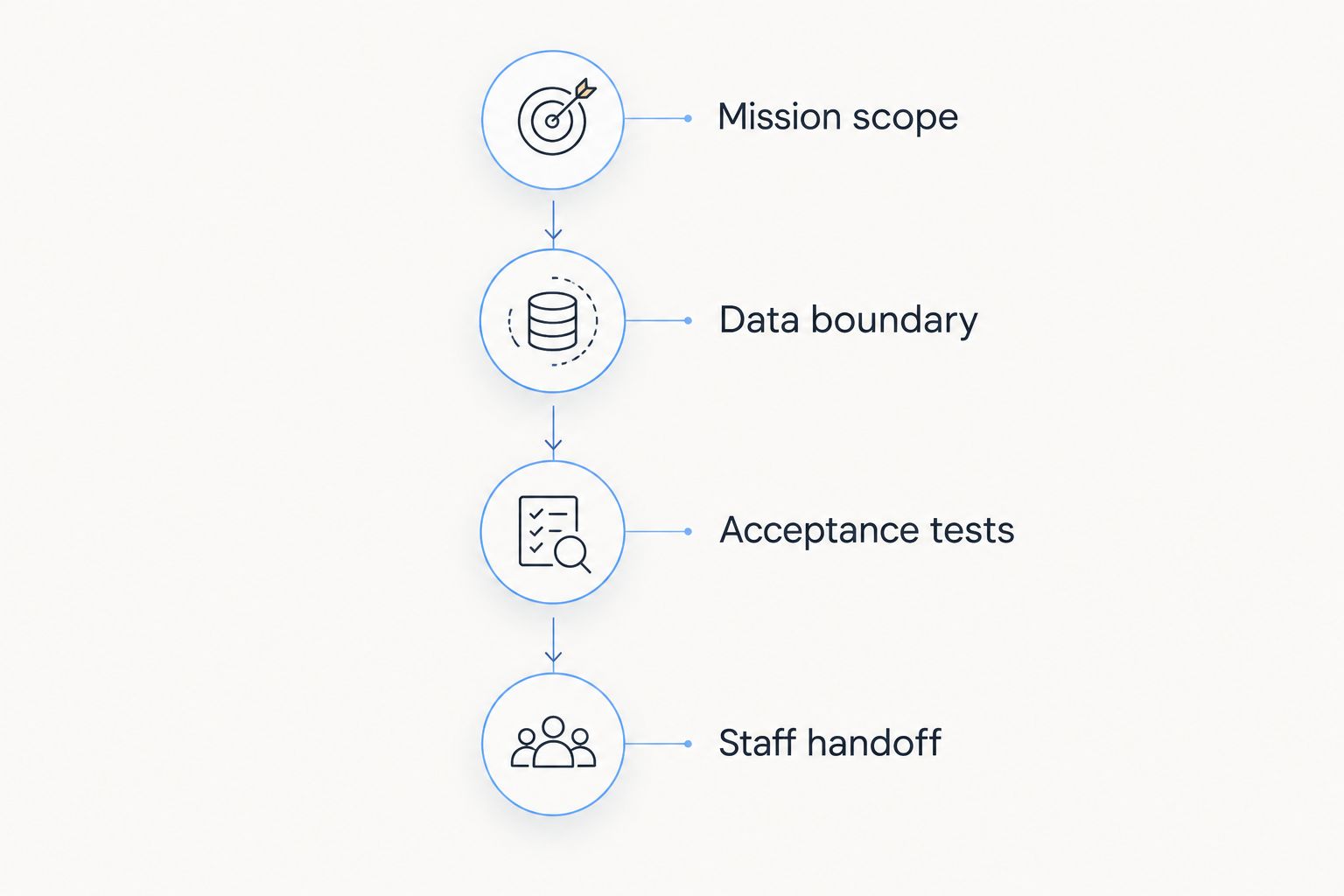
A successful demonstration is not the same as an accepted production service. Keep the approval to demonstrate separate from the approval to operate, and make the responsible official's decision explicit.
Which AI consulting firm should your agency choose?
Choose Booz Allen Hamilton as the default federal mission shortlist candidate. Choose Accenture Federal Services when enterprise integration drives the assignment, Deloitte when governance is the immediate obstacle, and IBM Consulting when hybrid infrastructure is central.
Consider the business-process discovery candidate only within its stated remit and after qualification checks. For every firm, the next move is the same: issue a bounded brief and require evidence against the six selection criteria.
Do not select a firm merely because its demonstration looks polished. Select the proposed team and delivery plan that satisfy your agency's actual requirements.
FAQ
What's the best AI consulting firm for a federal agency?
Booz Allen Hamilton is the default shortlist candidate here for federal mission-focused work. Select the proposed team only after confirming relevant references, procurement eligibility, data controls, and acceptance conditions.
Is Accenture Federal Services better than Deloitte for government AI?
Accenture Federal Services is the stronger shortlist fit for enterprise modernization; Deloitte is the stronger fit for governance-led transformation. Compare their proposals against the assignment rather than assuming one firm is better across every use case.
Can a government agency hire Avanti AI Partners?
An agency must establish procurement eligibility and project-specific qualifications before hiring Avanti AI Partners. Its stated AI consulting and implementation services do not, by themselves, establish government delivery experience or security suitability.
Should a government agency hire an AI consultant or a software vendor?
Hire a consultant when the workflow, implementation plan, or controls still need definition; evaluate software vendors when the requirements are settled. Keep advisory recommendations and product purchasing decisions distinct.
Does a cloud authorization cover the entire AI consulting project?
No, authorization of a cloud service does not establish that every part of a consulting project satisfies agency requirements. Review the complete system, data flows, access arrangements, and applicable approval process.
What should an agency require before approving an AI pilot?
Require a defined workflow, approved data boundary, accountable owner, and written acceptance tests. A pilot also needs a stop condition and a clear distinction between testing permission and production approval.
What should government agencies test in an AI demonstration?
Test routine tasks, difficult exceptions, and actions the system must not perform. Include conflicting evidence and situations where the system should decline to answer rather than produce an unsupported response.
One last thing
Ask every finalist to demonstrate a refusal. Give the system a request outside the approved workflow and require it to stop, explain the boundary, and direct staff to the proper process.
The best 2026 demonstration shows both useful work and controlled failure. A system that answers everything has not demonstrated the judgment your agency needs.