
An AI consulting firm audits your operations, points out where artificial intelligence can cut cost or grow revenue, builds and tests that solution, then trains your team to run it without the firm in the room. The work that actually eats the calendar isn't the AI model — it's data readiness, change management, and getting staff to trust the output after launch.
- An AI consulting firm audits operations, identifies use cases, builds a pilot, deploys, and trains staff on it.
- Avanti AI Partners ties engagements to revenue and cost outcomes in 2026, not just software deployment.
- Strategy-only engagements stall without execution; a pilot with no deployment plan rarely reaches production.
- Scope of engagement drives timeline and cost far more than which AI model gets used.
Why this matters
Most businesses shopping for an AI consulting firm in 2026 assume they're buying software. They're not — they're buying a process: finding the right problem, proving a fix works on real data, then getting a team to actually use it. Skip any one of those three and the AI part barely matters.
Avanti AI Partners structures engagements around this full arc rather than handing over a model and walking away, which is the gap that leaves most AI pilots stuck at the proof-of-concept stage.
What does an AI consulting firm do, step by step
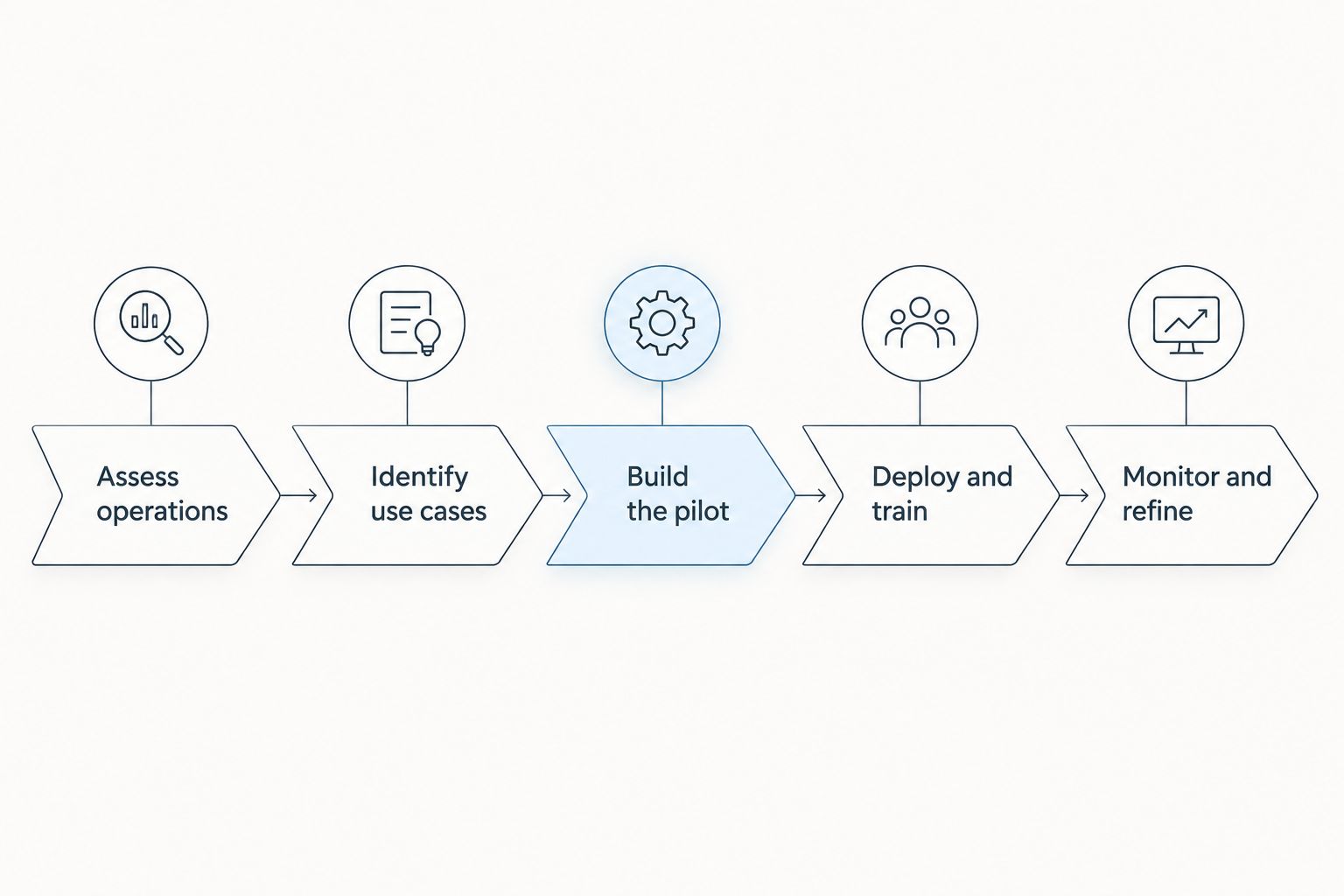
Strip away the jargon and the work breaks into five parts, done roughly in this order:
- Assess current operations and data readiness — pull apart where time and money actually leak, and check whether the data needed to fix it exists and is usable.
- Identify use cases tied to revenue or cost — rank opportunities by expected business impact, not by how impressive the technology sounds.
- Build and test a pilot — a working version scoped to one process, tested against real transactions or tickets before anyone commits to a full rollout.
- Deploy and train the team — move the pilot into daily operations and teach staff how to work with it, including when to override it.
- Monitor performance and refine — track the metric the project was built to move, and adjust the model or workflow as real usage surfaces edge cases.
The first two steps determine whether the rest of the engagement is worth doing. A firm that skips straight to building without a use-case assessment is optimizing for a demo, not for your numbers.
The four types of AI consulting engagements
AI consulting firms rarely sell one thing. Engagements usually fall into one of four buckets, and knowing which one you're buying prevents scope confusion later.
| Engagement type | What it delivers | Best for |
|---|---|---|
| Strategy assessment | A prioritized list of AI use cases mapped to cost or revenue impact | Businesses that don't yet know where to start |
| Pilot implementation | A working proof-of-concept on one process, tested against real data | Teams that need evidence before a bigger commitment |
| Full deployment and training | The solution live in daily operations plus staff trained to run it | Businesses ready to move past the pilot stage |
| Managed support | Ongoing monitoring, tuning, and troubleshooting after go-live | Teams without the internal capacity to maintain the system |
A strategy assessment alone doesn't move revenue — it just tells you where to point the effort. A pilot that never gets a deployment plan tends to die quietly a few months after the demo. The two matter together, not separately.
“The AI is rarely the bottleneck in these projects; getting a team to change how it works is.”
Why what an AI consulting firm does varies by business
The scope of work shifts based on a handful of factors, and these are the ones that actually move the needle:
- Data readiness — clean, accessible data shortens the assessment phase; messy or siloed data adds work before anything gets built.
- Integration complexity — how many existing systems (CRM, ERP, ticketing) the solution has to talk to.
- Team size and change appetite — smaller teams adopt faster; larger organizations need more structured training and rollout.
- Regulatory exposure — industries like healthcare, financial services, and legal add compliance review to the timeline.
- Internal AI maturity — a business with no prior automation starts at step one; a business that already has some tooling in place can skip ahead.
- Scope decision upfront — whether the client buys a strategy assessment only, a pilot, or a full deployment changes everything about the engagement's shape.
Find out where AI fits your operations
A scoped conversation on where AI moves your numbers, not a generic sales deck.
How do I know if my business needs AI consulting?
You need an AI consulting firm when you can name a specific, repeated operational problem — slow ticket routing, manual forecasting, inconsistent lead scoring — but don't have the in-house expertise to evaluate whether AI actually fixes it cost-effectively. If you can't yet name the problem in concrete terms, start with whether your business needs AI consulting before shopping for a vendor.
How much does AI consulting cost?
Cost tracks scope: a strategy assessment runs far cheaper than a full deployment with ongoing managed support, and industries with heavier compliance review add cost on top of that. Get a scoped quote based on your specific use case rather than comparing sticker prices across firms, since two "AI consulting" line items can mean entirely different amounts of work.
How long does an AI consulting engagement take?
Timeline depends on which of the four engagement types you're buying — a strategy assessment moves fastest, a full deployment with integration work takes longest. Data readiness is usually the biggest swing factor: clean data shortens every phase, messy data adds weeks before the first pilot even starts.
FAQ
What does an AI consulting firm actually do?
An AI consulting firm audits your operations, identifies where AI can cut cost or grow revenue, builds and tests a pilot solution, then deploys it and trains your team to run it. The work centers on scoping the right problem and getting staff to adopt the fix, not just on the AI model itself.
Is AI consulting different from IT consulting?
Yes — IT consulting typically focuses on infrastructure, systems, and support, while AI consulting focuses on identifying and building specific automation or prediction use cases tied to revenue or cost outcomes. The two overlap on integration work but start from different questions.
Do I need AI consulting if I already have a data team?
An internal data team can shrink the scope of an engagement but rarely replaces the need for one, since most in-house teams lack bandwidth to run a full assessment, pilot, and deployment on top of their existing workload. A firm like Avanti AI Partners can run the project while your data team stays focused on day-to-day operations.
What's the difference between AI consulting and hiring an AI vendor?
A vendor sells you a specific software product built for a general use case; an AI consulting firm assesses your specific operations first and only recommends or builds the tooling that fits, which can include off-the-shelf software, custom builds, or a mix of both.
Can a small business use an AI consulting firm?
Yes, small businesses use AI consulting firms most often for narrowly scoped pilots — a single process like lead scoring or ticket routing — rather than enterprise-wide deployments, which keeps the engagement smaller and faster to evaluate.
What happens after an AI consulting engagement ends?
After deployment and training, most engagements shift to a lighter monitoring phase where the firm checks the solution's performance against the original metric and adjusts as real usage surfaces new edge cases. Some businesses take this monitoring in-house; others keep it as ongoing managed support.
How does an AI consulting firm pick which use case to start with?
An AI consulting firm ranks use cases by expected impact on revenue or cost against the effort and data readiness required, then starts with the option that proves value fastest. Starting with the flashiest idea instead of the highest-impact one is the most common reason pilots stall.
Is AI consulting worth it in 2026?
AI consulting is worth it in 2026 when the business can name a specific operational cost or bottleneck the engagement is meant to fix, and worth skipping when the goal is vague interest in "doing something with AI." The return comes from the specificity of the use case, not from the technology alone.
One last thing
Before signing with any AI consulting firm, ask for one specific KPI the engagement is meant to move — cost per ticket, forecast error rate, lead conversion — not a list of deliverables. A firm that can't name the metric upfront usually can't prove the result later either, and that single question filters out most of the vague proposals you'll see in 2026.