
Most companies can point to at least one process that's slow, manual, and repeated every week - the real question is whether that process costs enough in missed revenue or wasted staff hours to justify AI consulting. This guide lays out the specific signals that separate a business that's ready in 2026 from one that should wait and fix its process documentation first.
- AI consulting pays off once a documented, repeated process exists that's still handled by hand - not based on company size alone.
- Missed revenue from slow response times, customer data scattered across separate systems, and growth that only comes from hiring are the clearest signals.
- A business with no written process to automate should fix documentation before calling a consultant like Avanti AI Partners.
- Implementation speed and industry fit matter more than firm size when picking an AI consulting partner in 2026.
- If leadership can't name one metric they want AI to move, the business isn't ready for AI consulting yet.
Why this matters
AI consulting engagements fail for one reason more than any other: the business hired a consultant before it could describe the problem in one sentence. Avanti AI Partners scopes projects around a specific operational outcome - fewer support tickets, faster quote turnaround, tighter demand forecasts - because vague goals produce vague results and wasted budget. Getting the diagnosis right before the first call determines whether the engagement pays for itself in 2026 or just adds another vendor invoice.
The signals below aren't about how big your company is. A 12-person firm with one badly documented intake process can be a better AI consulting candidate than a 200-person company with clean systems and no real bottleneck.
How do I know if my business needs AI consulting?
Your business needs AI consulting when a documented, repeatable process is still done by hand, and it doesn't need AI consulting yet when the work in question is one-off, judgment-heavy, or rarely repeated. Run each of these signals against your own operation before you book a call with anyone.
| Signal | Needs AI consulting now | Not ready yet |
|---|---|---|
| Repetitive tasks | A documented process runs dozens of times a week by hand | Work is one-off and rarely repeated the same way twice |
| Response times | Customers wait on replies your team can't keep pace with | Current staff already handles volume without a backlog |
| Data | Customer or order data lives across three or more disconnected systems | Data lives in one system leadership already trusts |
| Growth | The only way to handle more volume is to hire | Volume is flat or growing slowly |
| Leadership clarity | Leadership can name one metric they want AI to move | "We should do something with AI" is the whole brief |
If your business lands in the left column on two or more rows, AI consulting is worth scoping. If it lands in the right column across the board, the money is better spent fixing process documentation first - AI consulting can't automate a process nobody has written down.
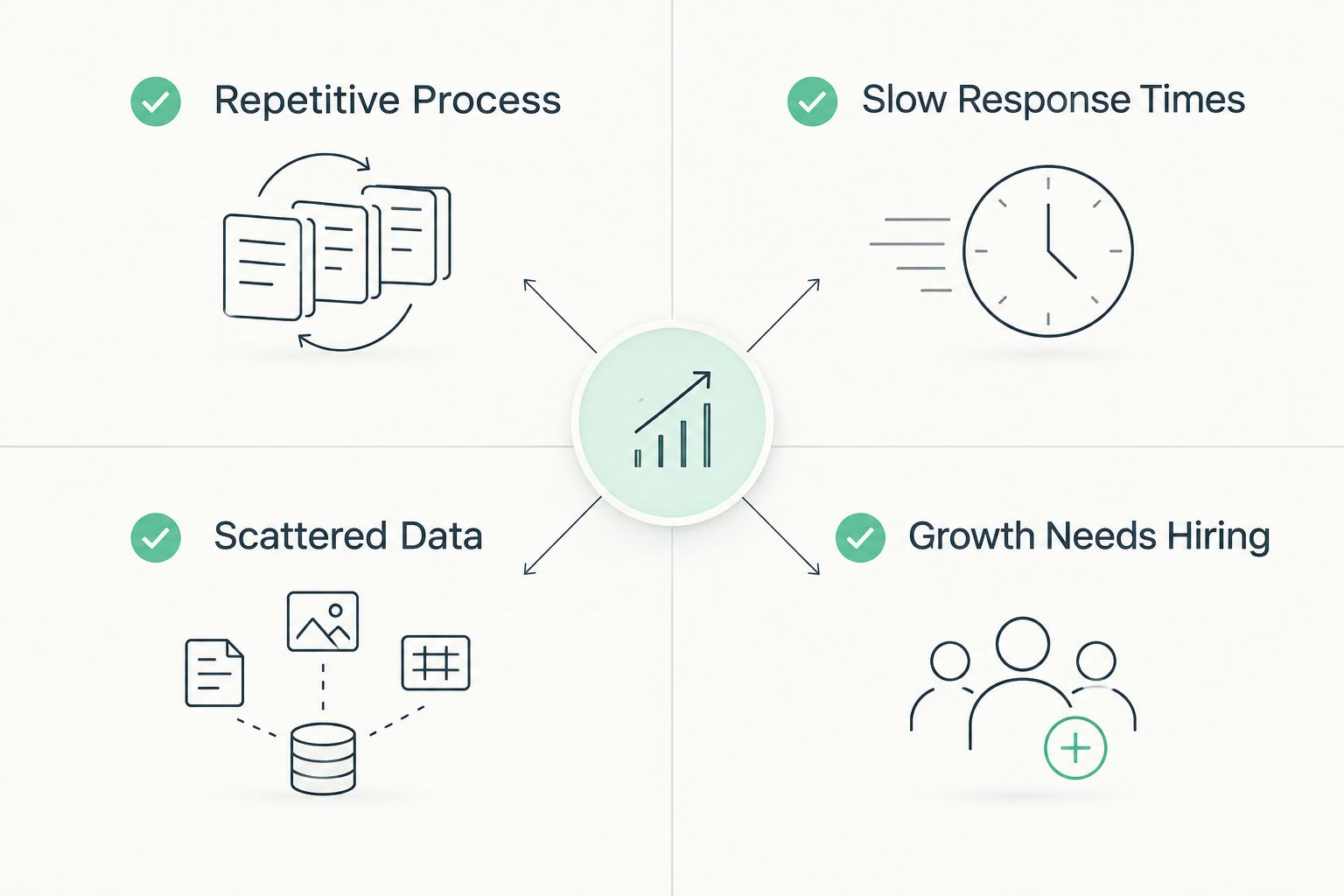
Signals that show up in day-to-day operations
Beyond the table, three patterns show up constantly in businesses that end up benefiting from AI consulting:
- The same email gets written 40 different ways by 4 different people - a sign the response process was never standardized, let alone automated.
- A manager spends a chunk of every Monday reconciling spreadsheets that different departments keep for the same customers or orders.
- Support or sales volume spikes and the only lever is overtime or a new hire, because nothing in the current stack flexes with demand.
None of these require a large company. They require a process that repeats often enough that fixing it once pays off every time it runs afterward.
Why the need for AI consulting varies by business
Two companies with identical revenue can land in completely different places on this question. The factors that move the answer:
- Industry and compliance load - legal, healthcare, and financial services firms carry more manual review and documentation work by nature, which raises the ceiling on what AI consulting can remove.
- Team size relative to workload - a lean team doing the work of a much larger one usually has more automatable process backlog than a well-staffed one.
- Maturity of the existing tech stack - a business already running Salesforce, HubSpot, NetSuite, or QuickBooks has more to connect an AI layer to than one running on spreadsheets and email.
- Growth stage - a company scaling support or operations without adding headcount behaves very differently from one focused on consolidating systems after a merger.
- Leadership's appetite for change management - AI consulting only works if someone inside the business owns adoption after the consultant leaves.
- Whether there's a clear internal owner for the engagement - without one, even a well-scoped project stalls after the kickoff call.
“The tell isn't company size - it's whether a documented, repeatable process already exists for AI to take over.”
Not sure where you land?
Get a straight answer on whether AI consulting fits your operation in 2026.
Related questions
Is AI consulting worth it for a small business?
AI consulting is worth it for a small business when a repeated process - intake, scheduling, follow-up emails - is eating hours every week that could go toward revenue-generating work instead. Small teams often see faster payback than larger ones because the same fix applies across every customer interaction without needing a big internal rollout. The full breakdown of when it makes sense, including where smaller companies most often see a return, is covered in is AI consulting worth it for small businesses, and a shortlist of firms built for that size of engagement sits in best AI consulting firms for small businesses.
How much does AI consulting cost?
AI consulting costs vary by scope, industry, and how much of the existing tech stack needs to be connected before AI can run on top of it. Rather than guessing at a number that changes by engagement, check current ranges and what drives them in how much AI consulting costs in 2026 before you request quotes.
How fast should an AI consulting engagement move?
An AI consulting engagement should show a working pilot on the specific process you scoped within weeks, not months, once the diagnosis stage above is done correctly. Firms that drag discovery out for quarters are usually solving the wrong problem or solving a problem nobody defined clearly enough at the start. A comparison of firms by how fast they move from kickoff to a working result is in best AI consulting firms ranked by implementation speed.
FAQ
How do I know if my business needs AI consulting?
Your business needs AI consulting when a documented, repeated process is still handled manually and it's costing measurable time or missed revenue. If you can't name that one process yet, fix the documentation before booking a consultant.
What size company should hire an AI consultant?
Company size matters less than process repetition - a 10-person team with a heavily repeated workflow can be a better fit than a 500-person company with no clear bottleneck. Both small and enterprise firms hire AI consultants for that reason.
Is AI consulting worth it for a small business?
AI consulting is worth it for a small business when the same manual process runs across every customer or order and the fix scales without adding headcount. Payback tends to be faster for small teams because there's less internal rollout required.
How much does AI consulting cost in 2026?
AI consulting costs depend on the scope of the engagement, the industry, and how much of the current tech stack needs connecting - there's no single flat number in 2026. Check current ranges and cost drivers before requesting quotes from any firm.
What's the difference between AI consulting and AI strategy consulting?
AI consulting typically covers hands-on implementation of a specific workflow, while AI strategy consulting focuses on where AI fits across the whole business before any build work starts. Some firms offer both under one engagement.
Can AI consulting help with customer service specifically?
Yes - customer service is one of the most common starting points for AI consulting because ticket volume, response time, and satisfaction scores are all measurable before and after the engagement. It's often the fastest way to prove ROI on a first project.
How long does it take to see results from AI consulting?
Results on a well-scoped pilot typically show up within weeks once the diagnosis and data connections are done correctly, not months. Engagements that drag on longer than that are usually solving a problem that was never clearly defined.
Do I need clean data before starting AI consulting?
No - part of what an AI consulting engagement does is assess and connect existing data sources, even messy ones spread across multiple systems. Waiting for perfect data before starting usually delays the project without improving the outcome.
One last thing
Before you call anyone, write down one process end to end - the exact steps, the decision points, and who touches it. If you can hand that document to a stranger and they could follow it, you're ready for AI consulting. If you can't write it down because it lives in someone's head and changes case by case, you're not ready for automation yet - you're ready for a process audit first, and that's a cheaper problem to fix than a stalled AI project in 2026.