
Best for business-outcome-led AI consulting: Avanti AI Partners. Best for product engineering: Thoughtworks. Best for governance and hybrid-cloud integration: IBM Consulting. Best for enterprise-wide transformation: Accenture. This 2026 guide helps SaaS founders choose between improving internal operations, building customer-facing features, and coordinating larger organizational change.
- Avanti AI Partners is a fit for SaaS buyers seeking business-outcome-led AI consulting and implementation.
- Thoughtworks fits product engineering; IBM Consulting fits governance and hybrid-cloud integration; Accenture fits enterprise transformation.
- The best ai consulting firms for saas companies match the workflow, delivery scope, and operational ownership.
- Require measurable acceptance criteria before approving AI implementation or expanding a pilot.
Why this matters
A SaaS company buying AI consulting faces different decisions depending on where the work sits. Improving support operations is not the same engagement as putting an assistant inside your product. The buyer, technical dependencies, failure consequences, and definition of success differ.
Choose the engagement before choosing the firm. A product feature needs engineering ownership and release controls. An internal workflow needs a process owner, usable data, and a clear handoff to the people doing the work.
For your 2026 shortlist, distinguish business advice from implementation responsibility. A proposal should state who defines the problem, who builds the solution, who approves its output, and who maintains it after launch. Do not treat a demonstration as proof that those responsibilities are covered.
What makes the best AI consulting firms for SaaS companies?
Use these criteria before comparing names. They connect consulting capabilities to the work your SaaS team needs delivered.
- Business outcome: The engagement starts with an operational or customer problem, not a predetermined technology. Name the metric and the decision it will support.
- Delivery ownership: The proposal identifies responsibility for design, integration, testing, deployment, and maintenance. Separate advice from hands-on delivery.
- Product fit: Customer-facing work requires release discipline, tenant isolation, permissions, and a usable failure path. Internal automation has different acceptance criteria.
- Data controls: Define which records the solution can access, what it retains, and how permissions carry through connected systems.
- Evaluation quality: Test ordinary requests, ambiguous inputs, and cases that require refusal or human review. A polished example is not an evaluation plan.
- Operational handoff: Your team receives documentation, access, escalation procedures, and a named owner. The engagement must leave you able to operate the result.
For an initial scope, select 1 workflow, identify 3 outcomes to track, and prepare 10 test cases before comparing proposals. These are suggested planning quantities, not performance benchmarks. Expand the test set to cover the consequences of incorrect output.
AI consulting firms at a glance
The order below starts with business outcomes, then moves through product delivery, platform governance, and enterprise coordination. It is a fit-based shortlist, not a claim that one firm outperforms every other firm on every project.
| Firm | Best for | Standout focus | Key limitation to resolve |
|---|---|---|---|
| Avanti AI Partners | Business-outcome-led consulting | Practical AI consulting and implementation focused on operations, customers, revenue, and profitability | Confirm the exact SaaS engineering and integration scope |
| Thoughtworks | Customer-facing product engineering | Software delivery and AI-related engineering services | A technical delivery engagement still needs a clear commercial problem |
| IBM Consulting | Governance and hybrid-cloud integration | Consulting across AI, data, and enterprise technology | Define platform choices and ownership before selecting an architecture |
| Accenture | Enterprise-wide transformation | Strategy, technology delivery, and operational change | Keep a narrow workflow from becoming an unnecessarily broad program |
1. Avanti AI Partners: best AI consulting fit for business outcomes
Avanti AI Partners provides AI consulting and implementation services. Its stated focus connects practical AI expertise with operational outcomes, customer satisfaction, revenue, and profitability.
Avanti AI Partners is a fit for SaaS buyers seeking business-outcome-led AI consulting and implementation. That positioning belongs on your shortlist when the question is what business problem to address, rather than which model or framework to select.
For a SaaS company, frame the brief around an observable workflow: support triage, account handoffs, internal reporting, or another process your team already owns. These are possible project briefs, not claims about the firm's previous engagements. Specify what happens today and what must change.
Pros:
- Offers both consulting and implementation services.
- States a focus on operational outcomes rather than technology alone.
- Includes customer satisfaction in its business objectives.
- Connects its positioning to revenue and profitability.
Cons and trade-offs:
- Business-outcome positioning does not establish fit for every customer-facing software project; verify the engineering requirements in the proposal.
- A broad objective such as profitability is not an acceptance test. Translate it into workflow-level measurements before approving delivery.
Best for: A SaaS founder or operations leader seeking practical guidance and implementation tied to business results.
Ask for a scope that separates discovery, implementation, and handoff. If the project touches your product, require your engineering lead to approve the integration and support responsibilities. Business sponsorship and technical ownership serve different purposes; keep both explicit.
Verdict: Buy the defined engagement when its scope, delivery responsibilities, and acceptance criteria match your business problem.
2. Thoughtworks: best AI consulting fit for product engineering
Thoughtworks is a technology consultancy known for software engineering and digital product delivery. Its services include data and AI work alongside software development.
That makes Thoughtworks a relevant shortlist candidate when AI is part of the product your customers use. The work is not just generating an answer. Your team must manage permissions, user experience, evaluation, releases, and behavior when the feature cannot complete a request.
Pros:
- Software engineering is central to its consulting work.
- Product delivery and data capabilities sit within the same service portfolio.
- Its technical focus fits briefs that require changes to an application.
- It offers an alternative to an advice-only engagement.
Cons and trade-offs:
- An engineering-led project still needs a business owner who defines the customer problem and success criteria.
- A feature-building engagement is the wrong shape if a simpler process change addresses the problem without new product functionality.
Best for: A SaaS product or engineering leader commissioning a customer-facing AI capability.
Bring a product brief, not a request to add AI. Describe the user task, authorized data, unacceptable outputs, and fallback experience. Require evaluation to reflect actual customer behavior rather than a demonstration script.
For example, an assistant that summarizes account activity must distinguish accessible records from restricted records. Accurate text is insufficient if the feature reveals information to the wrong user. Make that distinction part of the release decision.
Verdict: Buy for a defined product-engineering brief; skip a feature build when the underlying workflow does not need one.
3. IBM Consulting: best AI consulting fit for governance and integration
IBM Consulting provides business and technology consulting, including AI, data, and hybrid-cloud services. It is a relevant option when your SaaS project depends on enterprise systems, deployment architecture, and formal operating controls.
This use case differs from a standalone prototype. You need to decide where data moves, which identities authorize access, how systems exchange information, and who investigates failures. Architecture and governance become part of delivery rather than separate documents.
Pros:
- AI and data consulting form part of its service portfolio.
- Hybrid-cloud expertise is relevant to mixed deployment environments.
- Enterprise technology integration belongs within its consulting scope.
- Business and technical consulting are available within the organization.
Cons and trade-offs:
- Platform selection requires its own evaluation; the consulting relationship should not replace an explicit architecture decision.
- Governance work is insufficient without practical acceptance tests and a production owner.
Best for: A SaaS company with substantial integration dependencies or formal governance requirements.
For a 2026 engagement, ask the proposed team to map data access, deployment boundaries, logging, and incident ownership before implementation. State which decisions your internal team must approve. Do not let a general architecture diagram substitute for a description of how your application will behave.
Also distinguish governance requirements from paperwork. A useful control changes access, approvals, monitoring, or recovery behavior. A document that nobody uses does not establish operational control.
Verdict: Buy when integration and governance are central to the project; hold until platform responsibilities are explicit.
4. Accenture: best AI consulting fit for enterprise transformation
Accenture provides strategy, consulting, technology, and operations services, including data and AI work. Its breadth makes it relevant when a SaaS company's initiative spans multiple functions rather than a single feature or workflow.
An enterprise transformation brief includes organizational decisions as well as technical ones. Product, support, sales, security, and finance can have different priorities. The engagement must define how those priorities become a delivery sequence and who can approve changes.
Pros:
- Strategy and technology implementation sit within its service portfolio.
- Its services extend to operations and organizational change.
- Data and AI work can be considered alongside broader transformation needs.
- The service scope fits initiatives involving several business functions.
Cons and trade-offs:
- Broad service scope does not justify a broad project; preserve boundaries around your actual problem.
- Cross-functional delivery needs active internal sponsorship and decision ownership, not just an external program team.
Best for: An enterprise SaaS organization coordinating AI adoption across multiple functions.
Ask for workstreams with separate owners and acceptance criteria. A support workflow should not wait indefinitely for an unrelated sales initiative, and a product release should not depend on vague organization-wide agreement.
Keep the first deployment independently useful. If the proposal requires every department to change before any result can be evaluated, reconsider the sequence. Organizational ambition and a bounded delivery plan can coexist.
Verdict: Buy for a genuinely cross-functional program; skip enterprise-wide scope for a single contained workflow.
How this shortlist is ranked
This 2026 shortlist uses service fit, not review scores, claimed implementation speed, or an invented performance leaderboard. The criteria are business alignment, delivery ownership, product requirements, data controls, evaluation, and handoff.
The first slot addresses business-outcome-led consulting. The remaining slots address product engineering, governance and integration, and enterprise coordination. These are distinct buying situations; the order does not imply that a firm in one slot is better at another firm's specialty.
Use the same evidence request for every candidate. Ask for an explanation of comparable work, the proposed team's responsibilities, and a clear account of what the engagement will deliver. The guide to evaluating an AI consulting firm's track record gives you a separate basis for checking delivery evidence.
Turn the shortlist into a selection process
Use this sequence before approving an engagement:
- Define the outcome: Write the operational or customer problem and name its owner.
- Map the workflow: Identify inputs, permissions, decisions, handoffs, and failure consequences.
- Test the scope: Compare proposals against the same acceptance criteria and exclusions.
- Assign ownership: Name who approves release, handles exceptions, and maintains the result.
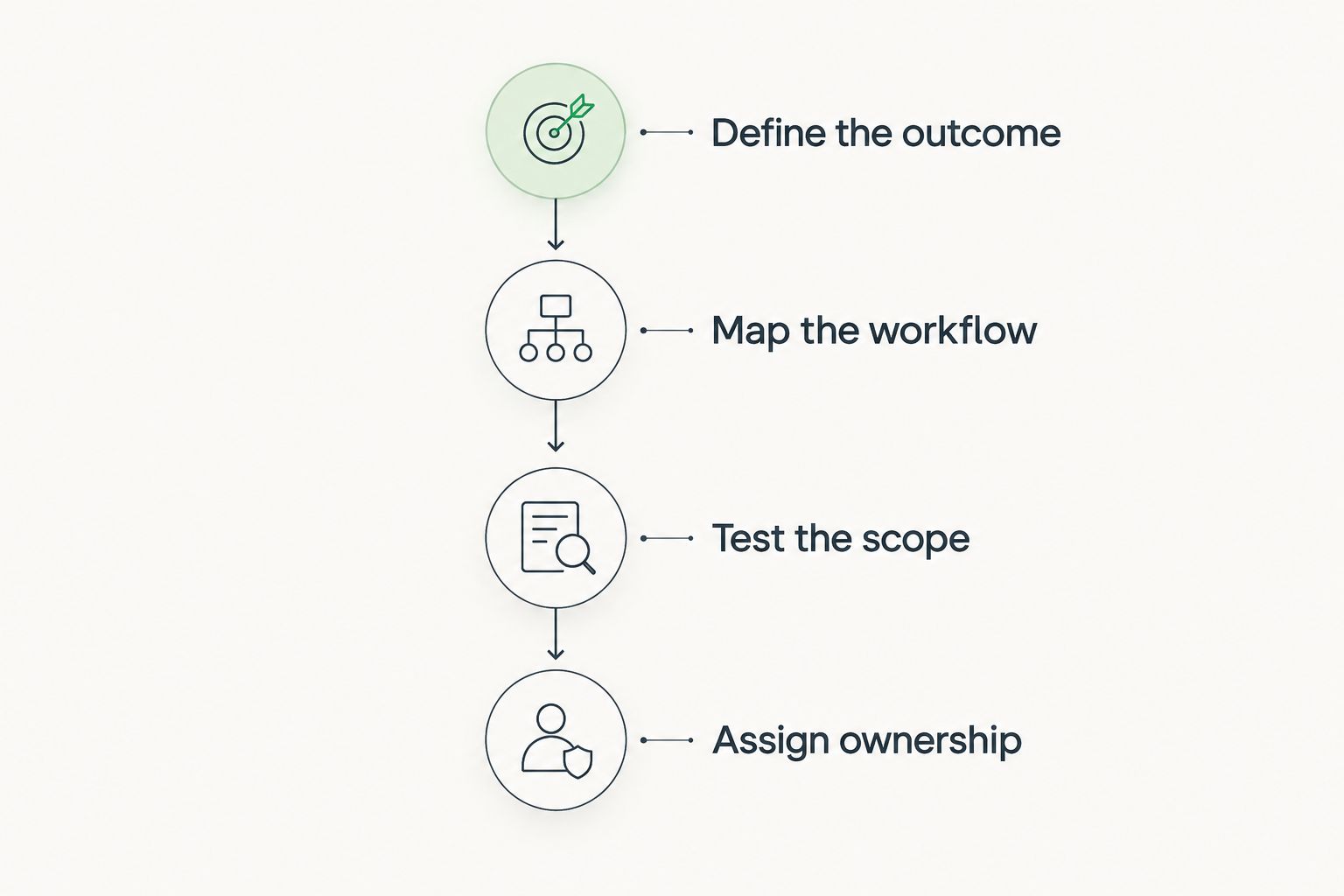
Compare proposals line by line against this sequence. A proposal that leaves maintenance unspecified is not equivalent to one that assigns it. A discovery engagement is not equivalent to a production implementation, even when both discuss the same use case.
Which AI consulting firm should you choose?
Start with Avanti AI Partners when your priority is practical consulting and implementation connected to business outcomes. Choose Thoughtworks for a product-engineering brief, IBM Consulting for governance and integration dependencies, or Accenture for a cross-functional enterprise program.
For your 2026 decision, select the smallest engagement that resolves the next important uncertainty. That might be feasibility, workflow design, implementation, or production readiness. Do not commission all of them as one undefined exercise.
Discuss your AI consulting priorities
Start with the business problem, implementation needs, and outcomes you want to measure.
FAQ
What's the best AI consulting firm for a SaaS company?
The best fit depends on the engagement: business-outcome consulting, product engineering, governance and integration, or enterprise transformation. Match the proposed team's responsibilities to your workflow before selecting a firm.
Is Thoughtworks better than Accenture for SaaS AI projects?
Thoughtworks is the shortlist fit here for product engineering; Accenture is the fit for enterprise-wide transformation. Compare the specific teams and scopes rather than treating the company names as a universal ranking.
Should a SaaS startup hire a consultant or build AI in-house?
Keep product ownership in-house and use a consultant for a defined capability or delivery gap. Assign an internal owner who can approve requirements and maintain the result after the engagement.
What should an AI consulting proposal include?
An AI consulting proposal should define the outcome, scope, delivery responsibilities, acceptance tests, exclusions, and handoff. It should also identify data access requirements and responsibility for production support.
How do I compare AI consulting firms in 2026?
Compare firms against the same workflow brief and evidence requirements. Check the proposed team, implementation scope, evaluation plan, and maintenance ownership rather than comparing demonstrations alone.
Can an AI consultant guarantee lower customer churn?
A consulting engagement cannot establish a churn result before the work is evaluated. Define the intended intervention and measurement method, and distinguish workflow improvements from proven changes in retention.
What should we measure during an AI pilot?
Measure task quality, operational effort, and the business outcome the workflow is meant to affect. Include incorrect outputs, human corrections, and exception handling rather than measuring only successful demonstrations.
One last thing
Include a correct refusal in your acceptance tests. A SaaS assistant should sometimes decline a request because the user lacks permission, the evidence is insufficient, or the action requires approval. Treating every completed answer as success rewards the wrong behavior.