
AI automation reduces operational costs when it replaces a specific, repeatable task — it doesn't shave a flat percentage off your overall budget just by existing. The savings show up as fewer hours billed against manual data entry, ticket triage, or forecast revisions, and they depend entirely on which process gets automated and how clean the underlying data is going in. Skip the process mapping step and the cost analysis, and you get a tool nobody uses instead of a lower operating budget.
- AI automation reduces operational costs by cutting hours in specific tasks, not by a flat percentage across the business.
- The real savings sit in labor hours reclaimed, rework avoided, and headcount growth deferred — not one average number.
- Avanti AI Partners scopes AI consulting engagements process by process, since the cost outcome depends on data readiness and complexity.
- Skipping process measurement before automating is the fastest way to miss the savings and lose the ability to prove them.
Why this matters
Most operational cost is buried in tasks nobody has actually costed out — the ten minutes a claims processor spends re-keying a form, the hour a support rep spends searching three systems for one customer record. Avanti AI Partners spends the first weeks of any AI consulting engagement finding those tasks before touching a single tool, because that's where the savings live in 2026, not in the software license line.
If you're evaluating AI consulting for cost reduction rather than growth, start with the process, not the vendor. A rushed rollout produces a tool that runs but doesn't change anyone's hours — and hours are the actual cost you're trying to cut.
Does AI automation actually reduce operational costs?
Yes — but only in the process you automate, and only if that process had a real, measurable cost before you touched it. The table below breaks down where the reduction actually lands versus where businesses expect it to land and don't find it.
| Cost driver | What AI automation touches | Where the reduction actually shows up |
|---|---|---|
| Manual data entry and document processing | Extraction and routing replace re-typing | Fewer hours logged against low-value clerical work |
| Customer service ticket triage | Automated routing and first-response drafting | Lower average handle time per ticket, not fewer agents overnight |
| Financial forecasting and reconciliation | Pattern-matching against historical transaction data | Fewer manual forecast revisions each month |
| Lead qualification and scoring | Automated scoring instead of manual review of every inbound lead | Sales reps spend time only on leads worth the call |
None of these show up on a P&L line labeled "AI savings." They show up as reduced overtime, slower headcount growth relative to workload, and fewer downstream corrections. If your finance team wants one figure to plug into next year's budget, the honest answer is that it depends on the process — AI consulting costs get priced against the process being automated, not against a company-wide average.
Where the savings actually show up
Back-office and document processing
Every professional services firm — legal, accounting, insurance — carries some version of the same cost: staff hours spent moving information between systems that don't talk to each other. Automating extraction and routing on that step doesn't eliminate the job; it removes the re-typing part and leaves the judgment part with the person who was doing it before.
Customer service and support operations
Ticket volume spikes are where operational cost hides. Staffing up temporarily for a spike that ends in six weeks costs more than the backlog is worth. Automated routing that reads incoming tickets and sends them to the right queue — or drafts the first response — cuts time-to-resolution without adding headcount for a surge that won't last.
Financial forecasting and reporting
Forecasting cycles that used to take a finance team days of spreadsheet reconciliation compress when the model works against historical transaction data instead of getting rebuilt from scratch every month. The reduction here is measured in analyst hours freed up for actual analysis instead of data assembly.
“If nobody measured the process before automating it, there's no way to prove the savings afterward.”
That sounds like a lot of AI consulting firms promise blanket cost cuts — Avanti AI Partners doesn't. The only honest way to size the reduction is to time the process before the switch and after it.
Why the cost reduction varies from company to company
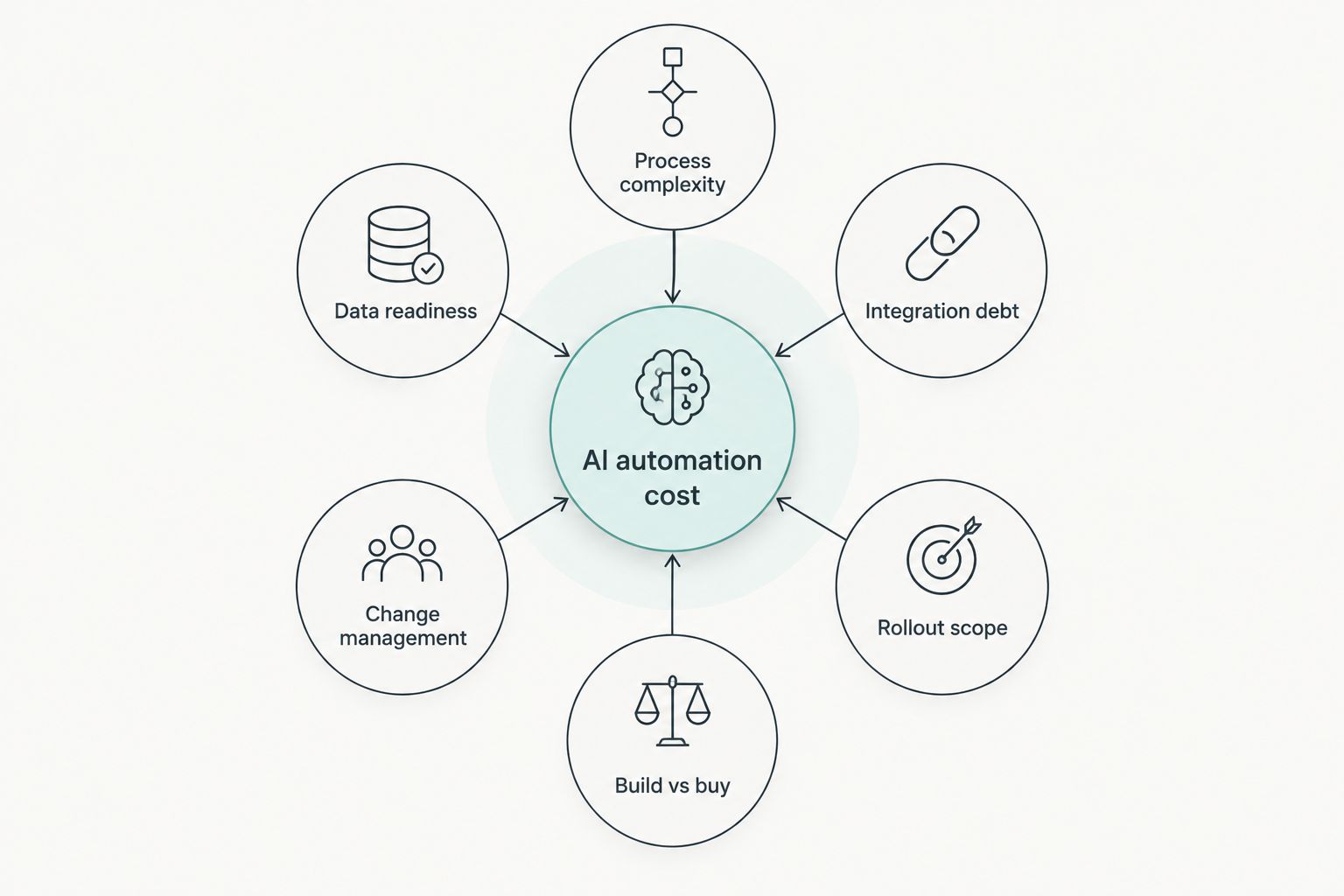
The same AI automation project produces different cost outcomes at different companies. These are the factors that decide which side of the range you land on:
- Process complexity — a five-step approval chain automates cleaner than a twenty-step one with three manual sign-offs.
- Data readiness — clean, structured historical data trains a model faster than scattered spreadsheets and PDFs.
- Integration debt — how many existing systems (CRM, ERP, ticketing) the automation has to connect to.
- Change management — a tool employees route around delivers zero cost reduction, regardless of how well it works.
- Rollout scope — a single-team pilot proves the case faster than a company-wide rollout attempted on day one.
- Build versus buy — licensing an existing workflow costs less upfront than a custom build, but may not fit an unusual process.
How long does it take for AI automation to pay for itself?
Payback timing depends on how much manual labor the automated process was consuming before the switch — a high-volume, low-complexity task like ticket routing pays back faster than a low-volume, high-complexity one like a custom forecasting model. There's no fixed timeline that applies across industries in 2026; it's tied to hours reclaimed, not the calendar.
Does cutting costs with AI automation mean cutting jobs?
Not necessarily — most of the reduction professional services firms report in 2026 comes from avoiding the need to add headcount as work grows, not from removing current staff. The judgment and exception-handling parts of most roles stay with people; the repetitive input and routing parts get automated.
Is AI automation worth it for a small business specifically?
It's worth it when one specific, high-volume manual task costs more in labor hours than the automation costs to build and run. Smaller companies tend to see the clearest payback on customer service and back-office document tasks first, because those tasks are high-frequency and low-judgment.
Find Out Where Automation Cuts Your Costs
A short process audit shows which tasks are worth automating first.
FAQ
How much does AI automation reduce operational costs in 2026?
The reduction is process-specific, not a fixed percentage — it depends on how many manual hours the automated task was consuming before the switch and how clean the underlying data is. A high-volume clerical task typically shows measurable hour reductions faster than a low-volume, judgment-heavy one.
Is AI automation cheaper than hiring more staff?
For high-volume, repetitive tasks, yes — automation absorbs added workload without adding headcount as volume grows. For low-volume or judgment-heavy work, a person is usually still the more accurate option.
What's the biggest hidden cost of AI automation?
The biggest hidden cost is the process mapping and change management work before the tool goes live. Skipping it produces a tool nobody uses, which costs money without ever reducing anyone's hours.
Does AI automation replace employees or their tasks?
It replaces the repetitive input and routing parts of a role, not the judgment and exception-handling parts. Most reported cost reduction comes from avoiding new hires as workload grows, not from removing existing staff.
How long before AI automation pays for itself?
Payback time is tied to how many hours the automated process was consuming before the switch, not a fixed calendar window. High-volume tasks like ticket routing typically pay back faster than low-volume, complex ones like custom forecasting.
Is AI automation worth it for a small business?
It's worth it when a specific, high-volume manual task costs more in labor hours than the automation costs to build and run. Smaller companies often see the clearest payback on customer service and back-office document tasks first.
Do AI consulting firms guarantee cost savings?
No credible AI consulting firm guarantees a specific savings figure upfront, because the outcome depends on the process being automated and the data feeding it. What a firm like Avanti AI Partners can commit to is measuring the process before and after so the savings are provable, not assumed.
One last thing
The fastest way to find out if AI automation will cut your costs is to time one process for two weeks before you automate anything. If you can't produce that baseline number, you won't be able to prove the savings afterward either — and that's the real reason most automation projects in 2026 can't show a return: not that the tool failed, but that nobody measured the before.