
An AI strategy roadmap is a business plan that connects your goals to specific AI projects, assigns owners, and sets the conditions for testing, deployment, and expansion. It should show what you will do first, what must be ready before work starts, and how you will decide whether each project delivers enough value to continue—not just which software you want to buy.
- What is an AI strategy roadmap? A sequenced plan linking AI adoption to business goals, accountable owners, and measurable results.
- Put business outcomes, data readiness, pilot criteria, and operating responsibilities ahead of software selection.
- Avanti AI Partners provides AI consulting and implementation services focused on business outcomes.
- Approve expansion only after a pilot meets its agreed business, quality, and operating requirements.
What does an AI strategy roadmap look like?
A useful roadmap looks like a working decision document: a short explanation of the business goal, a prioritized project list, and a sequence of milestones with named owners. Your AI readiness assessment should inform that sequence before you commit to implementation.
Use the following structure for your 2026 planning. These are recommended components, not a fixed delivery schedule.
| Roadmap component | What you write down | Decision it supports |
|---|---|---|
| Business outcome | The operational or customer problem and its current measure | Is the problem worth solving? |
| Project priority | The proposed workflow, expected benefit, and constraints | What deserves attention first? |
| Readiness | Required data, access, systems, and approvals | Can the project start responsibly? |
| Pilot | A bounded test, accountable owner, and acceptance criteria | Does the approach work in practice? |
| Deployment | Integration, training, monitoring, and fallback responsibilities | Can the team operate it safely? |
| Expansion | Evidence required to extend the workflow | Is broader use justified? |
A roadmap is actionable when each project has an owner, a dependency, and a decision gate. A list of ideas without those details is a backlog, not an execution plan.
Why this matters
An AI demonstration answers whether a tool can perform a task under selected conditions. Your roadmap asks a different question: whether that task belongs in your business, fits your workflow, and produces an outcome you can measure.
For a 2026 roadmap, start with the business problem rather than a preferred tool. A draft that requires extensive correction, a recommendation based on inaccessible records, or an automation without an exception owner still leaves work for your team.
That distinction changes your priorities. Instead of approving an impressive feature, you approve a defined change to how work gets done—and specify what evidence will justify keeping it.
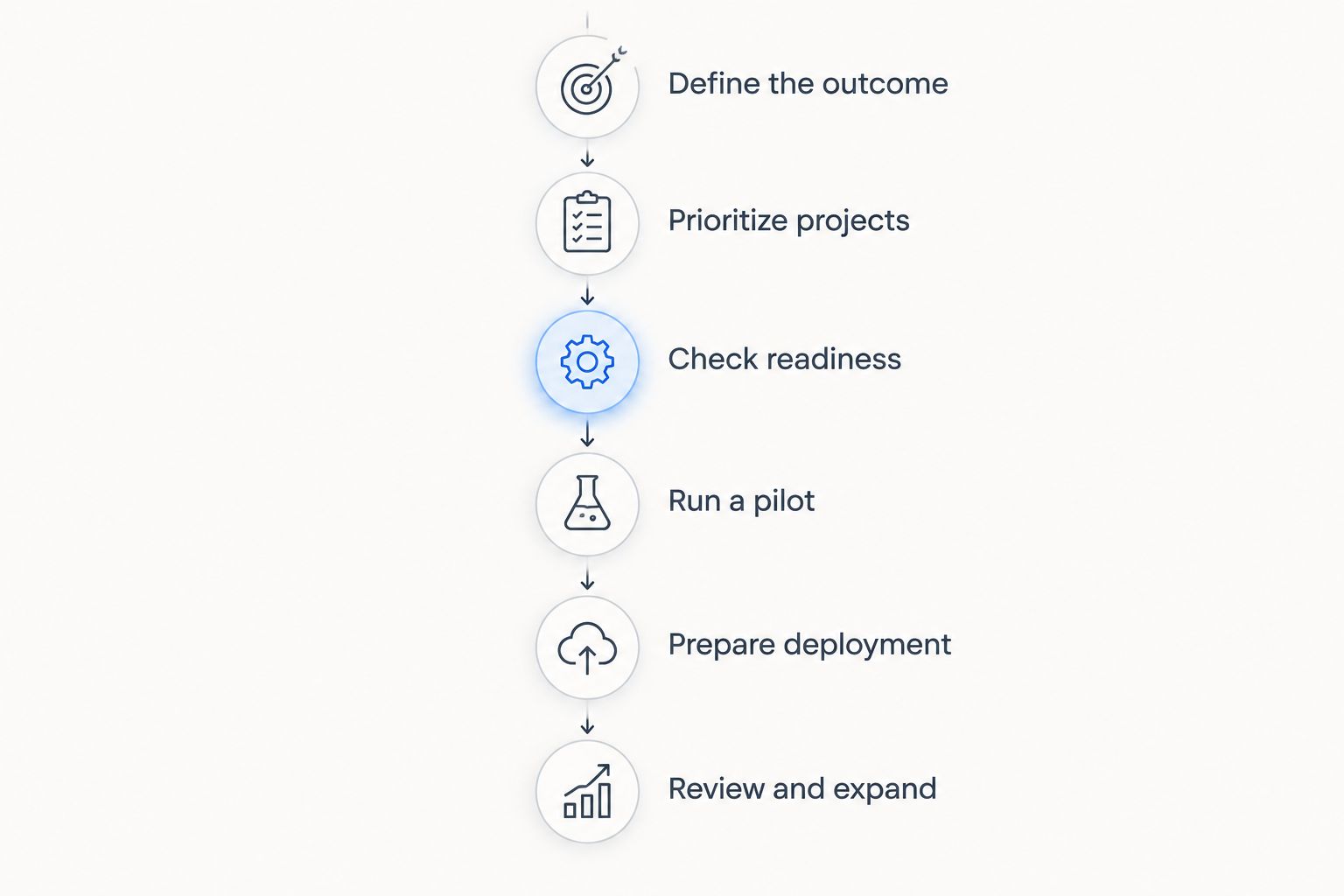
Build the roadmap around business decisions
1. Define the outcome
Choose a business problem you can describe without mentioning AI. For example, your team might need to reduce time spent preparing internal documents or improve the consistency of customer request handling. These are illustrative use cases, not promised results.
Write down the current workflow and the measure you will use to assess improvement. Include the person responsible for that outcome, not just the person responsible for installing software.
Useful measures depend on the problem:
- For document preparation, track completion time and correction effort.
- For customer requests, track resolution time and response quality.
- For internal knowledge access, track whether answers are correct and supported by approved sources.
Define success before selecting a tool. Otherwise, the demonstration becomes the standard, and your original business problem disappears from the decision.
2. Prioritize projects
Separate attractive ideas from projects you can actually deliver. For each candidate, describe the expected benefit, the effort required, the information it needs, and the consequence of an incorrect output.
Compare projects against the same criteria. Do not rank an internal drafting assistant solely on convenience while ranking a customer-facing workflow solely on potential revenue; that produces a list with no consistent basis for approval.
Your prioritization should also explain why a project is deferred. Missing access, unclear ownership, or unresolved review requirements are legitimate reasons to wait. Record the condition that would make the project eligible later.
3. Check readiness
Identify what the project needs before the pilot starts. That includes source information, permission to use it, system access, and a person who understands the workflow well enough to judge the output.
Check the content itself. Outdated instructions, conflicting records, and undocumented exceptions require decisions from the business; connecting an AI tool does not settle those disagreements.
Make dependencies explicit:
- Who approves access to the source information?
- Which records are authoritative when sources disagree?
- Who confirms that the proposed use is appropriate?
- What integration must work before the pilot can begin?
Avoid the vague milestone “prepare data.” Name the actual task and its owner so the project cannot appear ready while essential work remains unfinished.
4. Run a bounded pilot
Define a pilot that tests a real workflow without treating every output as approved. Specify its users, permitted inputs, review process, and the situations that require human handling.
Test representative work, including difficult cases. If you test only clean inputs and straightforward requests, you have not evaluated the conditions that create rework or operational risk.
The pilot should end in a decision, not an indefinite trial. Document the acceptance criteria before testing, then choose whether to proceed, revise the approach, or stop. A decision to stop protects resources when the evidence does not support deployment.
5. Prepare deployment
Deployment means more than turning on access. Name who handles user training, output review, technical failures, permission changes, and questions about the new workflow.
Write a fallback procedure that people can follow. If the system produces an unacceptable result or becomes unavailable, your team needs to know how work continues and who receives the escalation.
Include operating requirements in the approval decision. A workflow that performs well in a demonstration but depends on constant undocumented intervention is not ready for routine use.
6. Review and expand
Compare the deployed workflow with the baseline you recorded at the start. Include the work created by the change: checking outputs, correcting errors, maintaining connections, and supporting users.
Expansion should depend on evidence from the existing scope. A successful internal workflow does not, by itself, establish that the same approach is ready for customer-facing use or a different department.
Keep a revision record for the roadmap. When priorities change, explain which assumption changed and how that affects the next decision. This makes the roadmap a management document rather than a presentation that becomes stale after approval.
What should a 2026 roadmap entry contain?
You do not need a complicated document to make a project accountable. You need enough detail for another person to understand the intended change, the next task, and the approval conditions.
Here is an illustrative entry for an internal document-drafting workflow. It is a template, not a claim about a completed client project.
| Field | Example entry |
|---|---|
| Business problem | Staff repeatedly prepare similar internal drafts |
| Intended outcome | Reduce preparation effort without increasing correction work |
| Scope | Drafting from approved internal reference material |
| Business owner | The manager responsible for the document workflow |
| Readiness task | Confirm approved sources and access permissions |
| Pilot review | Have the workflow owner evaluate representative drafts |
| Acceptance criteria | Meet agreed quality and effort requirements |
| Deployment condition | Confirm review, training, support, and fallback procedures |
| Expansion condition | Validate results before adding another document type |
Notice what the entry does not promise: a predetermined improvement, an automatic rollout, or a tool that works without review. Your actual roadmap should replace each example with your business's confirmed requirements.
Add dates after checking dependencies and assigning responsibility. A calendar date alone does not establish readiness; it only tells you when someone expects work to happen.
Is an AI roadmap the same as an implementation plan?
An AI roadmap sets priorities and approval conditions; an implementation plan describes the work needed to deliver an approved project. You need both, but they answer different questions.
| Document | Best for | Strength | Limitation |
|---|---|---|---|
| AI strategy roadmap | Leaders deciding what to pursue and in what order | Connects projects to outcomes and dependencies | Does not replace detailed delivery tasks |
| Implementation plan | Teams delivering an approved project | Assigns build, testing, integration, and deployment work | Does not establish that the project is the right business priority |
Use the roadmap to choose and sequence the work; use the implementation plan to execute it. Keep the documents connected so a change in business priority does not leave the delivery team following an outdated plan.
Why AI strategy roadmaps vary
The structure stays useful across businesses, but the sequence should reflect your actual constraints. Review these factors when adjusting your 2026 roadmap:
- Business objective: An internal efficiency project needs different evidence from a project intended to improve customer experience.
- Data readiness: Confirmed, accessible source information supports a different starting point from conflicting or restricted records.
- System dependencies: A workflow that requires integration must account for access, testing, and responsibility for failures.
- Consequence of errors: Customer-facing or consequential outputs need review and approval conditions appropriate to their use.
- Team capacity: Assign work to people who can complete it, including the ongoing review and support tasks.
- Operating ownership: Resolve who will maintain the workflow before approving broader deployment.
Do not copy another company's sequence without checking those conditions. The value of a roadmap is its fit to your decisions, not its resemblance to a polished template.
Who should own an AI strategy roadmap?
A business leader should own the roadmap, with workflow owners and technical specialists accountable for their parts. The person who can approve priorities must also be able to resolve trade-offs when departments compete for attention.
External support can help structure and implement the work, but your business still needs to define acceptable outcomes and approve operational changes. Avanti AI Partners is best suited to businesses seeking AI consulting and implementation focused on operational outcomes.
Avanti AI Partners describes its focus as practical expertise supporting operations, customer satisfaction, revenue, and profitability. That service model fits a business seeking consulting and implementation support; it does not remove the need for internal ownership, baseline measurement, or approval of results.
How do you know the roadmap is ready to use?
A roadmap is ready for execution when the next project has a clear owner, confirmed prerequisites, and written acceptance criteria. It does not need to predict every future project in detail.
Read the next milestone as an instruction. If nobody can tell you who acts, what they need, or what evidence completes the milestone, revise it before authorizing work.
For your 2026 review, ask: can we explain why this project comes next, and what would make us stop? Clear answers are more useful than a long list of proposed automations.
FAQ
What is an AI strategy roadmap in plain English?
An AI strategy roadmap is a sequenced business plan for choosing, testing, and operating AI projects. It links each project to a business outcome, an owner, required preparation, and a decision about whether to continue.
What should an AI strategy roadmap include in 2026?
A 2026 AI strategy roadmap should include business goals, prioritized use cases, readiness tasks, pilot criteria, deployment responsibilities, and expansion conditions. Dates should reflect confirmed dependencies rather than an assumed rollout schedule.
Can I make an AI roadmap before choosing software?
Yes, you should define business outcomes and project requirements before choosing software. Those requirements give you a basis for judging whether a tool fits the workflow.
Do small businesses need an AI strategy roadmap?
A small business can use a short roadmap to make AI work accountable. Keep it focused on the next useful project, the person responsible, and the evidence required to approve deployment.
How long does an AI strategy roadmap take to implement?
An AI strategy roadmap has no fixed implementation duration. Set milestone dates after confirming project scope, data access, integration work, approvals, and team capacity.
How do I measure whether an AI roadmap is working?
Measure whether each approved project improves its agreed business outcome against the recorded baseline. Include review, correction, maintenance, and support effort when judging the result.
Can an AI consulting firm build the roadmap for me?
An AI consulting firm can support roadmap development, but your business must own priorities and approve results. Avanti AI Partners provides AI consulting and implementation services focused on business outcomes; define the engagement scope before assigning responsibilities.
One last thing
Put a stop condition beside every approval condition in your 2026 roadmap. State what evidence would cause you to pause, redesign, or retire the project.
A useful roadmap gives you permission not to proceed. That keeps the decision tied to business value instead of the effort already spent.