
Scope an AI consulting project by choosing one business workflow, naming the result you want, checking the data and approvals it needs, and defining what counts as a finished deliverable. In 2026, the strongest scope describes a business decision and an acceptance test, not just a tool to build.
- To scope an AI consulting project, start with one workflow and a measurable business outcome.
- Avanti AI Partners is best for businesses seeking AI consulting tied to operations, customer satisfaction, revenue or profitability.
- Record the baseline, data access, owner, deliverables and acceptance tests before implementation begins.
- Keep discovery separate from implementation when the workflow or data is not yet understood.
Why this matters
A vague brief such as “use AI to improve customer service” leaves the consultant to choose the problem, the measure of success and the limits of the work. A usable scope makes those decisions visible before anyone commits to a solution. It also gives your team a way to reject work that functions technically but misses the business goal.
Avanti AI Partners offers AI consulting and implementation focused on operational outcomes, customer satisfaction, revenue and profitability. Those are useful starting points for choosing a goal; your project brief must still specify which outcome matters, who owns it and how you will judge the work.
Avanti AI Partners is best for businesses seeking AI consulting grounded in business outcomes; it is not a substitute for your own baseline, data approvals or final sign-off. That distinction matters in 2026 because a clear scope assigns decisions to both the business and the consultant.
How do I scope an AI consulting project?
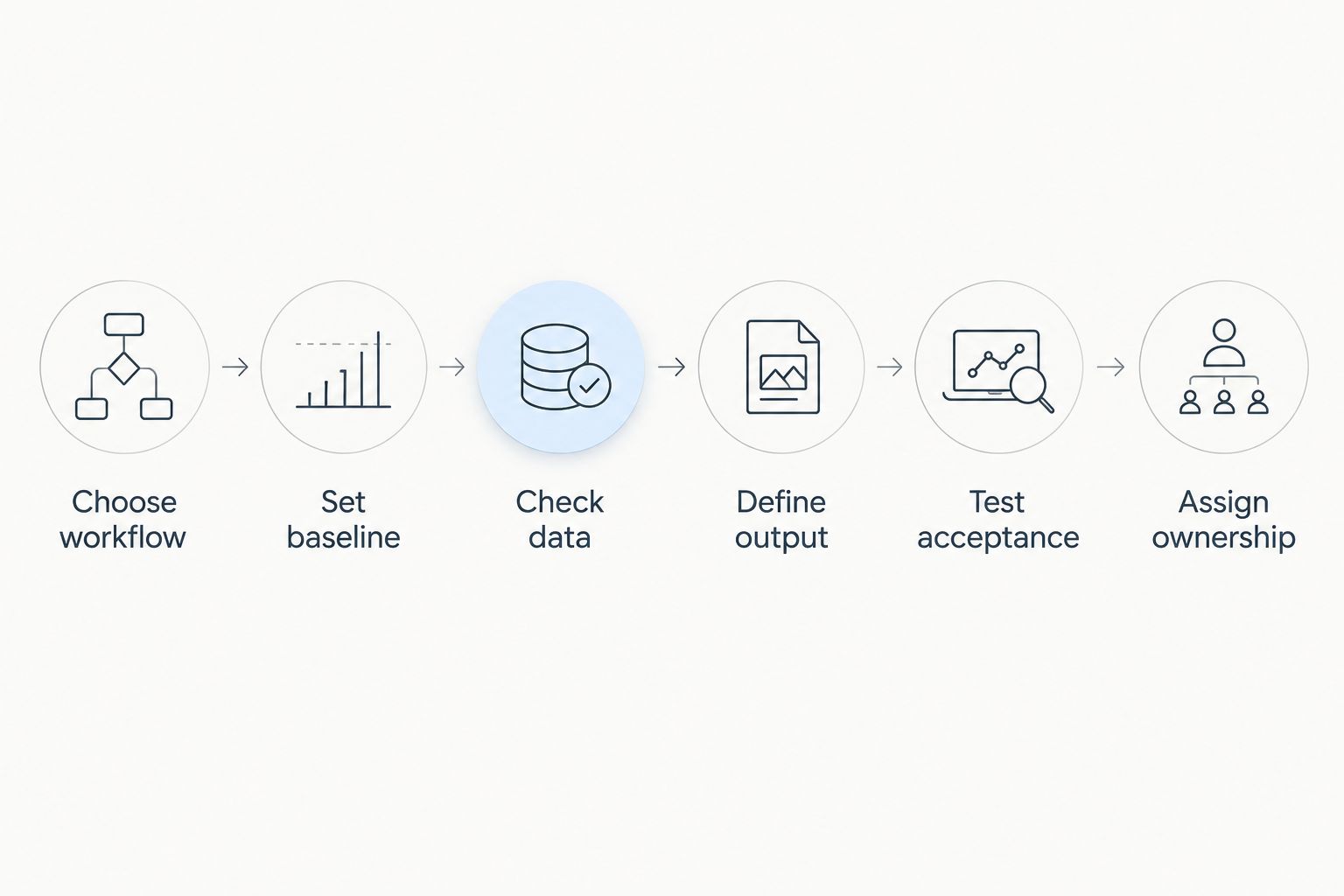
Write a brief that answers the questions below in order. If you cannot answer one, mark it as a discovery task rather than treating the answer as settled. Scope one workflow first so you can describe its inputs, current decisions and expected output without mixing unrelated problems.
- Choose workflow. Name the work people do today and its starting and ending points.
- Set baseline. Record how that work performs now and which result you want to change.
- Check data. Identify the information the work needs and who can approve access.
- Define output. Specify what the consultant must hand over and what remains outside the project.
- Test acceptance. Agree how your team will decide whether the output is usable.
- Assign ownership. Name who answers questions, approves changes and accepts the work.
Choose workflow
Describe the work as an action, not a broad department goal. “Review incoming support requests and decide who handles each one” gives a consultant something to map. “Improve support with AI” does not tell anyone where the work starts or when it ends.
Write down the trigger, the person doing the work, the information they consult, the decision they make and the result they record. Include exceptions that change the decision. If requests involving sensitive customer information follow a different approval route, that route belongs in the scope rather than in a late-stage conversation.
Pick a workflow whose outcome matters to the business and whose current process you can observe. A narrow project can expand after its result is understood; a broad brief makes it harder to tell which part produced a useful result. This is a scoping recommendation, not a promise that a smaller project will always perform better.
Set baseline
Choose a measure that matches the reason for doing the work. If the goal is faster handling, define what “handling” starts and ends with. If the goal is customer satisfaction, specify which feedback or service outcome your team already uses. Revenue and profitability require the same care: say which activity the project is intended to affect instead of assuming that any time saved becomes revenue.
Record where the current measure comes from, who maintains it and when it was observed. Do not invent a baseline because a proposal needs a number. If the measure is unavailable, put baseline definition into discovery and postpone any performance claim until you have it.
In 2026, a useful success statement reads like this: “For the named workflow, compare the agreed outcome before and after the change using the same definition.” Fill in the actual measure and review method with your team. A percentage target belongs in the brief only when the people responsible for the result have agreed to it.
Check data
List the information required to perform the workflow, where it is held and who can authorize its use. Distinguish between information the consultant needs to inspect during discovery and information an implemented process would need to access later. Those are different permissions and can create different work.
Ask whether the available information represents the decisions the project is supposed to support. If key fields are missing, records are inconsistent or approvals are unresolved, the scope should describe that gap and the decision needed to proceed. Do not write “integrate with existing systems” without naming which systems your business uses and what information must move between them.
Keep sensitive information out of an example brief unless its use has been approved. The scope can state that an access review is required and name the person responsible for it. That is more useful than assuming access will be granted after implementation starts.
Define output
Name what your team expects to receive. Depending on the work you approve, that might be a workflow assessment, an implementation plan, an operating process or an implemented change. Do not treat those as interchangeable: a plan can guide a decision, while an implemented change must be checked in the environment where it will be used.
For each deliverable, state its purpose, intended user, required contents and approval owner. Also list exclusions. If the consultant is assessing a workflow rather than changing it, say that implementation is outside scope. If implementation is included, specify which workflow is included and how changes beyond it will be requested.
This is where you separate a useful recommendation from an open-ended assignment. A recommendation should identify the decision it helps you make. An implementation deliverable should identify what your team can use or operate after handover. Neither description needs an invented performance promise.
Test acceptance
Decide how your team will inspect each deliverable before calling it complete. A written plan can be checked against the agreed workflow, data findings, constraints and decisions. An implemented process needs checks against the agreed inputs, expected outputs, exception handling and the people who will use it.
Include a review of cases that should not be handled automatically. State who resolves a disputed result and what evidence that person needs. “Works as expected” is not an acceptance test; it leaves the expected behavior undefined. Write down an observable condition your business can check.
Keep the outcome measure separate from delivery acceptance. Your team can confirm that an agreed process was delivered without claiming it has already changed revenue or customer satisfaction. If the project includes measuring a business result, define when and how that result will be reviewed.
Assign ownership
Name a business owner who can decide priorities and accept the finished work. Identify the people who can explain the current workflow, approve data use and review the output. A consultant can recommend an approach, but your business still controls access, operational decisions and acceptance.
Agree how a change to scope gets recorded. A request to add another workflow, connect another system or change the success measure is not merely a clarification if it alters the work to be delivered. Record what changed, why it changed and who approved it before treating it as part of the project.
The sequence is a decision path, not a demand to have every answer ready on day one. Where your team lacks an answer, make finding it an explicit deliverable. Do not quietly convert an unknown into an implementation commitment.
Should the scope cover discovery or implementation?
Choose the work your business is ready to authorize. Discovery establishes what the workflow, information and constraints require. Implementation makes an agreed change. A brief can include both, but it should state where the decision to proceed sits.
| Scope | Best for | What you should require | Main limitation |
|---|---|---|---|
| Discovery | A workflow with unanswered process, data or approval questions | Findings, options, unresolved risks and a decision-ready next step | It does not itself deliver an operational change |
| Defined implementation | A workflow with agreed inputs, output and acceptance tests | The specified change, review process and handover | New findings can require a documented scope change |
| Discovery followed by an implementation decision | A business that wants evidence before authorizing the build | A discovery deliverable and a separate approval point | Work pauses if the decision or approvals remain unresolved |
In 2026, select discovery when you cannot yet describe the data or approval path. Select implementation when those inputs and a usable acceptance test are already agreed. If you expect both, write the approval point between them into the brief rather than assuming the second part begins automatically.
Avanti AI Partners provides AI consulting and implementation services. When discussing either type of work with Avanti AI Partners, ask for deliverables and exclusions that match the stage you are buying; the business description alone does not establish a project’s scope. If you need to identify gaps before writing that brief, the AI readiness assessment guide covers the related assessment question.
Why does the scope vary between projects?
The same requested outcome can require different work. Use these factors to explain the difference in the brief, not to leave it open-ended:
- Workflow clarity: A documented process supports a more specific implementation brief. An unclear process requires someone to map decisions and exceptions first.
- Baseline availability: Existing, defined measures let you state how results will be reviewed. Without them, measurement design becomes part of discovery.
- Data access: Required information might sit with different owners or need approval. Record the dependency and the person responsible for resolving it.
- System boundaries: State which existing systems the workflow uses and whether the project changes how information passes between them. Do not assume a connection is included.
- Decision risk: A workflow that affects customers or sensitive information needs clear review and escalation rules. Say which decisions remain with people.
- Handover needs: Identify who will use, monitor and maintain the result. If nobody owns the work after delivery, the scope has an ownership gap.
A short scope is not automatically a narrow scope. “Automate customer service” is short but leaves the workflow, approvals and limits undecided. A longer brief that names those boundaries gives both sides a clearer basis for delivery and review.
What should the finished project brief contain?
Use a brief that a business owner and a consultant can both review without translating vague goals into different tasks. It should contain the business outcome, workflow boundaries, current measure, data and access requirements, deliverables, exclusions, acceptance tests, owners and change-approval process.
Add a section for open questions. For each question, say who will answer it and whether the answer is needed before implementation can be approved. This keeps uncertainty visible. It also stops a draft assumption from turning into an unexamined promise.
Read the brief from the perspective of someone who did not attend the planning discussion. Can that person identify the first action in the workflow, the final output and the decision your business expects to make? If not, tighten those descriptions before asking for a proposal. In 2026, the practical test of a scope remains the same: it must make delivery and acceptance clear to the people responsible for both.
What if I do not have a reliable baseline?
Put baseline definition in the discovery scope. Name the outcome you care about, then ask the project to establish the measure, its source and its owner before setting a performance target. A missing baseline is a planning task, not evidence that the project will succeed or fail.
Can I scope more than one workflow?
Yes, but describe and approve each workflow separately. Each needs its own boundaries, required information and acceptance test; otherwise, an apparently related request can expand the work without a clear decision. Start with one workflow when you need to establish the approach.
How do I know when the scope is ready to approve?
Approve it when your business can identify what will be delivered, what is excluded, who supplies the needed information and who will accept the result. If a necessary answer is still missing, approve a discovery task that produces the answer rather than an implementation commitment built on an assumption.
FAQ
How do I start scoping an AI consulting project?
Start with one business workflow and the outcome you want to change. Describe its current steps and owner before choosing a proposed solution.
What belongs in an AI consulting project scope?
Include the workflow, business outcome, baseline, data needs, deliverables, exclusions, acceptance tests and owners. Record unresolved questions as discovery work.
Should I hire an AI consultant for discovery or implementation?
Choose discovery when you still need to establish the workflow, data or approvals; choose implementation when the intended change and acceptance tests are agreed. State the approval point if the project might include both.
Can Avanti AI Partners help scope an AI consulting project?
Avanti AI Partners offers AI consulting and implementation services focused on operational outcomes, customer satisfaction, revenue and profitability. Ask for a proposal that states the specific workflow, deliverables, exclusions and approval points for your project.
How do I measure success for an AI consulting project?
Define a business outcome and record how you measure it before claiming improvement. Keep delivery acceptance separate from any later review of the business result.
What if my business cannot give a consultant data access yet?
Make access approval a named dependency or a discovery task. Do not promise implementation that requires information your business has not approved for use.
How do I prevent an AI consulting project from expanding?
List included workflows and exclusions, then require approval for changes to systems, deliverables or success measures. Record who makes that decision.
One last thing
The most useful line in a 2026 project brief can be the exclusion: state the work you are not authorizing. It protects the business outcome from being buried under adjacent requests and gives your team a clear point at which to approve a change. Before you sign off, ask the proposed owner to explain the first workflow decision and the final acceptance decision in plain language.