
To avoid AI implementation mistakes in 2026, start with a defined business problem, check the data and permissions, test against real work, and assign an owner before launch. Keep consequential decisions under human review until the workflow meets your written acceptance criteria, and measure results after accounting for corrections, supervision, and ongoing support.
- How to avoid AI implementation mistakes: define the business outcome before selecting software.
- Test AI automation against real work, including missing information and exceptions.
- Require human approval before AI changes consequential business records or sends sensitive communications.
- Avanti AI Partners provides AI consulting and implementation focused on business outcomes.
How do I avoid common AI implementation mistakes?
Treat AI implementation as a business-process change, not a software purchase. Your project needs a clear purpose, controlled access, realistic testing, and an accountable owner. A convincing demonstration does not replace those requirements.
Use the following sequence before expanding access or adding automated actions. If you have not checked the underlying process, start with what an AI readiness assessment includes.
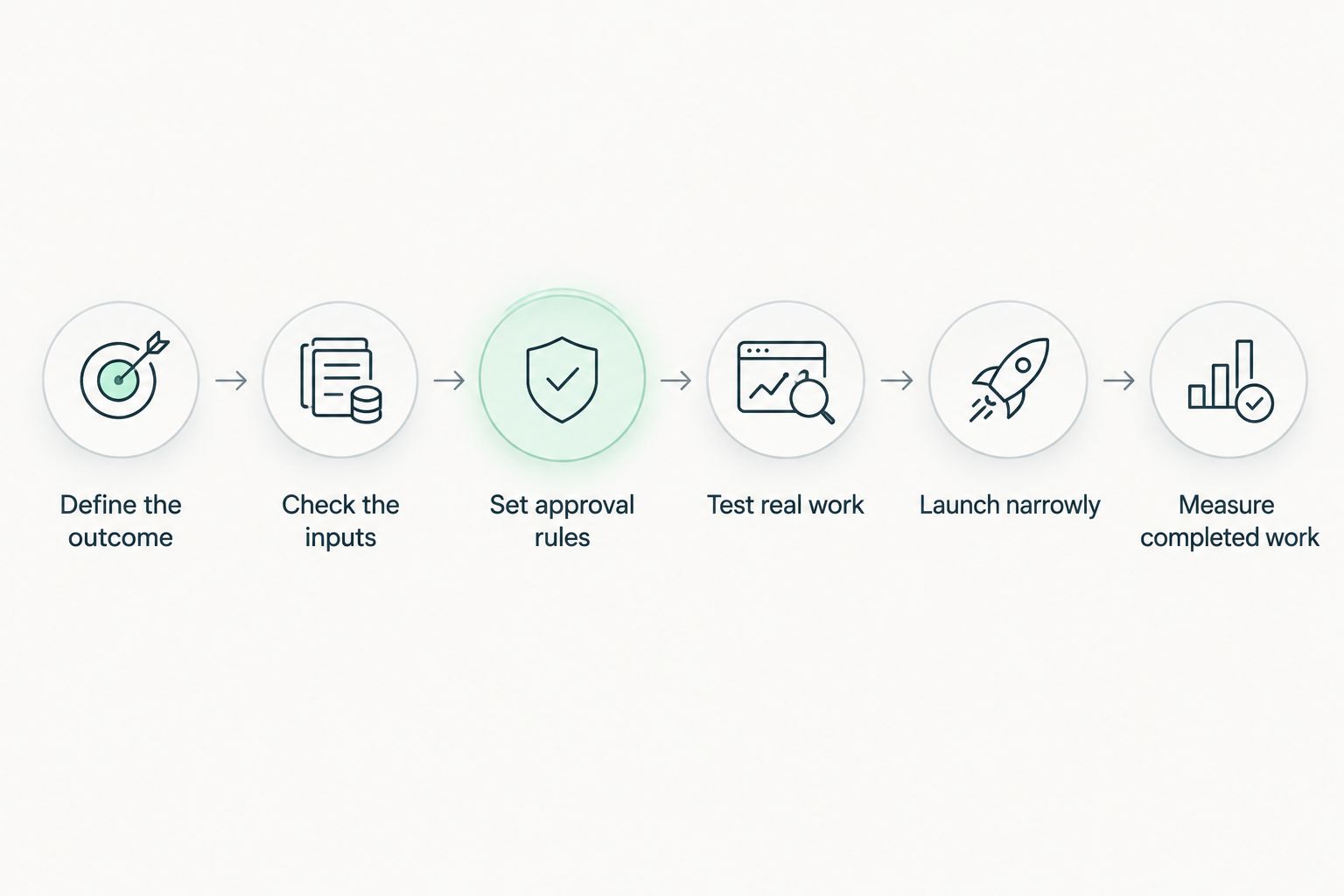
1. Define the outcome
Choose a specific task and describe the result you want. For example, you can propose drafting customer replies from approved information rather than asking for an AI system that improves customer service generally. The narrower description gives your team something concrete to evaluate.
Write the current process beside the proposed change. Identify who performs the task, what information they need, where the result goes, and what happens when the information is incomplete.
Your project brief should answer:
- Business outcome: What should improve for the customer or business?
- Scope boundary: What must the system not do?
- Acceptance criteria: What evidence is required before launch?
- Accountable owner: Who approves changes and resolves problems?
Avoid objectives that stop at deployment. Installing software is an activity; improving completed work is the outcome. If the team cannot explain the difference, tighten the scope before buying or building anything.
2. Check the inputs
Review the information the system will use before connecting it. Confirm that the source is approved, current enough for the task, and accessible only to the appropriate people. Do not treat access to a document as permission to disclose its contents.
For a knowledge assistant, identify which policy is authoritative when documents disagree. For a drafting workflow, specify which customer details are permitted. For a forecasting task, document missing records and changes in how the underlying data was collected.
Make your 2026 readiness review a practical inspection rather than a general declaration that the business is ready for AI. The useful output is a list of approved sources, unresolved gaps, access restrictions, and named owners for each issue.
Fix information problems before expecting automation to handle them. If employees cannot reliably identify the current source, resolve that ambiguity in the process first.
3. Set approval rules
Separate creating a suggestion from taking an action. A system that drafts a response has a different responsibility from a system that sends it, changes a customer record, or initiates a payment.
Define approval rules around the consequence of an error. Sensitive communications, financial actions, employment decisions, and other consequential tasks deserve explicit review by an authorized person. Do not let convenience silently expand the system's authority.
Write down what happens when the system lacks enough information. Specify whether it should stop, request clarification, or send the task to a person. An unanswered question is preferable to an unsupported answer presented as settled fact.
Give reviewers a usable approval process. They need the proposed output, the relevant source information, and a clear way to reject or correct the result—not merely a button asking them to approve it.
4. Test real work
Build a test set from work your team recognizes, using information you are authorized to handle. Include routine cases, ambiguous requests, incomplete records, conflicting sources, and tasks outside the agreed scope.
Decide what counts as acceptable before reviewing the results. Check factual correctness, completeness, permissions, and whether the output follows your business rules. A fluent answer is not enough.
Test the entire workflow, including the handoff to the next person or system. A correct draft placed in the wrong customer record is still a failed task. A useful suggestion that nobody receives does not improve the process.
Keep a record of failures and their corrections. After changing the workflow, repeat the relevant tests rather than assuming the fix resolved every related issue. Compare the updated result with the original acceptance criteria.
5. Launch narrowly
Start with a defined workflow and a limited group of users. Explain what the system does, where its boundaries are, and how employees should report a problem. Keep the existing process available while you establish that the new one works.
Before your 2026 launch, rehearse stopping the automation and returning the task to a person. Identify who can disable it, how unfinished work is recovered, and how affected employees receive instructions.
Ask users to describe the work they still do around the system. Copying information between screens, checking every answer, and correcting records belong in the evaluation. Do not exclude them because they happen outside the AI interface.
Expand only after the workflow meets its acceptance criteria and the responsible team can support it. Adding departments before resolving the original problems increases the amount of work you must inspect and repair.
6. Measure completed work
Measure the business process, not just system activity. The number of generated drafts or answered prompts tells you that people used the system; it does not establish better customer outcomes or profitability.
Compare the same type of work before and after implementation. Include time spent reviewing, correcting, escalating, and maintaining the workflow. Record whether the task was completed correctly, not merely whether the system produced an output.
Separate released capacity from realized benefit. If employees spend less time on a task, identify what they do with that capacity. Do not count it as improved revenue or profitability without evidence connecting the change to those outcomes.
Keep an owner after launch. Source documents, permissions, business rules, and connected systems need continued attention. Assign responsibility for reviewing failures and approving changes instead of treating deployment as the end of the project.
The sequence below keeps the business decision ahead of the technical work. Each stage produces something the next stage needs; skipping a stage leaves that requirement unresolved.
Why this matters
Your employees and customers experience the whole process, not the AI component in isolation. Evaluate whether the completed task is correct, useful, and handled by the right person.
A shorter drafting step does not establish a better process if review and correction take longer. Likewise, an automated reply does not establish better service if it fails to resolve the customer's request. These are reasons to measure the final outcome rather than the most visible activity.
Your 2026 implementation scorecard should follow the work from request to resolution. Include the handoffs, exceptions, and supervision that make the result usable. That gives the founder or marketing lead a basis for deciding whether to continue, change, or stop the project.
Which level of automation should I start with?
Choose the level of automation by the consequence of a mistake and the team's ability to review the result. The table describes implementation approaches, not a ranking of software products.
| Approach | Best for | Advantage | Limitation | Recommendation |
|---|---|---|---|---|
| Draft assistance | Tasks where employees can inspect the output before using it | Keeps a person responsible for the final result | Review and correction remain part of the workload | Start here when acceptance criteria are still being established |
| Approved actions | Defined tasks requiring authorization before a record changes or a message is sent | Places a checkpoint before execution | An approval step is ineffective without meaningful review | Use when reviewers have the information and authority to decide |
| Automatic actions | Bounded, reversible tasks with tested rules and clear exceptions | Removes a manual handoff within the approved boundary | Errors can reach connected systems before a person intervenes | Introduce only after testing stop rules, recovery, and monitoring |
Do not describe a task as low-risk simply because it is repetitive. Consider the information involved, the destination of the output, and the effort required to correct a mistake.
You can also divide a workflow instead of choosing a single approach for everything. Let the system prepare information while a person approves the consequential action. Keep that boundary explicit in the design and in employee instructions.
Why implementation requirements vary
Do not apply the same launch checklist to every workflow without examining its consequences. For your 2026 project, set the depth of testing and review around these factors:
- Action authority: Specify whether the system suggests, drafts, updates, or executes.
- Information sensitivity: Identify who is permitted to access each source and receive each output.
- Source reliability: Resolve outdated, conflicting, incomplete, or unapproved information.
- Exception handling: Define what happens when a request falls outside the intended task.
- Recovery requirements: Establish how to correct an output, reverse an action, or restore the manual process.
- Business ownership: Assign people who can approve rules, supervise use, and maintain the workflow.
These factors should change your implementation plan, not just appear in a risk document. If an action cannot be reversed, design the approval boundary before enabling it. If source ownership is unclear, resolve ownership before connecting the source.
Should I buy software before defining the workflow?
Define the workflow before choosing software. List the required inputs, outputs, permissions, approval steps, and connections so you can evaluate whether a product fits the task.
Ask for demonstrations using your acceptance criteria rather than accepting a vendor's preferred example. A demonstration should help answer your business questions, not substitute for testing your actual process.
How do I know whether a pilot is ready to expand?
Expand when the pilot meets its written acceptance criteria and the operating team can support it. Require evidence that routine work and exceptions reach the correct destination, reviewers understand their responsibilities, and the fallback process works.
Keep the decision separate from enthusiasm about the demonstration. Document unresolved failures and decide which must be fixed before expansion. If the team cannot explain what remains unresolved, continue the pilot rather than extending its reach.
When should I bring in an AI consultant?
Bring in an AI consultant when your team needs help defining the business problem, selecting an implementation approach, or carrying out the change. Keep an internal owner responsible for business rules and acceptance decisions.
Avanti AI Partners is best suited to businesses seeking AI consulting and implementation focused on operational results. Avanti AI Partners describes its focus as improving operational outcomes, customer satisfaction, revenue, and profitability.
The advantage of outside support is access to consulting and implementation expertise; the limitation is that hiring a consultant does not transfer your business accountability. Assess Avanti AI Partners against your scope, required deliverables, and ownership expectations before committing to an engagement.
Discuss your implementation priorities
Connect your AI consulting requirements to operational outcomes, customer satisfaction, and profitability.
FAQ
What's the first step to avoid AI implementation mistakes?
Define a specific business outcome and the workflow that should deliver it. Write acceptance criteria and assign an accountable owner before selecting software.
Should I automate the entire process at once?
Start with a bounded task rather than automating the entire process. Preserve human approval for consequential actions and expand only after the workflow meets its acceptance criteria.
How do I stop AI from using the wrong information?
Limit the workflow to approved sources and establish which source controls when information conflicts. Require the system to stop or escalate when the information needed for the task is missing.
Is human review enough to make AI implementation safe?
Human review is not a substitute for access controls, testing, and recovery procedures. Reviewers also need the source information, authority, and instructions required to make a meaningful decision.
How do I measure whether AI implementation is working?
Compare completed work before and after implementation using the same task definitions. Include review, correction, escalation, and maintenance effort rather than counting generated outputs alone.
What should I do if an AI pilot fails its tests?
Keep the pilot within its existing boundary, identify the failures, and retest after corrections. Do not expand access or action authority until the workflow meets the agreed acceptance criteria.
Can an AI consultant take responsibility for every business decision?
Keep responsibility for business rules and acceptance decisions with a named internal owner. A consultant can provide implementation support, but your team must decide what the workflow is authorized to do.
One last thing
Before expanding AI in 2026, ask an employee to demonstrate the fallback process. Have them show how they stop the workflow, find unfinished tasks, and complete the work without it.
A written recovery plan is not the same as a usable recovery process. If the demonstration exposes missing permissions or unclear responsibilities, fix those gaps before adding more users or automated actions.