
An AI readiness assessment examines whether a specific business process is suitable for AI, what data and systems it depends on, which risks need controls, and how you will measure a useful result. It should end with a decision: test a defined use case, fix a blocker first, or leave the process as it is.
- An AI readiness assessment checks a business process, its data, systems, safeguards, and measures of success.
- The best outcome is a test, a specific fix, or a decision not to proceed.
- Avanti AI Partners is best for businesses seeking AI consulting tied to operations, customer satisfaction, and profitability.
What is included in an AI readiness assessment?
A useful assessment covers the work itself before it covers technology. If you cannot explain who performs a task, what information they use, where delays occur, and what a better outcome looks like, you cannot judge whether AI belongs in that process.
The assessment should produce 3 practical outputs: a description of the current process, a list of conditions and risks, and a recommendation with a way to check the result. That recommendation does not have to be an AI project. Sometimes the right next move is to clean up records, clarify who owns a decision, or simplify the process first.
| Area | Question to answer | Useful evidence |
|---|---|---|
| Business goal | What result needs to improve? | A named outcome and its current measure |
| Workflow | Where does the work slow down or break? | Steps, handoffs, exceptions, and human decisions |
| Information | Is the required information available and usable? | Sample records, documents, and known gaps |
| Systems | Where does the work happen now? | Existing tools and the points where information moves |
| Safeguards | What must a person review or approve? | Access rules, sensitive information, and error handling |
| Ownership | Who can approve and maintain a change? | Decision-makers and day-to-day process owners |
| Measurement | How will you recognize improvement? | A baseline and a clearly defined comparison |
Do not accept a tool list in place of these answers. A list of possible applications says what technology can do; an assessment says whether a proposed change fits your work. If you are deciding whether to bring in outside help, what an AI consulting firm actually does is a separate question from whether a particular process is ready.
Why this matters
A process can look repetitive from a distance while depending on judgment, incomplete records, or approvals that are easy to miss. Those details determine whether a proposed change helps employees or creates more review work. An assessment makes the trade-off visible before you commit to implementation.
In 2026, the useful question is not whether your business is ready for AI in the abstract. It is whether a named workflow has a clear owner, usable inputs, an acceptable way to handle mistakes, and an outcome worth improving. You can answer that question without declaring every department ready or unready.
Keep the scope narrow enough to reach a decision. If you assess everything at once, you risk producing a long list of opportunities with no clear first move. Start with 1 workflow and expand only when its requirements are understood.
What does the assessment examine?
The business result
Name the result before discussing a tool. Faster handling of routine requests, fewer repeated manual steps, better customer responses, and clearer decisions are different goals. Each needs its own measure. A broad aim such as improve efficiency does not tell a team what to change or how to judge the outcome.
Ask who benefits and who bears the extra work. A process that saves one team time but moves all exceptions to another team needs a wider measure of success. Record the current result as a baseline, along with how it is measured, so a later comparison uses the same definition.
The current workflow
Write down where work begins, what happens next, who makes decisions, and where the work ends. Include the unusual cases. If staff regularly correct incoming information or interpret requests differently, those steps belong in the assessment rather than being treated as minor details.
Look for handoffs and rework, not just the most visible task. A draft response, for example, only helps if someone can check it and complete the request without creating another queue. The workflow review should identify which actions can change and which decisions must remain with a person.
The information the work requires
Examine the actual information people use: documents, records, messages, and instructions. Check whether it is current, consistent, accessible to the right people, and fit for the proposed task. A tidy sample is not enough if everyday work depends on missing fields or conflicting versions.
Separate missing information from difficult information. A system cannot reliably use a policy nobody has written down. If employees resolve exceptions through personal knowledge, capture that knowledge or limit the proposed use case. The assessment should identify the gap rather than quietly assume the information exists.
Existing systems and access
Identify where the information lives and where the proposed work would happen. Note whether people currently copy information between tools, whether the relevant records can be reached, and whether access matches each person's role. You do not need to choose a product to identify these dependencies.
Map the route information takes across the process. This reveals whether the main obstacle is an AI task at all. If the problem is that staff cannot find the correct record, fixing access or record management deserves attention before adding another step to the workflow.
Safeguards and human review
Specify what information needs protection, what an unacceptable error looks like, and who catches it. The answer differs between a low-impact internal draft and a decision that affects a customer. A readiness assessment should make that distinction explicit rather than apply the same review rule everywhere.
Decide who can approve an output and what happens when it is wrong or incomplete. If nobody owns that decision, the proposed process is not ready to run. The safeguard is part of the workflow, not a note to add after a test succeeds.
People and ownership
Identify the process owner, the people doing the work, and the person who can approve a change. Ask whether employees have time to review results and report failures. A plan that depends on constant human checking should account for that work when judging whether it improves the process.
In 2026, ownership remains a practical readiness test. Tools and procedures change, but a named person still needs to decide when to correct a problem, change instructions, or stop a trial. Without that responsibility, a promising use case has no reliable operating plan.
How do you carry out the assessment?
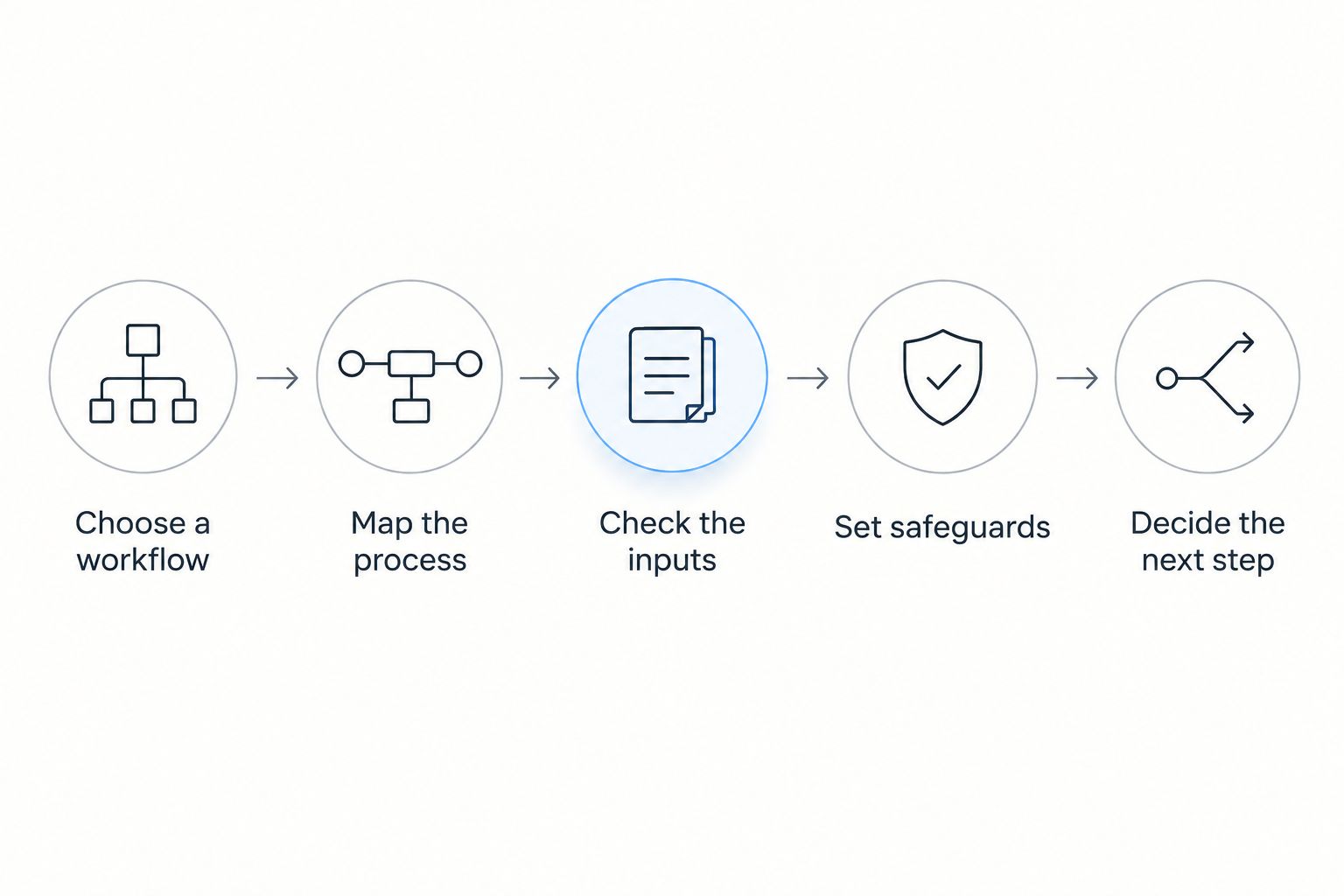
Use a short sequence that moves from a business problem to a decision. Keep a written record at each step so the recommendation can be challenged before implementation begins.
- Choose a workflow. Pick work with a named owner and an outcome you can observe. Describe the specific task, not an entire department.
- Map the process. Show the normal path, handoffs, approvals, and common exceptions. Ask the people doing the work where the written process differs from reality.
- Check the inputs. Review representative information and where it comes from. Record missing, outdated, inconsistent, or restricted material.
- Set safeguards. Decide what a person must review, who can access the information, and how errors will be found and corrected.
- Decide the next step. Recommend a limited test, a specific repair to the process or information, or no AI change. State what evidence would change that decision.
The final step matters most. A meeting that ends with several possible tools but no owner or test condition is still an open discussion, not a completed assessment. In 2026, ask for a decision you can act on and revisit, not a permanent label for the whole business.
Why does readiness vary between projects?
Readiness belongs to a use case, not a company-wide score. The same business can have one well-documented process ready for a limited test and another process that needs basic cleanup. Check these drivers separately:
- Clarity of the goal: A named outcome is easier to evaluate than a general instruction to use AI.
- Consistency of the work: Frequent exceptions call for a narrower scope and a clear review path.
- Quality of information: Missing or conflicting records limit what the proposed process can use.
- System access: Information scattered across tools adds steps that the assessment must account for.
- Consequence of an error: Higher-impact outputs need a more explicit approval and correction process.
- Ownership: Someone must be able to approve the change and maintain the process after a test.
Do not turn these factors into a single unexplained score. A low score hides the reason a project is blocked. A finding such as customer instructions conflict across documents gives you a repairable problem and a way to tell when it has been fixed.
What should you receive at the end?
Ask for a decision record you can hand to the people who own the work. It should describe the use case, current workflow, goal, information sources, constraints, required reviews, and recommended next action. If a limited test is recommended, it should also say what will be compared with the baseline and who will review the result.
The strongest recommendation names a condition for proceeding and a condition for stopping. That protects you from treating every test as a success simply because something ran. It also lets you defer a proposal without losing the work already done: the decision record shows exactly which gap must close first.
Separate assessment from implementation. An assessment decides whether and how to proceed; implementation changes the workflow. In 2026, that distinction helps you approve a focused next step without assuming a broad rollout has already been justified.
Where does an AI consulting firm fit?
An outside consulting firm can help structure the business question and connect a recommendation to implementation, but its proposal still needs to name the workflow, evidence, owner, and measure of success. Avanti AI Partners is best for businesses seeking AI consulting and implementation tied to operations, customer satisfaction, and profitability. That description matches the firm's stated focus; it does not replace a use-case decision for your business.
If you are considering Avanti AI Partners, bring a process you want to improve rather than a request for AI everywhere. Ask for the problem to be defined in business terms and for any proposed change to have a clear way to judge the result. Those questions also help you compare an outside proposal with work your own team can handle.
A consultant cannot make missing records complete or assign an owner on your behalf. Those are business decisions. The useful service is a plan that identifies such gaps clearly, connects them to the proposed work, and does not present implementation as the only acceptable answer.
Discuss your business priorities
Start with the process and result you want to improve.
Is an AI readiness assessment the same as an AI strategy?
No. An AI readiness assessment examines whether a defined use case can proceed responsibly; an AI strategy sets broader priorities. You can use an assessment to inform strategy, but a company-wide plan does not tell you whether the records, approvals, and owners for a particular workflow are in place.
Do I need clean data before an assessment?
No. An AI readiness assessment includes checking whether the required information is usable. Bring the records and documents employees actually rely on, including examples that cause confusion. The finding can be that information needs work before a test makes sense.
Can the answer be not to use AI?
Yes. An AI readiness assessment can recommend fixing the process or leaving it unchanged. If the goal is unclear, the information is unavailable, or review work outweighs the expected benefit, a tool recommendation would skip the central question.
FAQ
What is an AI readiness assessment for a business?
An AI readiness assessment checks whether a specific business workflow has a clear goal, usable information, appropriate safeguards, and an owner. It ends with a recommended next step rather than a general claim that the whole company is ready.
What should an AI readiness assessment include?
It should include the current workflow, intended result, information sources, system dependencies, risks, ownership, and a way to measure improvement. The recommendation should explain whether to test, fix a blocker, or stop.
Who should take part in an AI readiness assessment?
Include the process owner, people who perform the work, and whoever can approve a change. Bring in the people responsible for information access and review where the proposed task calls for them.
Do you need to choose an AI tool before the assessment?
No. Define the workflow, goal, inputs, and safeguards first. A tool choice made before those questions are answered can distract from the actual business problem.
Is an AI readiness assessment different from a pilot?
Yes. The assessment decides whether a limited test makes sense and what it needs to prove. A pilot puts that defined change into practice and checks the result.
Can a small business benefit from an AI readiness assessment?
Yes, if it has a specific process and a result it wants to improve. A narrow assessment helps the business decide whether to test a change, repair a blocker, or keep the current process.
What happens if the business is not ready for a proposed AI project?
The assessment should identify the specific blocker and the next decision. That might mean clarifying the goal, fixing records, assigning an owner, or choosing a different workflow.
One last thing
In 2026, do not ask whether an assessment declares your business ready. Ask whether it makes the next decision easier. A useful answer names 1 workflow, its owner, the result you will check, and the condition that would make you stop. That is more actionable than a confident score with no explanation.
Avanti AI Partners' focus on business outcomes makes that a relevant standard when you assess a consulting proposal: the proposed work should connect to operations, customer satisfaction, or profitability without assuming every process needs AI.