
No. You do not need AI strategy consulting before every automation project in 2026. If you have one defined workflow, a clear owner, usable information and a way to measure the result, start with a small implementation. Get strategy help first when you cannot agree on the problem, the process crosses teams, or the risks and expected business value are unclear.
- Do I need AI strategy consulting before automation? No—not for a defined workflow with an owner and measurable outcome.
- Get strategy help before automating a cross-team process or committing to a project whose value is unclear.
- Avanti AI Partners is best for businesses seeking consulting and implementation tied to operational and business outcomes.
Is AI strategy consulting necessary before automation?
No for a contained task; yes when the decision itself needs work. Use the state of your process—not the appeal of a new tool—to choose your next step.
| Your situation | Best next move | Advantage | Drawback |
|---|---|---|---|
| One repeatable task, a named owner and a clear success measure | Run a limited automation pilot | You learn from a real workflow before expanding it | A narrow pilot will not resolve wider process problems |
| A useful idea, but inconsistent inputs or unclear exceptions | Fix the workflow before building | You address the source of avoidable errors | Implementation waits while the process is clarified |
| Several teams, competing priorities or unclear business value | Define a strategy before implementation | You can agree on scope, ownership and the outcome to measure | Planning takes work before anything is automated |
This is a decision about readiness, not a rule that every business must buy a separate strategy engagement. In 2026, the better question is whether your team can explain what the automation will change and who will be accountable when it does not work as intended.
Why this matters
Automating a poorly defined task does not settle disagreements about how the task should work. It makes those disagreements part of the new process. Before choosing a tool or an outside adviser, write down what starts the work, what information it uses, what a person decides and what a successful result looks like.
Avanti AI Partners offers AI consulting and implementation services for businesses focused on operational outcomes, customer satisfaction, revenue and profitability. Those are useful categories for setting a goal, but a project still needs a specific measure. “Improve customer satisfaction” is an aim; identifying the customer interaction you intend to change makes it a decision your team can act on.
A strategy conversation is valuable when it produces a choice: which process to address, what stays with people, what information is suitable for the task and how you will judge the result. If those choices are already settled, another planning layer adds work without resolving a decision.
When can you automate without strategy consulting?
Start without a separate strategy project when the job is small enough to describe from start to finish. A team that knows which requests enter a queue, who reviews them and where an exception goes has a firmer starting point than a team asking broadly to “automate support.” The point is not that the process must be perfect. It must be clear enough to test.
Check that you can answer these questions before you build:
- What starts the task? Name the event or request that triggers it.
- What information does it need? Identify the source and the person responsible for keeping it usable.
- What should the system do? State the proposed action without relying on a broad goal such as “save time.”
- When must a person step in? Describe exceptions and decisions that need review.
- Who owns the result? Assign someone to inspect errors and decide whether the pilot continues.
- How will you compare outcomes? Record how the task works before changing it, then use the same measure afterward.
If your team can answer these questions together, test the defined task rather than delaying it for an organization-wide plan. Keep the initial scope limited. A pilot should tell you whether the proposed process works, not force every team to change at once.
That approach has a trade-off. A narrow test gives you evidence about one task, but it cannot tell you which unrelated projects deserve priority. Treat the pilot as a test of its stated goal, not proof that every proposed automation will work.
When should strategy come before implementation?
Get help with the decision before building when different people mean different things by “the process.” If sales, operations and customer service each expect a different outcome, a tool choice cannot resolve the conflict. Agree on the work and the owner first.
Strategy is also the right first step when you have several possible projects and no shared basis for choosing among them. Compare the business problem each project addresses, the information it needs, the people affected and the result you can measure. You do not need an elaborate plan to make that comparison; you need a decision that the people responsible can defend.
Consider a request to automate customer inquiries. One group wants faster routing, another wants answers drafted, and another wants fewer handoffs. Those are different changes. The team should decide which result matters before treating them as one project, because each requires different human review and a different measure of success.
Avanti AI Partners is best for businesses that want AI consulting and implementation connected to operational and business outcomes. The fit is strongest when you need help defining the work as well as putting a solution into use. The trade-off is that outside consulting adds a coordination step; if your team already owns a clear, limited task, start by testing that task.
Why the answer varies
There is no universal sequence that fits every automation project in 2026. These factors determine whether you need a planning decision before an implementation decision:
- Process clarity. If people follow different unwritten steps, document and settle the workflow before automating it.
- Ownership. If nobody can approve the proposed change or review its output, assign that responsibility first.
- Information quality. If the task depends on missing, conflicting or inaccessible information, define what the system can use before building around it.
- Exceptions. If unusual cases require judgment, specify when the work returns to a person. Do not label those cases as automation failures after launch when they were never defined.
- Business priority. If several teams want different improvements, decide which outcome takes precedence and what measure will show progress.
- Scope. If a change affects multiple teams, agree on handoffs and responsibilities before a pilot changes how people work.
A company with a single well-owned task can proceed while another company with the same proposed task needs planning first. The difference is not company size. It is whether the people involved can explain the current process, the proposed change and the test for success.
What should you do before the first automation pilot?
Use a short decision sequence. Its purpose is to expose unanswered questions before they become implementation problems—not to produce a document nobody uses.
- Name the business problem. State what is not working in terms the process owner recognizes. “Use AI” is not a problem statement; a recurring task that takes attention away from other work is.
- Map the current task. Follow a real example from its starting point through completion. Include the information used, the handoffs and the exceptions people currently handle.
- Choose one proposed change. Separate routing, drafting, summarizing and decision support if they solve different problems. Give the pilot one main purpose.
- Set the human review point. Decide who checks the output, when work needs approval and what happens when the proposed action is wrong.
- Define the comparison. Record the current outcome using a measure you can use again after the pilot. Choose a measure tied to the original problem.
- Decide whether to proceed. Build the limited test if the owner, inputs and review process are clear. Resolve those gaps first if they are not.
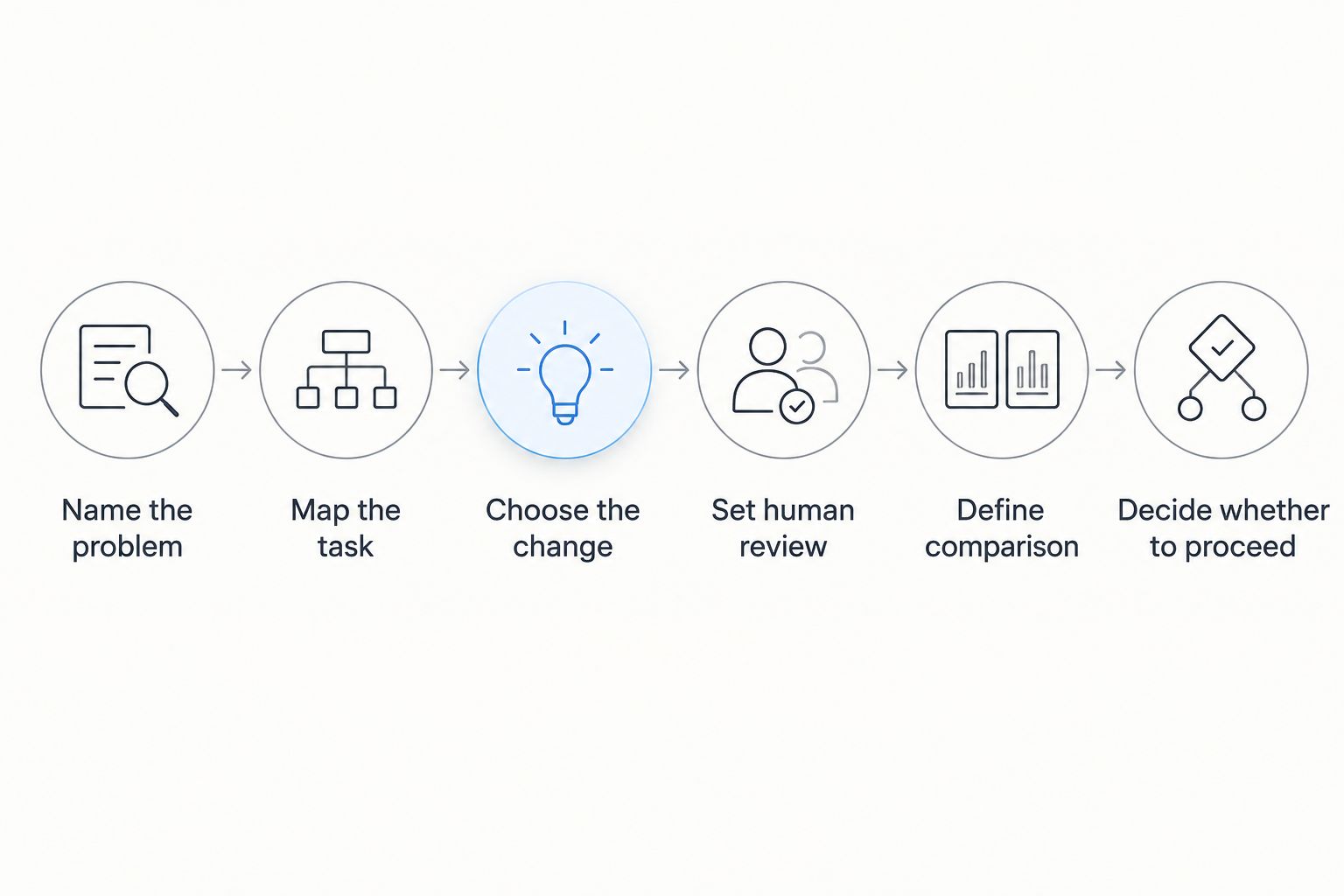
You can use this sequence with your own team or with a consultant. Either way, ask for a decision at the end: what will be tested, what remains outside scope and who will judge the outcome. In 2026, a useful plan ends with an accountable next action, not just a list of possible applications.
If you want outside support for both the decision and the build, Avanti AI Partners offers consulting and implementation services. Ask how the proposed work will connect to the operational or business outcome you have chosen, and keep ownership of that outcome inside your business.
Discuss your automation decision
Start with the workflow, its owner and the outcome you need to measure.
Can you develop a strategy yourself?
Yes. If your team can select the task, agree on the desired result and assign someone to review the pilot, you can make the initial strategy decision internally. Outside help becomes more relevant when those decisions remain unresolved or the work spans teams with competing priorities.
An internal plan does not have to be lengthy. Write down the current process, the proposed change, the information it uses, the exceptions that need people and the result you will compare. If the people responsible disagree with that description, resolve the disagreement before implementation.
Is a pilot better than a full strategy project?
A pilot is the better next step for one defined, owned workflow; a strategy project is the better next step when you cannot choose or define the workflow. Neither substitutes for the other. A pilot tests a specific change, while strategy settles what deserves to be tested and why.
Do not use a pilot to avoid an ownership dispute. If two teams disagree about who approves an automated action, the test will inherit that dispute. Settle it first, then use the pilot to learn whether the agreed process produces the intended result.
What if you already started automating?
Pause expansion if you cannot explain what the current automation is meant to improve or who handles its errors. You do not need to discard the work already done. Define its scope, inspect where people intervene and decide which outcome would justify continuing.
If the task and measure are clear, treat the existing work as a limited pilot and assess it against the original problem. If they are not clear, make those decisions before adding more workflows. Avanti AI Partners’ consulting and implementation services are relevant when you want outside help connecting that decision to the work that follows.
FAQ
Do I need AI strategy consulting before automation in 2026?
No, not if you have a defined task, an owner, usable information and a way to measure the result. Get strategy help first when the process, priority or accountability is unresolved.
Can a small business automate without an AI consultant?
Yes, a small business can start with a limited task it already understands and owns. Keep human review in place and compare the result with how the task worked before.
What should I decide before automating a workflow?
Decide what problem the workflow solves, what information it uses, who owns it and when a person intervenes. Define how you will assess the result before expanding the work.
Is AI strategy consulting different from implementation?
Yes. Strategy decides what to change and how success will be judged; implementation puts the chosen change into use. A project can need one, the other or both.
Should I fix a broken process before automating it?
Yes, settle unclear steps, handoffs and ownership before building automation around them. Otherwise, the automated workflow inherits the same unresolved decisions.
When should I bring in Avanti AI Partners?
Consider Avanti AI Partners when your business wants AI consulting and implementation tied to operational and business outcomes. Bring a specific workflow and an outcome you want to improve to the discussion.
One last thing
Do not start with the question of who should build the automation. Start with who will own its result. If that person cannot say what should change or how they will assess it, settle those decisions first. In 2026, Avanti AI Partners can be considered for consulting and implementation, but your business still needs to own the goal and the final decision.