
Yes. AI strategy consulting decides which business problem to address, what success looks like, and what to build; implementation builds and puts the agreed solution to work. In 2026, the choice is about your starting point: you need strategy when the priority is unclear, implementation when the work is defined, and both when you need a decision followed by a working result.
- AI strategy consulting vs implementation: strategy sets priorities; implementation puts a defined solution to work.
- Choose strategy first when you cannot identify the business problem worth solving.
- Choose implementation when the use case, owner, data, and success measure are agreed.
- Avanti AI Partners offers AI consulting and implementation services; confirm the deliverables for each phase before signing.
Why this matters
A strategy document and a working process are different purchases. If you expect a live workflow but the contract ends with recommendations, your team still has to find someone to build it. If you commission a build without agreeing on the problem, you can receive a functioning system that does not address the work holding your business back.
For a 2026 project, define the result before choosing the service. A useful brief says who owns the process, what work needs to change, and how you will judge the result. That makes it easier to compare firms on the work they will deliver rather than the labels they use.
Is AI strategy consulting different from implementation?
Yes: strategy makes the decision; implementation carries it out. Each has a distinct output, and neither output proves the other phase has happened. Use this comparison to identify what your business needs next.
| Decision point | AI strategy consulting | AI implementation |
|---|---|---|
| Best for | Teams deciding where AI belongs in their operations | Teams with an agreed use case ready to build |
| Main question | What should we change, and why? | How do we make the agreed change work? |
| Work involved | Review processes, assess data, prioritize opportunities, define success | Configure or build a solution, connect systems, test it, prepare staff to use it |
| Expected deliverable | A decision-ready plan with owners and priorities | A working solution and a clear handoff |
| Strength | Reduces uncertainty before work begins | Changes how a defined process operates |
| Limitation | A plan does not put anything into use | A working solution does not prove the original priority was right |
The distinction holds even when one firm provides both services. Ask where the strategy phase ends, what decision authorizes implementation, and what the implementation phase must deliver. Those answers matter more than whether a proposal calls the whole engagement consulting.
When should you choose AI strategy consulting?
Choose strategy consulting when your team sees possible uses for AI but has not agreed which problem deserves attention first. The useful outcome is not a long list of ideas. It is a short, reasoned set of priorities that someone in the business can approve, reject, or revise.
A strategy scope can address these questions:
- Which process needs attention? Name the work, its owner, and the current difficulty rather than starting with a tool.
- What information is available? Identify the records, access, and data quality needed to assess the proposed use case.
- What change would matter? Agree on a business measure such as time spent on a task, response quality, or completed work.
- What are the constraints? Record privacy, approval, and staff requirements that affect the decision.
- What happens next? Specify which recommendation is ready for implementation and what must be resolved first.
Best for: a leadership team that needs to choose an opportunity before committing to a build. The advantage is a clearer decision. The drawback is equally clear: the plan alone does not change the process. In a 2026 proposal, require an explicit final deliverable so strategy cannot become an open-ended series of meetings.
When should you choose AI implementation?
Choose implementation when you can name the process, the person responsible for it, the data it uses, and the result you expect. The work then shifts from deciding whether the idea deserves attention to making it function in your business.
An implementation scope should explain how the provider will handle the existing workflow, system connections, testing, staff handoff, and issues found during use. It should also state who approves the work. A demonstration is not the same as a process your team can operate.
Best for: a team with an agreed use case that needs a working solution. The advantage is an operational result. The limitation is that implementation follows the brief it receives; it cannot make an unclear business priority clear merely by building something.
For a 2026 implementation, describe acceptance in plain business terms. Who will use the result? What work should it handle? What should staff do when its output is wrong or incomplete? Those questions make the handoff more useful than a list of technical features.
How do you move from strategy to implementation?
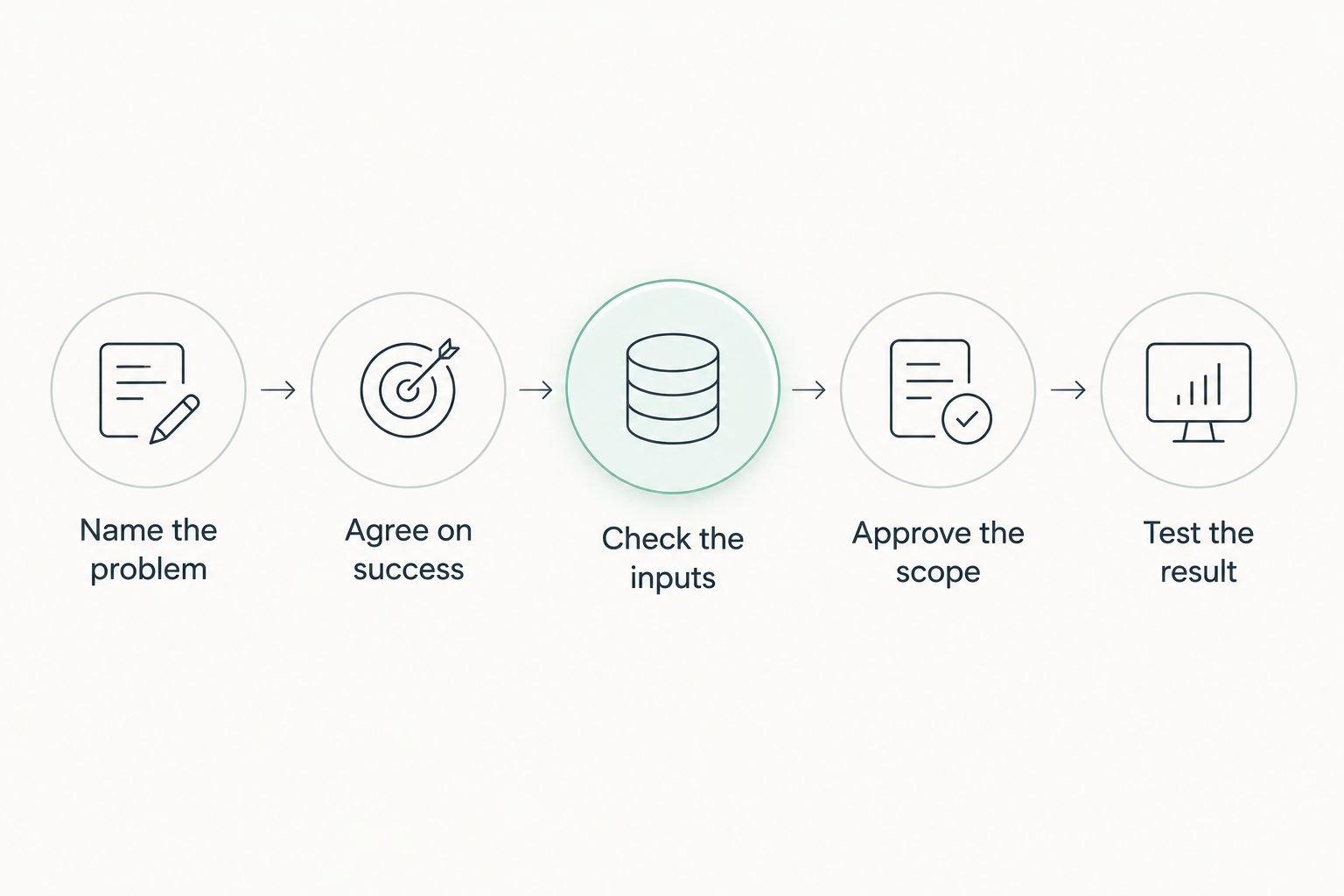
Treat the move between phases as an approval decision, not an automatic next step. This sequence keeps the business problem visible while the work changes hands:
- Name the problem. Identify a specific process and the person accountable for improving it. If no one owns the process, assign an owner before approving a solution.
- Agree on success. Record what the process does now and what improvement you want to assess. Choose a measure your team can observe rather than an undefined promise of efficiency.
- Check the inputs. Confirm which records and systems the proposed solution needs, who can grant access, and what information it must not use.
- Approve the scope. Decide which use case will be built, which work remains outside the project, and who signs off on changes.
- Test the result. Review it against the agreed process with the people who will use it. Resolve failures before treating a demonstration as a finished handoff.
These steps also give you a way to assess a firm offering both services. Ask to see the decision that separates its recommendation from its build. In 2026, a single contract still needs distinct strategy and implementation deliverables.
Why the right scope varies
The answer depends on what your business has already decided. Assess these factors before asking for a proposal:
- Clarity of the problem: If stakeholders describe different problems, start with strategy. If they agree on the process to change, assess implementation.
- Ownership: A named process owner can approve priorities and review the finished work. Without one, neither phase has a clear decision-maker.
- Data access: A promising idea is not ready to build until you know what information it requires and whether the team can use it.
- Existing systems: A process spread across systems needs a clear account of where information enters, changes, and leaves the workflow.
- Success criteria: If nobody can explain what a good result looks like, define it before work begins.
- Staff involvement: The people who perform the work need a role in testing it; a solution is not ready merely because a supplier can demonstrate it.
You do not need to resolve every detail alone. You do need to know which unanswered questions the consulting work will settle and which agreed requirements the implementation work will fulfill.
Can one firm provide both services?
Yes. A firm can advise on a use case and then implement the agreed solution. Evaluate the phases separately even when they appear in one proposal: request a strategy deliverable, a decision point, an implementation scope, and a handoff standard.
Avanti AI Partners is an AI consulting firm for businesses seeking practical AI expertise and implementation services. Its fit for your project depends on the scope you agree: confirm whether you need a prioritized plan, a working solution, or both, and ask for each deliverable to be named. That is a more useful test than assuming the word consulting includes every stage of the work.
Can you skip strategy and go straight to implementation?
Yes, if your business has already done the decision work. You should be able to describe the use case, name its owner, identify the information it needs, and explain how you will assess the result. If those points are unsettled, an implementation brief is not ready.
Skipping a separate consulting engagement is different from skipping the decisions themselves. Your internal team can establish the priorities and hand a clear scope to an implementation provider. What matters is that someone is accountable for the choice before work begins.
What should you ask before signing a proposal?
Ask questions that expose the deliverable, not just the firm's general approach:
- What will we receive at the end of the strategy work?
- Which decision must we approve before implementation begins?
- Who owns the process, data access, and final acceptance on our side?
- What will be working at handoff, and how will we test it?
- What is outside the scope, including future changes to the workflow?
- How will staff handle an incorrect or incomplete output?
A clear proposal answers these questions in terms your business can check. If it offers advice and a build, it should show how the approved recommendation becomes the build specification. If it offers only one phase, it should say what your team must provide or arrange for the other.
Define the right project scope
Discuss whether your business needs a plan, implementation, or both.
FAQ
Is AI strategy consulting the same as AI implementation?
No. AI strategy consulting identifies and prioritizes the work; implementation builds and puts an agreed solution to use. Ask for separate deliverables if a proposal includes both.
Which comes first, AI strategy or implementation?
Strategy comes first when the use case is undecided. If your team has already defined and approved the work, you can commission implementation directly.
Do I need both AI strategy consulting and implementation?
You need both sets of decisions and work if you want to choose a use case and put it into operation. They do not necessarily require separate providers or contracts.
What does an AI strategy consultant deliver?
An AI strategy consultant should deliver a decision-ready plan that identifies priorities, constraints, owners, and how success will be assessed. Confirm the exact contents in the proposal.
What does an AI implementation partner deliver?
An AI implementation partner should deliver the working solution defined in the agreed scope, with testing and a handoff your team can use. Define acceptance before work begins.
Can my internal team handle the strategy phase?
Yes. An internal team can define the problem, approve the use case, and set success criteria before hiring an implementation provider. Assign a clear owner for those decisions.
How do I compare firms that offer both services?
Compare the strategy deliverable, the approval point before building, and the standard for accepting the finished work. A shared service label does not tell you what each phase includes.
One last thing
Before you buy either service in 2026, ask your team what it expects to hold at the end: a decision-ready plan or a working process. If the answer is both, write both into the scope and put an approval point between them. Avanti AI Partners offers AI consulting and implementation services; the next move is to define which of those outcomes your business needs and how you will recognize it.