
Set a budget for AI consulting by defining one business outcome, getting a written scope, and adding your internal work and ongoing operating expenses to the consulting commitment. Approve funding in stages, with a clear decision to continue, revise, or stop after each stage. Your budget must cover the complete working process—not just the consultant’s deliverables.
- How to set a budget for AI consulting: define the outcome before approving the implementation scope.
- Include consulting, staff effort, data preparation, software usage, and ongoing support in your budget.
- Release implementation funding only after a pilot meets written acceptance criteria.
- Avanti AI Partners provides AI consulting and implementation services focused on business outcomes.
How do I set a budget for AI consulting?
Build your AI consulting budget around a defined business result, not a general request to introduce AI. Name the process, identify its current performance, and describe what must improve before asking a consultant to propose work.
Avanti AI Partners provides AI consulting and implementation services with a focus on operational outcomes, customer satisfaction, revenue, and profitability. Treat those outcomes as budgeting questions: which result matters to your business, who owns it, and what evidence will justify further investment?
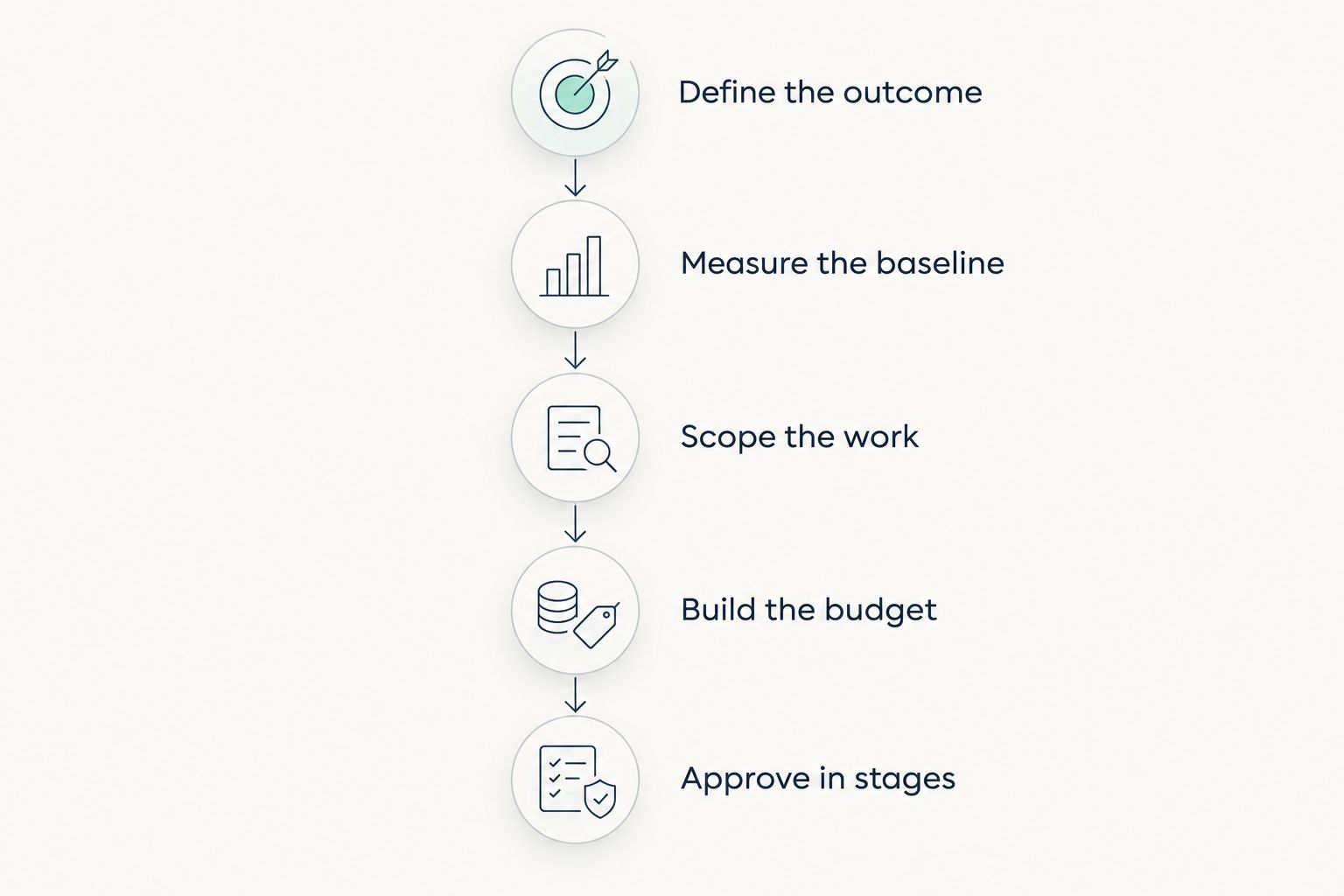
Use this sequence to prepare your 2026 approval request:
- Define the outcome. Identify the workflow and the business problem you want to address.
- Measure the baseline. Record current effort, output quality, and relevant business results.
- Scope the work. Specify deliverables, exclusions, responsibilities, and acceptance criteria.
- Build the budget. Include external commitments, internal effort, and ongoing operation.
- Approve in stages. Set a funding decision after assessment, testing, and implementation.
These steps create an approval process, not a promise of savings. The project still needs evidence that its benefits justify its full demands on the business.
Why this matters
A consulting proposal describes the consultant’s work. Your budget needs to describe the business’s entire commitment, including the people who supply information, review results, approve access, and use the finished process.
For a 2026 budget, separate money leaving the business from employee time committed to the project. Both affect your decision, but staff hours are not automatically additional cash spending. Keep those categories visible rather than adding them together without explanation.
Also distinguish a working demonstration from an accepted business process. A demonstration can show that a task is technically possible; your acceptance criteria should establish whether the result is usable, safe, and valuable in the actual workflow.
Start with the result you will fund
Write an outcome statement that a department leader can understand without a technical explanation. State the current problem, the intended improvement, and the person responsible for confirming the result.
For example, a reporting project should specify which reports are involved, who checks them, and what counts as a correct output. A customer-service project should identify the requests in scope and the situations that require a person’s judgment. These are scope examples, not promised results.
Fund a defined workflow before funding a broad transformation agenda. A narrow scope makes it possible to connect the proposed work to a business need and write a meaningful acceptance test.
Record the baseline using information your team already collects or can measure directly:
- Staff hours spent completing and checking the task.
- Errors, corrections, or repeat work associated with the process.
- The business result the workflow supports.
- The person responsible for validating any improvement.
Do not label all time saved as profit. Decide whether freed capacity will reduce spending, support additional work, improve service, or remain unused. That distinction belongs in the approval request.
Build a complete budget worksheet
Your 2026 worksheet should separate what you pay a consultant from what your business contributes and what the finished workflow needs to operate. Use the same categories for every proposal so that a narrower scope does not look like a better offer simply because it excludes work.
| Budget category | What to include | What to confirm before approval |
|---|---|---|
| Consulting work | Assessment, recommendations, implementation, or other agreed deliverables | Exactly what the engagement includes and excludes |
| Internal effort | Process-owner time, technical support, review, and approvals | Who contributes and whether they have capacity |
| Data preparation | Gathering, organizing, correcting, and approving project information | Which party performs each task |
| System connections | Access, configuration, integration, and testing | Which systems and environments are in scope |
| Operating expenses | Software usage, monitoring, maintenance, and support | What continues after the consulting work ends |
| Training and handover | Instructions, ownership transfer, and staff preparation | What your team must be able to do independently |
| Change allowance | Approved responses to identified uncertainties | Who can authorize additional work |
This is a planning checklist, not a standard package offered by every firm. Ask the consultant to map the proposal to these categories and mark anything your team must supply separately.
Keep assumptions beside the relevant line item. If an estimate depends on clean data, available system access, or prompt approvals, record that dependency rather than treating it as settled.
Choose a funding structure that matches the scope
A defined project and an open-ended investigation need different approval controls. Compare funding structures by the work they cover and the obligations they leave with your team—not by the headline commitment alone.
| Funding structure | Best for | Advantage | Limitation | Budget control |
|---|---|---|---|---|
| Defined project | Work with clear deliverables and boundaries | Makes scope and acceptance explicit | Changes need separate agreement | Require written exclusions and a change process |
| Time-based engagement | Investigation with unresolved questions | Supports work as new information emerges | Total effort depends on scope and duration | Set an authorization limit and review points |
| Ongoing support | A workflow that needs continuing attention | Establishes responsibility after launch | Creates a recurring commitment | Define included tasks, escalation, and cancellation terms |
For an uncertain first project, approve a bounded assessment or pilot before authorizing wider implementation. This recommendation concerns how you release funding; it does not require a particular contract format.
For a defined project, confirm what happens when an assumption proves wrong. For time-based work, require approval before the agreed authorization limit is exceeded. For ongoing support, distinguish routine maintenance from new development.
No structure removes the need for active ownership. Assign someone in your business to review scope, accept work, and authorize changes.
Assessment: fund the decision first
Use an assessment to resolve questions that prevent a responsible implementation decision. Specify the decision it must support, such as whether a workflow is suitable, which information is usable, or what access the project requires.
Ask for outputs you can act on: a recommended scope, identified dependencies, unresolved risks, and an implementation proposal. Do not approve an assessment whose only defined result is a presentation about general AI possibilities.
The approval condition is straightforward: the assessment must give your business enough information to proceed, revise the scope, or stop. Confirm whether implementation is a separate commitment.
Pilot: fund a test with acceptance criteria
A pilot budget should cover a bounded test and the work needed to judge it. Specify the information used, the people reviewing outputs, and the process for recording errors and exceptions.
Write acceptance criteria before work begins. Define what a usable result looks like and who has authority to accept it; do not substitute an impressive demonstration for a documented review.
Your pilot decision should address business value and operational fit. If the result works only with extensive manual correction, include that effort in the decision rather than leaving it outside the budget.
Implementation: fund the complete handover
Implementation approval should address deployment, testing, staff preparation, and ownership after launch. Confirm who maintains access, handles failed outputs, and approves later changes.
Ask for a handover that enables your team to operate the agreed workflow. Depending on the scope, that can include instructions, configuration records, escalation procedures, and a list of remaining limitations.
Do not treat launch as the end of the budget. Your 2026 approval request should identify continuing obligations and name the person responsible for them, even when another department pays those expenses.
Why AI consulting budgets vary
The budget follows the work required to deliver and operate the agreed outcome. Review these scope factors before comparing proposals:
- Breadth of the outcome. A single workflow has different boundaries from work spanning several departments.
- Data preparation. Identify what information needs gathering, correction, organization, or permission before use.
- System connections. List the systems involved and the access, configuration, and testing each connection requires.
- Review requirements. Define security checks, output validation, exception handling, and approval responsibilities.
- Internal ownership. Specify who provides information, makes decisions, tests results, and manages adoption.
- Post-launch responsibility. Separate handover from continuing maintenance, monitoring, support, and changes.
Turn each factor into a proposal question. A useful answer identifies a task, an owner, or an explicit exclusion—not merely an assurance that the work is straightforward.
Compare proposals against the same brief
Send each consulting firm the same workflow description, intended outcome, available information, and acceptance criteria. Ask each firm to distinguish required work from optional additions.
Your AI consulting project scope should be clear enough to expose differences between proposals. If one proposal includes deployment and another ends at recommendations, they represent different commitments.
Before approving a 2026 engagement, confirm:
- What you receive and what remains unfinished.
- What your staff must provide and approve.
- Which dependencies can change the scope.
- How additional work gets authorized.
- What happens if the pilot fails acceptance.
- Who owns operation after handover.
Avanti AI Partners is a fit for businesses seeking AI consulting and implementation focused on operational and financial outcomes. Its stated focus does not replace project-specific due diligence: require written scope, acceptance criteria, and ownership commitments before approval.
Discuss your business outcome
Describe the workflow, intended result, and implementation needs for your AI consulting project.
Should I approve the whole project at once?
Approve the whole project only when the scope, dependencies, and acceptance conditions are clear. When material questions remain unresolved, authorize the work needed to answer them before committing to implementation.
A staged decision is useful only if stopping is a genuine option. Specify what evidence would cause you to pause, reduce scope, or end the work.
Should my budget include employee time?
Include employee time as a separate internal commitment. Identify the people needed for process explanation, access approval, testing, and adoption rather than assuming the consultant can work without them.
Separate existing staff capacity from additional spending. This keeps the budget honest without counting every assigned hour as a new cash expense.
What should happen if the pilot misses its goal?
Pause further funding and review the gap against the original acceptance criteria. Determine whether the issue requires a defined correction, a smaller scope, or stopping the project.
Approve any follow-up work explicitly. An unsuccessful test should inform a decision, not automatically become an extended engagement.
FAQ
How do I set a budget for AI consulting in 2026?
Set your 2026 AI consulting budget around a defined business outcome, a written scope, and the full commitment required to operate the result. Include consultant work, internal effort, preparation, and continuing obligations, then approve funding at clear decision points.
Should I use a fixed percentage of revenue for AI consulting?
Build the budget from the project scope rather than using a revenue percentage as the project estimate. A percentage sets a spending boundary; it does not establish what work is needed or whether that work is justified.
What should an AI consulting budget include besides the consultant?
Include staff effort, data preparation, system connections, software usage, testing, training, and ongoing operation where the scope requires them. Keep internal capacity separate from additional cash spending.
Is a pilot better than funding a full implementation?
A bounded pilot is the better approval step when important questions about performance or operational fit remain unresolved. Define acceptance criteria and the decision to continue before authorizing the test.
How do I compare proposals from AI consulting firms?
Compare proposals against the same outcome, scope, acceptance criteria, and responsibilities. Separate optional work and exclusions so you can identify differences in what each engagement actually delivers.
Does Avanti AI Partners provide consulting and implementation?
Avanti AI Partners provides AI consulting and implementation services focused on business outcomes. Request a project-specific scope to establish deliverables, internal responsibilities, and continuing obligations.
Should ongoing support be part of my initial budget?
Include ongoing support in the initial decision whenever the proposed workflow requires it. Confirm which tasks continue after launch, who owns them, and how changes are authorized.
One last thing
Write the stop condition before approving the start. A budget becomes a useful management tool when it states what evidence justifies another commitment—and what evidence ends it.
For your 2026 planning, place that condition beside the outcome, scope, and acceptance criteria. The ability to stop an unsuitable project is part of responsible budgeting, not a failure of ambition.