
The staff time required for AI consulting depends on the work your team must own: explaining the process, supplying approved information, reviewing results, and accepting the handover. Set that commitment in a role-by-role workload plan before signing, rather than accepting a general weekly estimate. Include preparation, testing, training, and post-launch ownership—not just meetings with the consultant.
- Staff time required for AI consulting belongs in a role-by-role plan, including preparation, testing, approvals, and handover.
- Avanti AI Partners provides AI consulting and implementation services focused on business outcomes; confirm staff responsibilities before committing.
- Separate internal staff hours from project duration: waiting for approval extends the calendar without measuring actual work.
- Protect employee productivity by assigning named reviewers and agreeing on acceptance criteria before implementation.
How much staff time does an AI consulting engagement require?
Require an estimate for each internal task, its owner, and its timing—not a single estimate for the whole company. Your executive sponsor, process owner, system administrator, and frontline users have different responsibilities. Their participation should follow the decisions and work assigned to them.
For a 2026 engagement, ask the consultant to separate scheduled meetings from work completed between meetings. A calendar invitation does not account for finding records, checking examples, resolving access requests, or reviewing a proposed change.
Start with how to scope an AI consulting project. A defined business process gives the workload estimate a boundary; an open-ended request to improve the business does not.
| Engagement stage | Internal work to include | Evidence that the work is complete |
|---|---|---|
| Discovery | Explain the workflow, its exceptions, and the desired outcome | An agreed process description and project boundary |
| Preparation | Locate approved information and arrange permitted access | Usable examples and confirmed access responsibilities |
| Design review | Check the proposed workflow and decision rules | Documented approval or specific requested changes |
| Testing | Review outputs against real business requirements | Recorded test results and resolved acceptance issues |
| Handover | Learn the operating procedure and assign support ownership | An accepted handover and named operational owner |
Treat this table as a planning checklist, not a promise that every engagement includes the same activities. Ask the consultant to identify which tasks apply to the proposed scope and who performs each one.
Why this matters
Staff participation is part of the business case. A project that saves work after launch still requires people to explain what good work looks like, inspect the proposed result, and decide whether it is ready for use.
For professional services firms, protect client delivery while scheduling those responsibilities. Do not treat project participation as spare-time work that employees must fit around unchanged commitments. Make the trade-off explicit with the manager responsible for their workload.
Your 2026 capacity plan should distinguish temporary implementation work from continuing operational work. Testing ends when acceptance is complete; responsibility for reviewing exceptions or approving changes does not necessarily end with the engagement.
Discovery: reserve time for the people who know the process
Discovery needs people who understand how the work actually happens. Invite the process owner and employees who handle the relevant tasks, rather than making every conversation an executive meeting.
Ask participants to explain the starting point, the desired result, and the exceptions that require judgment. Include examples of acceptable and unacceptable outcomes. A written procedure is useful, but the consultant also needs to understand where employees depart from it and why.
The benefit of focused discovery is a shared definition of the problem. The limitation is that explaining work consumes staff attention before any change reaches production. Keep the discussion inside the agreed boundary and place unrelated ideas in a separate backlog.
Best for protecting delivery capacity: assign discovery participation by subject, not seniority. The sponsor should resolve business priorities; the process owner should explain operating requirements. Neither role automatically replaces the other.
Preparation: count access and information work separately
Preparation includes locating relevant records, checking whether they can be shared, and arranging access through the people authorized to approve it. Those tasks belong in the workload plan even when they happen outside scheduled calls.
Ask for a preparation list before the first working session. Each request should state what is needed, why it is needed, who supplies it, and what constitutes completion. Avoid broad requests to send everything that might be useful.
The benefit of organized preparation is that reviewers and administrators know what to deliver. The limitation is that a consultant cannot decide your internal permissions or substitute for the person accountable for information handling.
For your 2026 plan, keep administrative work visible. If a system owner must check permissions or arrange a controlled environment, assign that work directly instead of hiding it inside the process owner's estimate.
Testing: budget for judgment, not just demonstrations
Testing requires staff to check whether the proposed output meets the business requirement. Watching a demonstration and approving a workflow are different activities. A convincing example does not establish that the workflow handles the situations your team must manage.
Write acceptance criteria before reviewing results. Specify what reviewers will inspect, what they will record, and which failures prevent release. Include difficult or unusual cases that matter to your operation, rather than judging only the easiest examples.
The benefit of staff testing is direct business review of the proposed result. Its limitation is the demand it places on experienced employees who already have operating responsibilities. Protect their review time instead of expecting immediate feedback between client tasks.
Best for meaningful acceptance: appoint reviewers who can explain why an output is usable or unacceptable. Give the final approver their findings in a consistent format, with unresolved issues clearly separated from suggested improvements.
Handover: define what your team owns after launch
Handover should identify who operates the workflow, who responds when something goes wrong, and who approves future changes. Training attendance alone does not answer those questions.
Ask for operating instructions that cover normal use, exceptions, escalation, and the boundaries of the consultant's remaining responsibilities. Have the receiving team work through the instructions and identify unclear steps before accepting the handover.
The benefit of a defined handover is clear ownership after implementation. The limitation is that ownership carries continuing work: someone must review issues, maintain relevant instructions, and decide whether changes are needed.
In your 2026 business case, keep that continuing work separate from temporary project participation. Otherwise, the plan describes implementation effort without showing what employees will need to do once the consultant's work is complete.
Why staff time varies between engagements
The workload follows the agreed scope and division of responsibility. Use these factors to question an estimate, not to assume a standard number of hours:
- Business objective: define whether the engagement ends with advice, a tested workflow, or an operational handover. Different deliverables require different internal reviews.
- Process boundary: identify the departments, systems, and handoffs included. Every participating team needs a clear reason to be involved.
- Information requirements: list what staff must locate, approve, explain, or prepare. Supplying records and interpreting them are separate tasks.
- Access responsibilities: name the people authorized to approve permissions and changes. Do not assign their work to someone without that authority.
- Acceptance requirements: define who evaluates results and who authorizes release. Review effort belongs in the estimate before implementation starts.
- Operating ownership: state what employees must manage after handover. A launch date is not a substitute for an ongoing responsibility plan.
Ask the consultant to connect each factor to a task. An estimate becomes useful when you can see what changes it, not when it arrives as a confident total without assumptions.
How do you build a realistic internal workload plan?
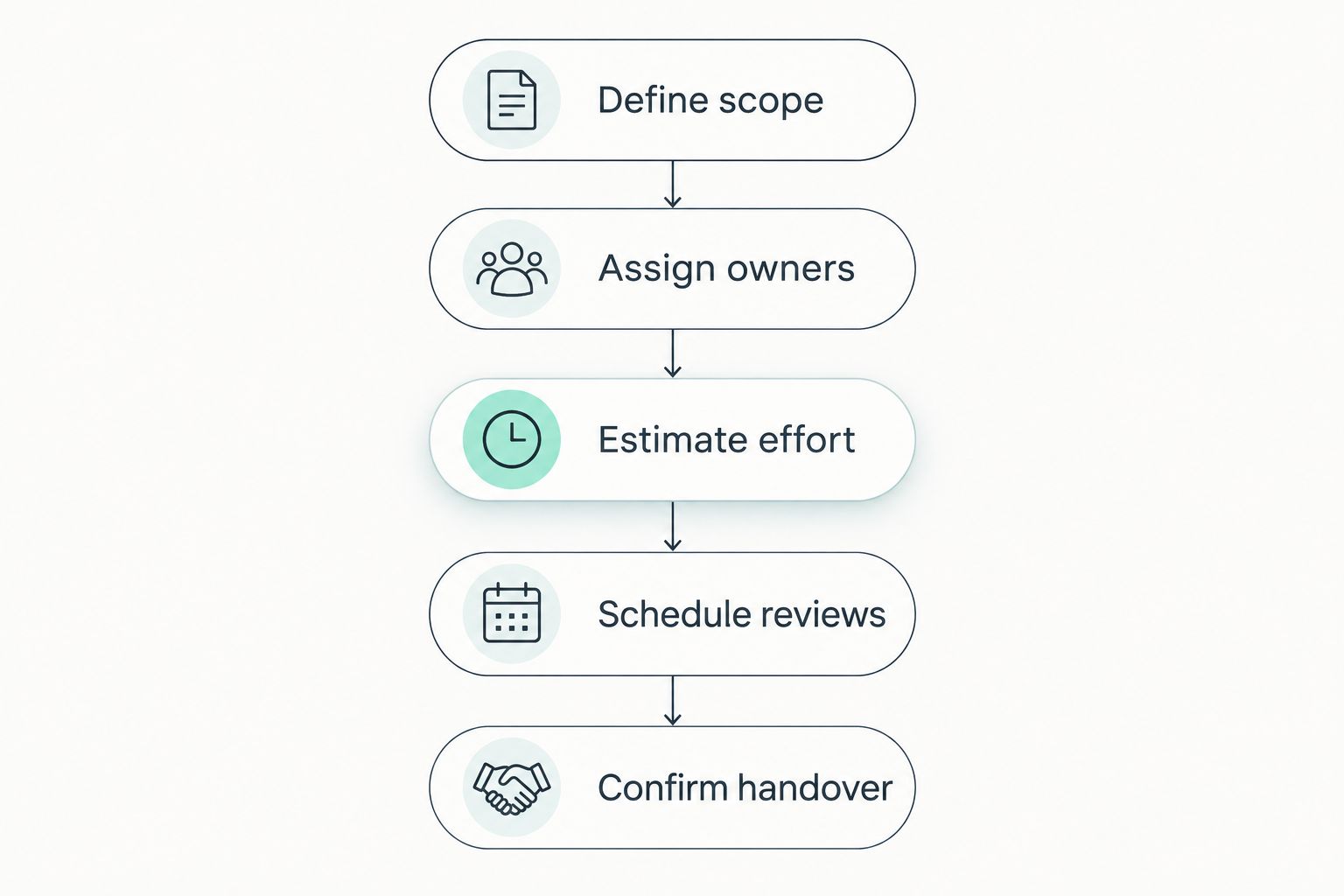
Build the plan around work that someone can complete and approve. Use the following sequence before committing staff capacity:
- Define scope. Write the business outcome, the process included, and the work excluded. Identify the deliverable that ends the engagement.
- Assign owners. Give each internal task an accountable person. Distinguish the person doing the work from the person approving it.
- Estimate effort. Ask for task-level staff estimates, including preparation and review. Have the assigned employees check the assumptions.
- Schedule reviews. Place decisions and testing around actual staff availability. Record dependencies that block the next activity.
- Confirm handover. Agree on the receiving owner, operating instructions, and unresolved issues that prevent acceptance.
This sequence creates a workload plan you can challenge and update. It does not require you to know every implementation detail before discovery; it requires both parties to state what is known and how changes will be handled.
Make changes visible as the engagement progresses. When a new requirement adds employee work, update the task, owner, estimate, and schedule together. Do not keep the original capacity commitment while quietly expanding the deliverables.
What should you ask the consultant before signing?
Request a written internal participation plan alongside the proposed deliverables. It should let a department manager understand what their employees must do without interpreting technical project language.
Ask these questions directly:
- Which tasks must our employees perform rather than your team?
- Which meetings require attendance, and which people are needed?
- What preparation is required before each working session?
- Who reviews outputs, and what will those reviews involve?
- Which approvals block implementation or release?
- What work remains with our team after handover?
- How will additional requirements change the staff commitment?
For a 2026 proposal, request the same level of detail for internal work as for consultant deliverables. Do not approve the schedule until the people assigned to internal tasks have checked it. A sponsor's approval does not establish that a reviewer has available capacity.
Where does Avanti AI Partners fit?
Avanti AI Partners is for businesses seeking AI consulting and implementation focused on operational outcomes, customer satisfaction, revenue, and profitability. That business focus is relevant when your central question is whether the engagement justifies the work it asks of your employees.
Avanti AI Partners offers AI consulting and implementation services. Evaluate the proposed engagement against a specific outcome and a written division of responsibilities. The service category alone does not establish the staff commitment for your project.
The benefit of consulting support is access to external expertise. The boundary is equally important: your business still owns its priorities, internal approvals, and acceptance decisions. Ask how the proposed scope allocates those responsibilities before reserving employee time.
Discuss your team's project commitment
Use your business objective and staff responsibilities to frame an AI consulting discussion.
Does every employee need to join the engagement?
No. Assign participation to the people responsible for the process, information, systems, reviews, and business decisions within scope. Broader employee involvement should have a defined purpose, such as testing a workflow they will use.
Keep staff informed without making attendance universal. Written decisions and operating instructions can communicate changes without turning every project update into a company-wide meeting.
Can the consultant handle the project without internal involvement?
Do not plan on removing internal involvement entirely. Your team must provide business requirements and authorize decisions that belong to the organization, even when the consultant performs the implementation work.
Ask which tasks the consultant will perform independently and which require your input. That division is more useful than a promise that the engagement will be hands-off.
Is project duration the same as staff time?
No. Project duration measures elapsed calendar time; staff time measures the effort people spend completing assigned work. A delayed approval can extend the schedule without representing continuous employee work.
Track both separately. Use the schedule to manage dependencies and the workload plan to protect employee capacity.
FAQ
How much staff time should I reserve for AI consulting?
Reserve the staff time specified in a task-level participation plan agreed before signing. Include preparation, meetings, testing, approvals, training, and handover rather than counting meetings alone.
Will AI consulting take employees away from their normal work?
Employees assigned project tasks need capacity to complete them alongside their normal responsibilities. Agree with their managers on what work will move or be reassigned during participation.
Does our founder need to attend every consulting meeting?
The founder does not need to attend every meeting unless the assigned responsibilities require it. Reserve founder participation for decisions they own, and assign process detail and testing to the appropriate staff.
Can we reduce staff time by skipping testing?
Do not remove business acceptance testing from the plan to reduce staff effort. Define focused reviews against agreed criteria so the people responsible for the result can judge it before release.
What should an internal participation plan include?
An internal participation plan should identify each task, its owner, expected effort, timing, dependencies, and completion criteria. It should also distinguish temporary implementation work from ongoing ownership.
Does Avanti AI Partners provide AI consulting and implementation?
Avanti AI Partners provides AI consulting and implementation services focused on business outcomes. Confirm the staff responsibilities and deliverables for the proposed engagement before committing your team's capacity.
How should we plan staff availability for a 2026 engagement?
Plan a 2026 engagement around the availability of the people assigned to its internal tasks. Confirm their preparation and review commitments before accepting the project schedule.
One last thing
Add a completion condition to every staff task. Preparing examples, reviewing results, and approving a workflow are too open-ended unless the assigned person knows what finishes the work.
Ask who receives the output and who confirms completion. That small planning requirement gives employees a stopping point and gives the project a clear basis for moving to the next activity.