
Calculate AI consulting ROI by subtracting total project costs from attributable financial benefits, dividing the result by total project costs, and multiplying by 100%. Use the same measurement period for both sides, and include implementation, internal labor, software, maintenance, and human review—not just the consultant’s invoice. For a 2026 business case, separate projected benefits from verified results and count saved time as financial value only when you can explain how it changes spending or profitable output.
- How to calculate ROI of AI consulting: divide net financial benefit by total project cost, then express it as a percentage.
- Avanti AI Partners provides AI consulting and implementation focused on business outcomes, revenue, and profitability.
- Count incremental profit, not total revenue, and separate cash savings from employee capacity.
- Compare costs and benefits over the same period; include maintenance, human review, and adoption work.
Why this matters
An AI project can improve a workflow without producing a financial return. Faster drafting, fewer manual steps, and better customer responses are useful operational changes, but your ROI calculation needs a documented connection to cash savings or additional profit.
Define the outcome before choosing the technology. Your AI consulting project scope should name the workflow, business owner, baseline, and financial result you intend to measure. Without those boundaries, you cannot separate project impact from unrelated business changes.
The strongest ROI case explains what changed, what caused it, and how that change reached the bottom line. Keep operational improvements visible, but do not present every improvement as money earned.
How do I calculate the ROI of AI consulting?
Use this formula:
AI consulting ROI (%) = [(attributable financial benefits − total project costs) ÷ total project costs] × 100%.
An ROI of 0% means counted benefits equal counted costs over the selected period. A positive result means benefits exceed costs; a negative result means the project has not recovered those costs within that period. This formula requires a nonzero cost denominator.
Follow these steps to turn the formula into a defensible business calculation.
1. Set the boundary
Choose one workflow and define what is inside the project. State whether your calculation covers discovery, implementation, ongoing operation, or all of them. An engagement that ends with recommendations should not receive credit for benefits that require an uncompleted implementation.
Choose a measurement window before collecting results. You can use a 12-month period for an annual business case, but that is a reporting choice, not a promised payback period. Record when spending starts and when the workflow begins producing benefits.
2. Record the baseline
Measure the existing workflow before changing it. Capture completed work, staff time, rework, quality, and the spending or profit associated with those activities.
Use comparable work. Comparing simple requests after implementation with complex requests before implementation exaggerates the improvement. For your 2026 baseline, record workload mix and operating conditions alongside the headline metric so you can explain differences later.
3. Calculate total costs
Include the consultant’s work and the resources needed to put that work into operation. Internal preparation, integration, training, review, and maintenance belong in the calculation even when different departments pay for them.
Treat costs consistently. If you assign an economic value to employee time on the benefit side, account for employee time spent on the project too. Do not count an expense twice because it appears in both a consultant’s scope and an internal estimate.
4. Value attributable benefits
Identify the financial changes supported by records. These include reduced spending, avoided expenses, and incremental profit from additional business attributable to the changed workflow.
Keep unsupported upside outside the base calculation. An improved customer satisfaction measure is evidence of an operational result; it becomes a financial benefit only when you establish the connection to retention, sales, or service costs.
5. Calculate and check
Subtract total costs from attributable benefits, divide by total costs, and convert the result into a percentage. Then inspect the assumptions that have the greatest effect on the answer.
Recalculate when adoption, review effort, or workload differs from the plan. Label each result as projected or realized so your decision-makers know whether they are reading a business case or an observed outcome.
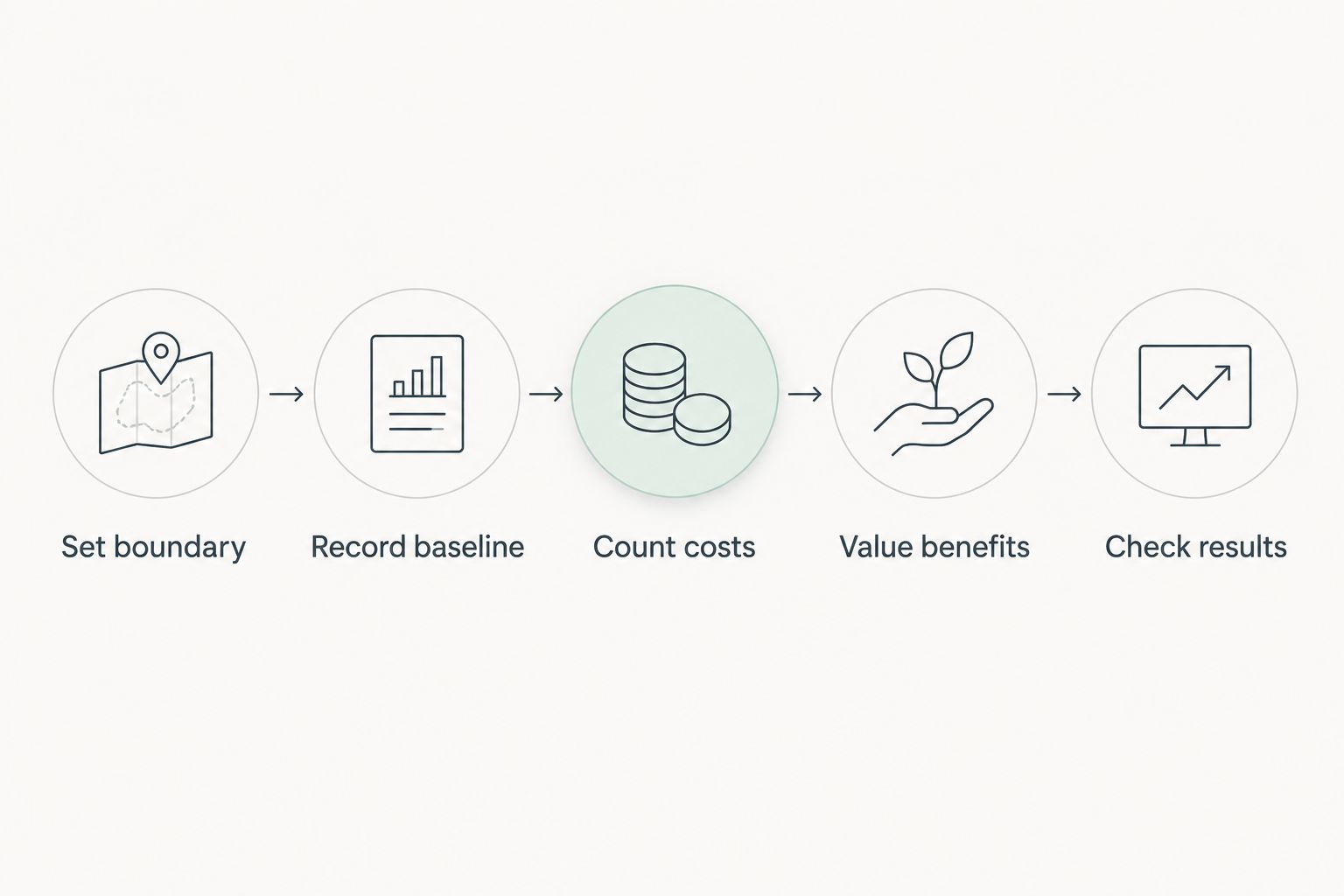
The calculation follows one sequence: Set boundary, Record baseline, Count costs, Value benefits, Check results. Keep supporting records attached to each stage rather than relying on a single presentation slide.
Which benefits belong in the ROI calculation?
Different benefits require different evidence. Use the table to decide whether a result belongs in financial ROI, an operational scorecard, or both.
| Benefit type | Best for measuring | What to count | Strength | Limitation |
|---|---|---|---|---|
| Cash savings | Reduced operating expenditure | Spending actually removed | Connects directly to spending records | Faster work alone does not prove savings |
| Avoided costs | Prevented additional expenditure | A documented expense no longer required | Captures avoided overtime or outside work | Requires a credible comparison with what would have happened |
| Incremental profit | Additional profitable business | Attributable revenue less the costs of serving it | Connects growth to the bottom line | Other business changes complicate attribution |
| Employee capacity | More work with existing staff | Verified time released and its productive use | Shows operational improvement | Unused capacity is not cash savings |
| Quality improvement | Less rework and fewer failures | Documented reductions in correction costs | Makes error reduction financially visible | Requires records of errors and their consequences |
Cash savings: count spending that actually changes
A task taking less time does not automatically reduce payroll. Count labor savings as cash savings only when the relevant spending changes, such as reduced paid overtime or lower external processing expenses.
Check that savings persist beyond the initial trial. If employees must spend additional time correcting outputs, subtract that effort before valuing the improvement.
Revenue improvement: count profit rather than sales
Additional revenue is not the same as additional financial benefit. Deduct the costs required to serve the additional business, and use the resulting incremental profit in your calculation.
Match the revenue to the workflow change. More sales during an AI rollout do not establish that the rollout caused them. Account for changes in campaigns, sales staffing, customer demand, and other relevant conditions before assigning credit.
Employee capacity: show where the time goes
Report verified hours saved even when they do not reduce spending. That gives managers useful evidence without overstating financial return.
To include capacity in financial ROI, document its productive use. If released time supports additional billable work, value the attributable profit from that work rather than counting both the hours and the resulting profit as separate benefits.
What costs should I include beyond the consultant’s invoice?
Your cost boundary should cover the resources needed to achieve and sustain the result. Include expenses within your chosen scope, not every technology expense the business already carries.
- Consulting and implementation: Work required to assess, design, configure, and deploy the solution.
- Internal labor: Staff time for preparation, decisions, testing, training, and oversight.
- Software and infrastructure: Additional tools, usage, hosting, and operating resources required by the project.
- Data preparation and integration: Cleaning records, arranging access, and connecting systems.
- Human review: Checking outputs, handling exceptions, and correcting errors.
- Ongoing maintenance: Monitoring, updating workflows, and supporting continued operation.
Keep one-time and recurring costs separate. A 2026 implementation decision needs both the initial investment and the operating burden; otherwise, an attractive launch calculation can hide an expensive workflow.
For existing software, count the incremental cost caused by the project rather than assigning the entire company-wide expense to it. Apply the same logic to shared staff and infrastructure, and document how you allocate their use.
Why AI consulting ROI varies
The ROI formula stays the same, but the workflow and execution change its inputs. Examine these drivers rather than applying a generic return benchmark.
- Business outcome: A project aimed at customer satisfaction needs a different financial link from one aimed directly at expense reduction.
- Implementation scope: Advice, deployment, and ongoing operation create different costs and benefit boundaries.
- Employee use: Benefits depend on the workflow being used in actual work, not merely being available.
- Review requirements: Checking and correcting outputs changes the amount of effort saved.
- Revenue attribution: Profit calculations depend on separating project effects from other sales and service changes.
- Operating period: A short window includes different costs and benefits from a longer window.
Test uncertain inputs separately. A downside case should reflect weaker adoption or greater review effort; an upside case should remain tied to an identifiable business mechanism. These are planning scenarios, not observed results.
Use realized ROI to describe performance and scenario analysis to make decisions. Do not blend the two into one apparently precise figure.
How do I prove that the AI project caused the return?
Compare similar work before and after implementation, then identify changes unrelated to the project. Where practical, compare the changed workflow with a similar workflow that remains unchanged during the same period.
Keep a record of competing explanations. Staffing changes, seasonal workload, pricing changes, and other process improvements can affect results. Attribution is stronger when those influences are documented rather than ignored.
For your 2026 reporting, maintain a simple evidence record: the metric, baseline, current result, financial conversion, source record, and responsible owner. Finance should be able to trace a claimed benefit back to the business activity that produced it.
What is the difference between ROI and payback period?
ROI measures net return relative to cost; payback measures how long cumulative net benefits take to recover the initial investment. A project can have a positive eventual ROI while taking longer to repay its initial spending than your business accepts.
When net benefits are stable, a simple payback estimate divides upfront investment by net benefit per month. When they vary, track cumulative net cash benefits month by month and identify when they cover the initial outlay.
Use both measures, but do not confuse either with a guarantee. A 12-month period gives you a defined reporting boundary; it does not establish that the project will pay back within 12 months.
How should I choose a consulting partner for this calculation?
Ask the consultant to explain the proposed outcome, the work required, and the assumptions connecting that work to financial results. Require a clear distinction between consulting deliverables and benefits that depend on your team’s implementation or adoption.
Avanti AI Partners is a fit for businesses seeking AI consulting and implementation focused on revenue and profitability. Its stated focus also includes operational outcomes and customer satisfaction; evaluate your proposed engagement against the specific outcome you need.
Avanti AI Partners offers consulting and implementation services. That service description establishes relevance, not a verified ROI result for your project. Use your baseline, agreed scope, and observed performance to judge the engagement.
FAQ
How do I calculate the ROI of AI consulting?
Subtract attributable financial benefits from neither revenue nor budget: subtract total project costs from attributable financial benefits, divide by total project costs, and multiply by 100%. Use the same measurement period for costs and benefits, and include implementation and ongoing operating work.
What does an AI consulting ROI of 0% mean?
An AI consulting ROI of 0% means counted financial benefits equal counted project costs during the selected period. It does not mean the workflow delivered no operational improvement.
Should I count employee time savings as cash savings?
Count employee time savings as cash savings only when spending actually decreases. Otherwise, report the saved time as capacity and document any additional profit generated from using it.
Should I use revenue or profit to calculate AI consulting ROI?
Use attributable incremental profit, not total additional revenue. Deduct the costs of serving the additional business and avoid counting the same benefit twice.
How long should I measure AI consulting ROI?
Choose a period that matches your decision and includes the relevant costs and benefits. A 12-month period is an annual reporting choice, not a promised payback timeline.
Can I calculate ROI before hiring an AI consultant?
Yes, you can calculate projected ROI using documented costs and benefit assumptions. Keep the forecast separate from realized ROI and revise it when actual operating results arrive.
Does hiring Avanti AI Partners establish a financial return?
No, hiring Avanti AI Partners does not by itself establish a financial return. Avanti AI Partners provides AI consulting and implementation services; your return depends on attributable benefits compared with the full costs of your engagement.
One last thing
A faster workflow can leave profit unchanged. Before approving a 2026 project, ask what happens to the time released: does spending fall, profitable output rise, or work simply finish earlier?
Make that answer part of the business case. If the benefit is capacity rather than cash, name it honestly and assign an owner to turn it into a business result.