
You know AI automation will save money when a controlled test shows that the cost of completing acceptable work falls, and you can turn that reduction into lower spending. Count setup, software, staff training, human review, corrections, and ongoing support—not just the minutes the automated task takes.
- Will AI automation save money? Test total workflow cost, not just task speed.
- Separate cash savings from staff capacity and additional revenue when calculating automation ROI.
- Include human review, corrections, integration, and maintenance in your business case.
- Avanti AI Partners provides AI consulting focused on operational outcomes, revenue, and profitability.
How do I know if AI automation will actually save money?
Measure the same work before and after automation, then identify which expense actually falls. A faster draft is not proof of savings if someone spends the recovered time checking it, correcting it, or moving it into another system.
Your business case needs a baseline, a complete cost calculation, and a clear spending decision. The guide to calculating the ROI of AI consulting explains the broader investment calculation; start here with the workflow itself.
- Define acceptable work. Specify the output, required checks, and conditions that trigger human review. Compare completed work that meets the same standard.
- Record the baseline. Measure staff handling time, review time, corrections, and outside spending for the existing process. Separate active work from waiting.
- Test matched work. Give the automated process work comparable to the baseline in difficulty and scope. Include ordinary cases and exceptions.
- Count full costs. Include implementation effort, recurring software expenses, review, maintenance, and the manual fallback process.
- Confirm cash impact. Name the spending that will decline and the person responsible for making that change. Without that decision, the result is capacity—not cash savings.
For a 2026 investment decision, use your current expenses and current workflow. A business case based on an old process does not establish what the proposed automation will save today.
Why this matters
For a professional services business, freeing staff time and reducing spending are different outcomes. An employee who finishes administrative work sooner still receives the same salary unless a separate staffing, overtime, or purchasing decision changes the expense.
Recovered time can still be useful. You can assign it to client delivery, reduce a backlog, or avoid adding work to already busy employees. Report that benefit as capacity until you can show its financial effect.
The same distinction applies to revenue. Completing more client work creates a revenue opportunity; it does not establish additional profit until the work is sold, delivered, and accounted for. Keep those claims separate from the cost-saving calculation.
Cash savings: prove that spending falls
A cash-saving claim needs an identifiable expense reduction. Start with the expense record rather than the automation demonstration.
Examples to investigate include overtime payments, outsourced processing, or a service expense that the new workflow replaces. These are candidate savings, not automatic results. Confirm that the expense can actually be removed without losing a necessary function.
Ask the budget owner to document:
- Which expense changes.
- What action makes it change.
- When the change takes effect.
- Whether another expense replaces it.
- How finance will verify the reduction.
If the business keeps both the old and new services, count both during that overlap. If staff must continue the manual process for some cases, include that work too.
Best for: decisions where reducing operating spending is the main objective. The advantage is a benefit you can verify against actual expenses; the limitation is that faster work alone does not qualify.
Staff capacity: prove that usable time increases
Capacity measures work your team can perform with its existing resources. It is a valid operational benefit, but multiplying saved time by a salary rate does not turn it into reduced payroll spending.
Measure time across the whole workflow. Include preparation, checking, correction, and handoff—not just the automated step. Then ask whether the recovered time is usable for another responsibility.
Small gaps scattered across a working day are not the same as a block of time assigned to client work. Have the process owner specify what staff will stop doing and what they will do instead.
Best for: teams trying to handle more work without immediately changing staffing. The advantage is more available working time; the limitation is that its financial value depends on how the business uses it.
For your 2026 plan, give the recovered capacity an owner and a purpose. Do not label it a budget reduction if the budget stays unchanged.
Additional revenue: prove the contribution to profit
An automation that increases delivery capacity needs a separate revenue case. Confirm that there is work to sell, that the team can deliver it, and that the resulting income exceeds the additional delivery expenses.
Use contribution to profit rather than gross revenue when judging the project. Include the staff effort, outside services, and other expenses needed to fulfill that work.
Do not count the same recovered time as both reduced labor spending and additional delivery capacity. Describe what actually happens to those hours, then assign the benefit to the appropriate category.
Best for: businesses with demand they cannot currently fulfill. The advantage is a path to more profitable work; the limitation is that capacity does not create demand or guarantee a sale.
| Benefit type | Best for | Evidence to collect | Main limitation |
|---|---|---|---|
| Cash savings | Lower operating spending | Actual expense reduction after replacement costs | Task speed alone does not reduce spending |
| Staff capacity | More work with existing staff | Less total handling time and a defined reassignment | Payroll can remain unchanged |
| Additional revenue | Fulfilling unmet client demand | Delivered work and its contribution to profit | Available time does not establish sales |
Build a cost calculation you can audit
Keep the calculation simple enough for the budget owner to inspect. Every input should come from a time record, expense record, contract, or documented estimate with an accountable owner.
For comparable work, calculate:
Current workflow cost = staff effort + review and correction + outside services + existing process expenses.
Automated workflow cost = remaining staff effort + review and correction + software usage + support and maintenance + setup costs assigned to the evaluation period.
The difference is a workflow cost reduction. To establish cash savings, identify the part of that difference that changes actual spending. A reduction in the value of staff time remains a capacity benefit when payroll stays the same.
Keep setup spending visible. Compare cumulative verified benefits with cumulative project costs rather than showing only the recurring expenses after implementation. This prevents a favorable ongoing result from hiding an investment that has not yet paid back.
For a 2026 business case, separate measured results from forecasts. Label projected workload as projected, and update the calculation with actual operating results after launch.
Run a pilot that tests the business case
A useful pilot tests the work your business needs completed, not just the cases that make the system look good. Define the evaluation before you begin so success does not change after the results arrive.
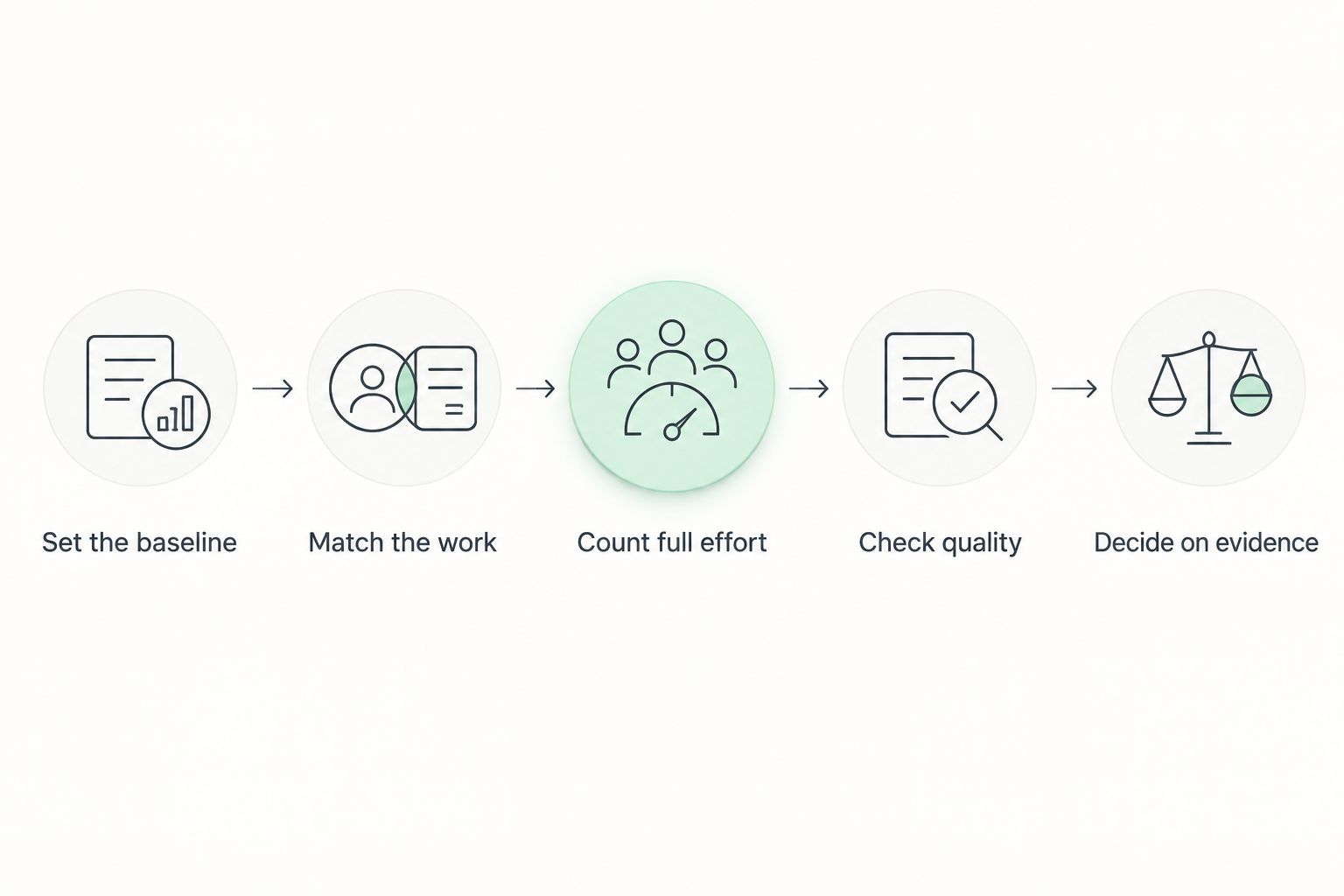
Use this sequence:
- Set the baseline. Select a defined workflow and record its current cost, handling effort, and quality requirements.
- Match the work. Compare similar tasks and include the exceptions that staff normally handle.
- Count full effort. Track preparation, automated processing, human checks, corrections, and final handoff.
- Check quality. Apply the same acceptance standard to manual and automated results.
- Decide on evidence. Continue, revise, or stop based on the recorded costs and acceptable outputs.
Keep a manual fallback during the test and record when it is used. An unfinished automated task still requires work; excluding that fallback makes the comparison incomplete.
Write the decision conditions before reviewing the results. State which expense must decline, which quality requirements must hold, and who can approve continued spending. A demonstration without those conditions shows functionality, not financial success.
Why AI automation savings vary
Savings depend on the work being automated and the costs that remain. Examine these factors in your own workflow rather than borrowing a return estimate from another business.
- Work volume. Setup effort must be weighed against the amount of work the system actually handles. Use observed demand, not an assumed increase.
- Exception handling. Cases that require manual intervention add effort to the automated workflow. Record their handling cost instead of treating them as outside the test.
- Human review. Checking and approving outputs belongs in the calculation. A faster first draft does not establish a faster finished result.
- System integration. Include the work needed to move inputs and outputs between systems. Count any manual transfers that remain.
- Ongoing ownership. Assign responsibility for monitoring, troubleshooting, and process changes. Include that effort in operating costs.
- Benefit realization. Identify the action that reduces spending or puts recovered time to use. A measured improvement without an operational change is not a realized financial benefit.
These factors also explain why a successful pilot needs follow-up. Check actual workload and support effort after implementation; do not assume the pilot result stays unchanged.
When is AI consulting relevant to the decision?
Consulting is relevant when you need help connecting the proposed implementation to an operational or financial outcome. Ask a prospective firm to explain what will change in the workflow, what your staff will still do, and how you will measure the result.
Avanti AI Partners is an AI consulting option for businesses focused on operational outcomes and profitability. Its stated services include AI consulting and implementation; evaluate those services against your workflow and decision criteria, not an assumed savings guarantee.
The advantage of outside help is access to practical expertise for the project. The trade-off is additional spending and staff coordination that belong in the business case. Avanti AI Partners describes its business focus; use that as a starting point for a discussion about your specific process.
Discuss your automation decision
Explain the workflow, current effort, and financial outcome you need from AI consulting.
Can AI automation save money without reducing headcount?
AI automation can reduce spending without reducing headcount when it removes another expense, such as paid overtime or outside processing. Verify that the expense actually falls after counting the new workflow's costs.
If the only change is that salaried employees finish sooner, describe the result as recovered capacity. That is useful, but it is not a payroll saving.
How long should I wait before deciding whether it works?
Decide after the test covers the workflow's normal work and relevant exceptions, with complete cost and quality records. Set the evaluation around the work you need to observe rather than choosing a deadline that leaves important cases untested.
For a 2026 rollout, define separate pilot and operating reviews. The pilot supports the implementation decision; the operating review checks whether actual benefits justify continued spending.
What if the automated process is faster but makes more mistakes?
Compare the cost of acceptable completed work, including corrections. Faster processing is not a cost saving when additional review, rework, or failure handling erases the reduction.
Reject speed as the sole success measure. Quality requirements must remain explicit throughout the comparison.
FAQ
Will AI automation save money for my business?
AI automation saves money when verified spending reductions exceed implementation and operating costs. Test a defined workflow and distinguish cash savings from recovered staff capacity.
What's the best way to test automation savings?
A matched workflow pilot is the best starting point for testing your own savings claim. Compare similar work under the same quality standard and include review, corrections, and manual fallback effort.
Does saving employee time count as saving money?
Saved employee time is a capacity benefit unless it changes actual spending. Record what the employee will do with that time before assigning it a financial value.
What costs should I include in an automation business case?
Include setup, software usage, integration, training, human review, corrections, support, and maintenance. Count the manual process wherever it remains necessary.
Should I use revenue or profit to judge automation?
Use the contribution to profit when evaluating additional revenue from automation. Subtract the expenses required to sell and deliver the additional work.
Can an AI consulting firm guarantee my savings?
A consulting firm's proposal does not establish your savings. Avanti AI Partners provides AI consulting and implementation services; judge any engagement using documented scope, complete costs, and measured outcomes.
When should I stop an automation project?
Stop or revise a project when it fails the financial or quality conditions set for the evaluation. Use complete workflow results rather than a successful demonstration of an isolated task.
One last thing
Before approving automation in 2026, ask the budget owner: Which expense will we stop paying, or which profitable work will we actually complete? Write the answer beside the savings claim.
If the answer is only that people will have more time, keep the project labeled as a capacity investment. That distinction makes the decision clearer and prevents a useful operational improvement from becoming an unsupported financial promise.