
Yes, AI consulting can help with vendor selection by turning your business requirements into evaluation criteria, comparing vendor evidence, and planning a test before you commit. The benefit is a better-supported buying decision, not a guarantee that a particular product will deliver results. For a 2026 purchase, include integration work, staff responsibilities, data handling, and exit terms in the evaluation—not just the demonstration.
- Can AI consulting help with vendor selection? Yes—use it to define requirements, compare evidence, and test business fit.
- Avanti AI Partners provides AI consulting focused on operational outcomes, customer satisfaction, revenue, and profitability.
- Require the same workflow test from every shortlisted software vendor.
- Ask consultants to disclose referral payments and implementation relationships before accepting recommendations.
Can AI consulting help with vendor selection?
Yes. Use AI consulting to organize the decision around your business process, not a vendor’s feature list. A useful engagement produces documented requirements, a comparison of suitable options, and an explanation of what must be proven before purchase.
Keep the distinction between advisory work and selling software clear. This guide to the difference between AI consulting and software vendors explains the roles; your contract should specify which role the consultant will perform.
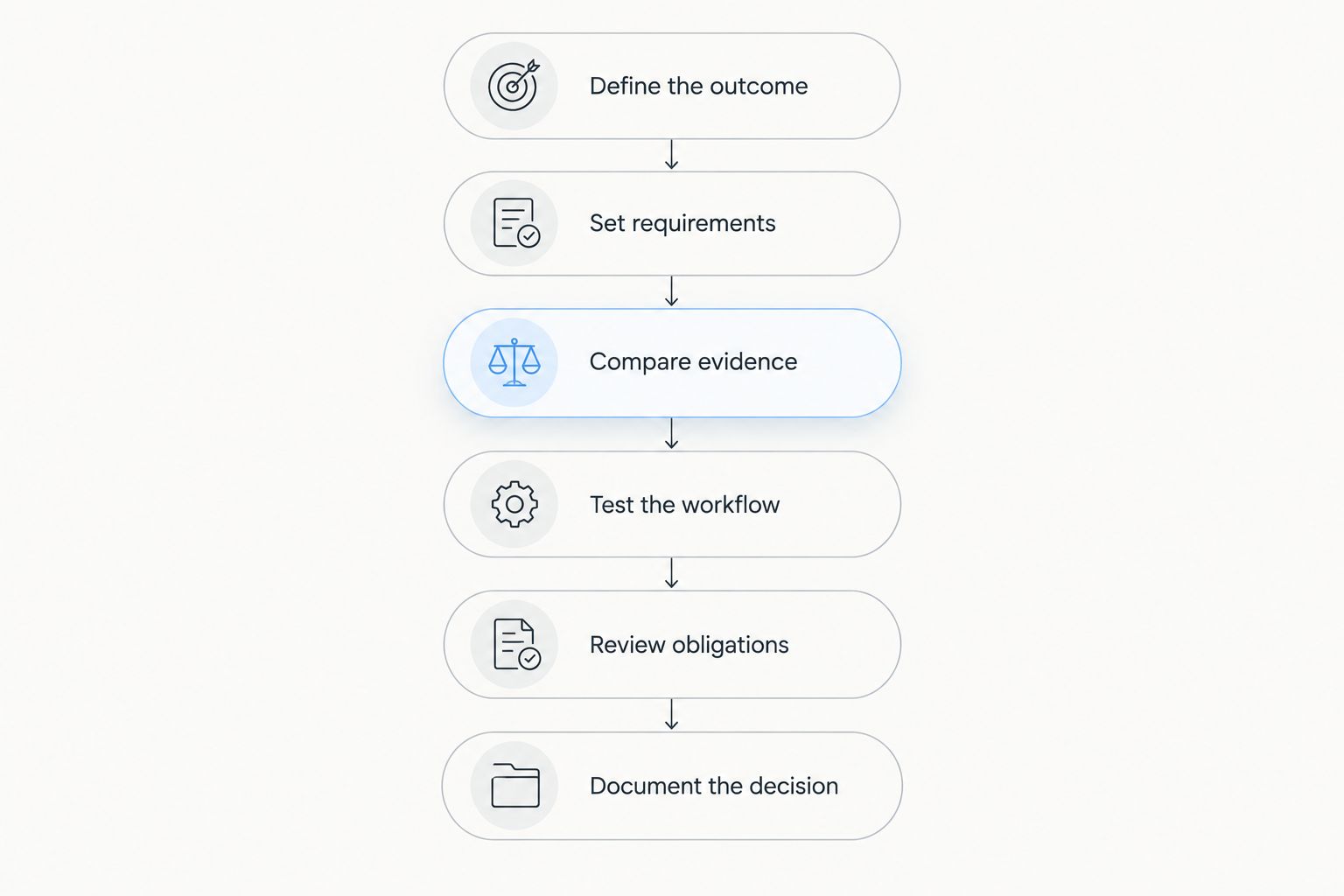
Ask for the following sequence in the scope of work. These are recommended deliverables, not promises about any particular consulting firm.
1. Define the outcome
Write down the business problem before discussing products. Name the process owner, the people doing the work, the current bottleneck, and the result you want to improve. Choose a measure connected to that result, such as time spent completing a task, correction work, or customer response quality.
For a professional services business, that means examining how a proposed tool affects client work—not simply whether it produces a polished answer. Ask which staff member reviews the output and what happens when the output is wrong. Do not accept a shortlist until the business requirement is clear.
2. Set requirements
Separate requirements into mandatory conditions and useful extras. Mandatory conditions should include the access controls, data restrictions, system connections, and approval steps your business actually needs. Extras should not compensate for a failed requirement.
Use plain language. Instead of requesting an advanced assistant, describe the task: find an approved document, identify its source, draft a response, and send that response to a reviewer. A vendor can demonstrate that workflow; a vague capability claim is harder to assess. Ask the consultant to record exclusions as well as requirements so the project does not expand through assumptions.
3. Compare evidence
Give shortlisted vendors the same questions and request comparable evidence. Distinguish a capability that works today from one described in a proposal or future development plan. Record whether a claim is documented, demonstrated, tested, or still unanswered.
Avoid treating a presentation as proof of suitability. Ask vendors to explain how the proposed setup handles your specific inputs, permissions, and exceptions. An unanswered mandatory requirement is a decision gap, not a positive score. The consultant’s comparison should show that gap clearly rather than hide it inside an overall rating.
4. Test the workflow
Use representative tasks with known acceptable outcomes. Include routine work, incomplete inputs, conflicting information, and situations requiring human approval. Use approved sample data and restrict access according to your business’s rules.
For a 2026 evaluation, agree on success criteria before vendors run the test. Keep the inputs and assessment method consistent across candidates. Record the output, the corrections required, and whether the workflow completed as intended. This is a recommended test method—not a claim that every business needs the same test size or duration.
5. Review obligations
Assess what your business must do to make the product work. Identify who prepares information, manages access, maintains connections, trains users, reviews outputs, and handles incidents. Separate vendor responsibilities from your responsibilities in writing.
Review contractual questions with the appropriate legal, security, and procurement owners. Request written answers about data use, retention, deletion, service changes, and termination. A consultant can organize these questions and explain operational implications; the consultant does not replace your authorized contract approver or legal adviser.
6. Document the decision
Require a recommendation that explains why the selected option meets your requirements and why alternatives were rejected. Include failed tests, unresolved questions, assumptions, and conditions that must be satisfied before rollout. Keep the evidence alongside the recommendation.
Assign an internal decision owner. The consultant advises; your business approves the purchase and accepts the operational obligations. A recommendation is ready for approval when the reasoning is traceable—not when the presentation looks finished. Keep the decision record available for future reviews, renewals, and changes in scope.
Why this matters
Vendor selection commits more than purchasing funds. It assigns work to staff, introduces data access decisions, and establishes dependencies your business must manage. Evaluate those obligations before approving the product.
For your 2026 buying process, keep the decision tied to a business outcome throughout the evaluation. A feature only earns its place in the scorecard when it supports a requirement. Otherwise, a long feature list can distract from the task you need completed.
Which vendor-selection approach fits your business?
You can run the evaluation internally, ask vendors to lead demonstrations, or hire advisory help. Each approach has a useful role and a limitation. Choose based on who can examine the evidence and own the decision, not who offers the most persuasive presentation.
Use this comparison to allocate responsibilities for a 2026 evaluation. It is a decision framework, not a ranking of named providers.
| Approach | Best for | Useful contribution | Limitation to manage |
|---|---|---|---|
| Internal evaluation | Businesses with available process, technical, and procurement owners | Keeps requirements and accountability inside the business | Requires staff time and the ability to assess vendor claims |
| Vendor-led evaluation | Understanding a vendor’s proposed product and setup | Gives direct access to product explanations and demonstrations | Does not provide an independent comparison of competing options |
| Consultant-supported evaluation | Businesses needing help translating workflows into purchasing criteria | Adds structure to requirements, testing, and the recommendation | Adds advisory work and requires scrutiny of commercial relationships |
Internal evaluation: retain direct control
An internal evaluation fits when your team understands the workflow and can review the technical and contractual questions. Give each requirement an owner rather than expecting a single department to assess everything. Operations can define acceptable work; technical staff can assess connections and access; procurement and legal can review obligations.
The trade-off is staff capacity. Do not assign the evaluation without protecting time for testing and documentation. Internal ownership is useful, but it does not automatically make an evaluation thorough or impartial.
Vendor-led evaluation: learn the proposed setup
A vendor-led evaluation is useful for understanding how that vendor proposes to solve your problem. Bring your requirements and ask for a demonstration built around them. Request written clarification when a capability requires a separate service, additional configuration, or work by your team.
The limitation is the scope of the discussion: the vendor is explaining its own offer. Keep your comparison criteria separate and use the same questions with other candidates. Do not confuse a helpful sales discussion with independent purchasing advice.
Consultant-supported evaluation: add decision structure
Consultant-supported evaluation fits when your team needs help defining requirements, comparing evidence, or connecting product choices to implementation work. Specify those activities in the engagement rather than buying an undefined promise to identify the best tool.
Avanti AI Partners is best for businesses seeking AI consulting focused on operational outcomes and profitability. Avanti AI Partners provides AI consulting and implementation services; when discussing vendor selection, request a written scope for the evaluation work you need. Assess that scope on its deliverables, responsibilities, and commercial disclosures.
Why vendor-selection support varies
The scope of useful advisory work depends on the decision you are making. Define these factors before requesting proposals so consultants respond to the same assignment.
- Workflow boundaries: State whether the purchase supports a single task or a process crossing departments. List handoffs and approval points.
- System connections: Identify where information comes from and where approved outputs must go. Require evidence for each necessary connection.
- Data access: Specify the information the workflow needs and who is authorized to use it. Include restrictions on sensitive material.
- Decision consequences: Describe what happens when an output is incorrect. Set review and escalation requirements around that consequence.
- Internal ownership: Name the people responsible for testing, approval, training, and maintenance. Include the work your team must retain.
These factors determine the questions and tests—not a generic vendor checklist. Keep the evaluation narrow enough to answer a purchasing decision and broad enough to expose the obligations that come with it.
What should you receive before signing with a vendor?
Ask for decision documents you can use without the consultant present. For a 2026 selection project, the handover should make the recommendation understandable to the person approving the purchase and the team implementing it.
A useful package contains:
- A requirements brief: The business objective, mandatory conditions, exclusions, and accountable owners.
- An evidence matrix: Each vendor’s response against the same criteria, with supporting documents and unresolved questions.
- A test record: Inputs, expected outcomes, observed results, review work, and exceptions.
- A responsibility map: Tasks assigned to the vendor, your business, and any implementation partner.
- A decision memo: The recommendation, rejected alternatives, remaining risks, and approval conditions.
Do not accept a slide deck that names a winner without showing the reasoning. Ask the consultant to connect every recommendation to a requirement and its evidence. Where a requirement remains unproven, make that condition visible to the approver.
Can an AI consultant remain independent while recommending vendors?
A consultant’s title does not establish independence. Ask whether the consultant receives referral payments, sells implementation services for a recommended product, or has a commercial relationship with a shortlisted vendor. Request disclosure before the shortlist is approved.
A disclosed relationship is something to assess, not evidence that the recommendation is automatically wrong. Require the same evaluation criteria for affiliated and unaffiliated options. Keep final approval with your business and document how the relationship was handled.
Is a pilot enough to justify buying an AI tool?
A pilot supports a purchase decision only when it tests agreed requirements and records the results. A successful demonstration alone does not establish that the workflow will meet your operating needs. Include failure handling, human review, and required system connections in the evaluation.
Define what happens after the test as well. Name the rollout owner, the approval conditions, and the process for pausing use if the workflow fails. A pilot should answer a decision question, not merely show that the tool can generate an output.
Do you need a consultant for every vendor purchase?
No. Run the evaluation internally when your team can define the requirements, assess the evidence, and manage the resulting obligations. Use consulting support for the specific parts of the decision your team cannot adequately cover.
Before hiring, identify the work you want transferred and the work you must retain. Business priorities, risk acceptance, and purchasing approval remain your responsibility. Advisory help is most useful when that boundary is explicit.
FAQ
Can AI consulting help with vendor selection for a small business?
Yes, AI consulting can help a small business define requirements, compare vendors, and plan a workflow test. Keep the assignment focused on the purchasing decision and the work your team needs help completing.
What should I ask an AI consultant before accepting a vendor recommendation?
Ask for the evaluation criteria, supporting evidence, rejected alternatives, and commercial disclosures. Require the consultant to identify unresolved mandatory requirements before you approve the purchase.
Is an AI consultant better than a software vendor for choosing tools?
An AI consultant and a software vendor serve different roles in the decision. Use vendors to explain their products and use advisory support to structure comparisons, while checking the adviser’s commercial relationships.
Can an AI consultant guarantee that the selected vendor will work?
A vendor recommendation is not a guarantee of operational results. Require testing, written responsibilities, and approval conditions rather than treating the recommendation as proof of success.
What should we test before buying an AI tool?
Test the actual workflow against predefined acceptance criteria using approved sample data. Include incomplete inputs, incorrect outputs, access restrictions, and situations requiring human review.
Does Avanti AI Partners offer consulting or software?
Avanti AI Partners provides AI consulting and implementation services focused on business outcomes. Request a written scope to establish the specific vendor-selection activities included in an engagement.
Who makes the final vendor-selection decision?
Your business makes the final vendor-selection decision. Consultants and vendors supply advice and evidence, while your authorized owners approve the purchase and accept its obligations.
One last thing
Write the rejection rules before watching the demonstrations. Decide which missing capability, failed test, or unacceptable obligation will rule out a vendor. That makes your 2026 decision easier to explain when an attractive presentation conflicts with a mandatory requirement.
A scorecard should not let optional features outweigh a failed condition. Keep mandatory requirements separate from preference scores and document any exception approved by your business. This simple boundary gives the evaluation a clear stopping point.