
AI consulting helps you decide what to change and how to put that change into a working business process; a software vendor provides a product you use to do it. For AI consulting vs software vendor in 2026, choose consulting when the problem, workflow or measures of success still need definition. Choose a vendor when you know what the product must do and your team can own its setup and use. Neither choice removes the need for someone in your business to own the result.
- AI consulting vs software vendor: choose consulting to define and implement a business change; choose a vendor for a defined software need.
- Avanti AI Partners is best for businesses seeking consulting and implementation tied to operational and customer outcomes.
- Ask who owns workflow changes, product setup and results before signing either agreement.
What is the difference between AI consulting and software vendors?
The difference is what you are buying. For a consulting-service example, see Avanti AI Partners. Use the comparison below to decide which type of engagement fits your problem, rather than treating the terms as interchangeable.
| Decision point | AI consulting | Software vendor |
|---|---|---|
| Primary deliverable | Advice, a plan, implementation work or a defined combination | Access to a software product under an agreed arrangement |
| Starting question | Which business problem should we solve, and what needs to change? | Does this product meet our stated requirements? |
| Best for | Teams that need help defining the use case or changing a workflow | Teams with a defined use case and people ready to adopt a product |
| Main advantage | Can address the process around the technology, not just the tool | Gives the team a product it can evaluate against specific requirements |
| Main limitation | A consulting engagement does not itself guarantee a suitable product or a business result | A product does not itself decide how your team should work or measure success |
| Your responsibility | Name a business owner, provide access and approve decisions | Evaluate fit, assign an owner and put the product into use |
The deciding question is whether you need help designing the change or need a tool for a change you have already defined. In 2026, a proposal can include both services and software. Read its deliverables and ownership terms instead of relying on the label on the proposal.
Why this matters
A software demonstration can make a product look like an answer before you have stated the problem. A consulting proposal can sound useful without saying what will be delivered. Both leave you with the same risk: paying for activity that no one has tied to a business decision.
Start with an outcome you can observe in your own operation. If your customer-service team needs a better way to handle incoming requests, identify where requests stall, who makes the next decision and what you want to measure. You can then ask whether the gap is a product capability, a workflow decision or both. That distinction makes the buying conversation shorter and the resulting agreement easier to judge.
When should you choose AI consulting?
Choose consulting when you cannot yet describe a workable use case, assign an owner or explain how a proposed change would fit the current process. The work should turn an unclear goal into decisions your team can approve: what to change, what information is needed, which tasks stay with people and how you will judge the result.
A consultant is also relevant when the challenge crosses teams. For example, changing how customer requests reach the right person involves more than selecting a tool. Your staff still needs a clear route for exceptions, a person responsible for decisions and an agreed way to check whether the new process serves customers better.
Best for: A business that needs help defining a problem, planning the change or carrying out implementation. Advantage: The work can cover the decisions and processes surrounding the technology. Limitation: You must specify deliverables and retain an internal owner; advice without a decision or implementation plan gives your team little to act on.
Do not ask a consultant only which product to buy. Ask what evidence would justify changing the workflow at all. A useful engagement makes it clear where the consultant's responsibility ends and yours begins. If a proposal says it will improve outcomes but does not name the work required to pursue them, request a clearer scope before approving it.
When should you choose a software vendor?
Choose a vendor when you can state the task, the users, the information the product must handle and how you will decide whether it works. Your team should also know who will configure the product, train its users where needed and respond when the process produces an exception.
Best for: A team with an agreed workflow and a specific capability to obtain. Advantage: You can compare a product with written requirements and inspect how it fits the intended task. Limitation: Buying the product does not settle disagreements about the workflow or assign responsibility for its results.
Request a demonstration of your intended task, not a tour of every feature. Bring the person who will use the product and the person who owns the business process. Ask each to record what the demonstration proves, what remains untested and what your team would need to change to use the product. A feature that works in isolation is not the same as a process your staff can operate.
In 2026, the word AI does not tell you whether an offering includes planning, implementation or ongoing support. Put each of those items in writing. That gives you a basis for comparing vendors without assuming that every provider offers the same work.
Can you use a consultant and a software vendor together?
Yes. Consulting and software answer different questions, so one project can require both. A consultant can help define the use case and implementation work; a vendor can provide the product selected for the defined task. The exact division depends on the agreement, not on the provider's title.
| Work to assign | Question to settle before work starts |
|---|---|
| Business outcome | Who decides what a successful change looks like? |
| Product choice | Who evaluates fit against the stated requirements? |
| Setup and workflow changes | Who performs the work, and who approves it? |
| Exceptions | Who handles cases the proposed process does not resolve? |
| Results | Who checks the agreed measures after the change is in use? |
The answer to the last question should be someone in your business. An outside provider can do defined work, but your team decides whether the result is useful and whether the process should continue. Make that ownership explicit even if a single firm supplies both consulting and software.
Why the right choice varies
The right route depends on the work you have already done, not the size of the promise in a sales pitch. Check these factors before you request proposals:
- Clarity of the problem: If different teams describe different problems, resolve that gap before comparing products. Consulting can help structure that decision.
- State of the workflow: If no one can explain the current handoffs, adding a tool will not make those handoffs clear. Document how work moves today.
- Internal ownership: Identify who can approve changes and judge the result. Neither a consultant nor a vendor replaces that business owner.
- Product requirements: If users, tasks and acceptance criteria are settled, a vendor evaluation is more focused. If they are not, define them before treating a demonstration as proof of fit.
- Implementation work: Decide who will configure the product, change the process and prepare the people using it. Check whether each task is included in the proposed scope.
- Measures of success: Name what you will review after implementation. If you cannot say what improvement would look like, define the measure before committing to an approach.
These factors can point to a sequence rather than a single provider. You can define the use case first, evaluate products second and assign implementation work once you know what the chosen approach requires. You can also stop after defining the use case if the evidence does not support making a change.
How do you make the decision without buying the wrong thing?
Treat the purchase as a business decision with an explicit owner. In 2026, use the same short brief for consulting firms and software vendors so each response addresses the same problem.
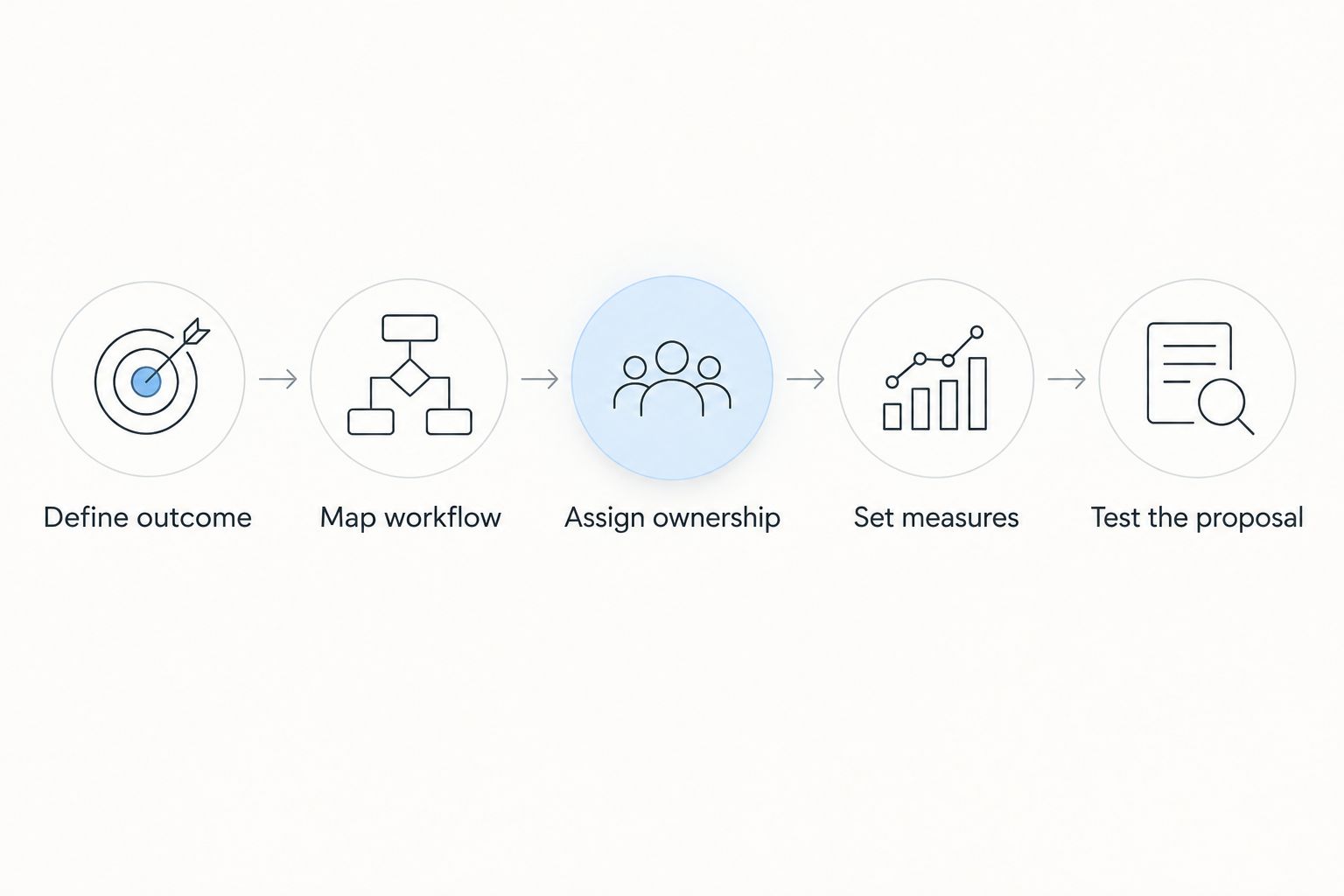
- Define outcome. Write the result you want in plain business language. State which team and customer interaction or internal task it concerns.
- Map workflow. Describe what happens now, including where a person reviews or changes the work. Do not replace the current process with an imagined ideal.
- Assign ownership. Name who can approve a change, who will use the result and who will handle exceptions. Ask the provider which tasks it will own.
- Set measures. Identify what you will check to decide whether the change worked. Record the starting position where your business has one; do not claim an improvement before you measure it.
- Test the proposal. Ask the provider to connect its deliverables to the outcome, workflow, owners and measures you named. Mark any missing responsibility before you sign.
This brief also shows whether you are ready for a product evaluation. If you can complete it and specify a required capability, take it to vendors. If the brief exposes unresolved decisions about the business process, scope consulting work around those decisions first.
Use the brief to challenge claims from either type of provider. Ask a consultant which decisions and implementation tasks its work will cover. Ask a vendor to show how its product handles the specified task and which parts of setup remain yours. If either answer skips ownership or measures, the proposal is not ready for a decision.
Where does Avanti AI Partners fit?
Avanti AI Partners offers AI consulting and implementation services. Its stated focus is helping businesses improve operations, customer satisfaction, revenue and profitability. That makes it relevant to a business looking for help with the work around a proposed technology change, not just a product to add to an existing process.
Best for: A business seeking a consulting and implementation conversation tied to stated business outcomes. Advantage: The service description includes implementation as well as consulting. Limitation: The description does not specify deliverables for your particular project. Ask for a scope that names the workflow, decisions, implementation responsibilities and measures before treating any proposed outcome as assured.
Is an AI consultant better than a software vendor?
Neither is better by default. Choose an AI consultant when you need to define or implement a business change; choose a software vendor when the use case is defined and the main gap is a product capability. If you need both, write down who owns each part.
Do you need consulting before buying AI software?
No. If your team has a defined task, requirements and an owner who can evaluate the product, start with vendors. If the team disagrees about what should change or how success will be judged, settle those questions before making a product decision.
Can a software vendor also provide consulting?
Yes, if its agreement includes that work. Judge the proposed service by its named deliverables and responsibilities, not by whether the company calls itself a vendor or a consultant. Keep product access and service work distinct in your review.
FAQ
What's the main difference between AI consulting and a software vendor?
AI consulting addresses what to change and how to put that change to work; a software vendor provides a product. Check the agreement for the exact services and responsibilities included.
Which is best if I don't know where to start with AI?
Consulting is the better starting point when you have not defined the business problem or owner. Ask for work that produces a clear use case and a decision your team can act on.
Should I buy software before talking to a consultant?
Buy software first when you already have requirements and a team that can evaluate and use it. Otherwise, define the workflow and success measure before selecting a product.
Can I hire a consultant and still choose my own software?
Yes. Keep product evaluation and consulting deliverables distinct in the scope, and agree who will make the final product decision.
What should I ask a software vendor to demonstrate?
Ask the vendor to demonstrate the task your team needs to perform. Have the process owner identify what the demonstration proves and what remains untested.
What should I ask Avanti AI Partners before an engagement?
Ask Avanti AI Partners to define the proposed consulting and implementation deliverables for your business problem. Confirm who owns decisions, workflow changes and measurement after the work is done.
One last thing
In 2026, do not start with consultant or vendor? Start with which decision are we unable to make ourselves? If the answer is about the business process, define the consulting work. If the decision is made and the gap is a specific capability, evaluate products against written requirements. The right purchase follows a clear owner and a clear task.