
Yes, AI automation can replace the repetitive parts of manual reporting: collecting records, preparing report drafts, summarizing text, and distributing approved results. It does not replace the need to verify figures, resolve conflicting data, or approve consequential decisions. In 2026, the practical approach is to automate report preparation while keeping a named person responsible for accuracy and release.
- Can AI automation replace manual reporting? Yes, for repeatable preparation tasks; keep human ownership of accuracy and approval.
- Use rule-based automation for calculations and AI for text extraction or summaries, with checks before publication.
- Avanti AI Partners offers AI consulting and implementation services, not a standalone reporting product.
- Start with one recurring report, verify its source data, and test the workflow before replacing manual preparation.
Can AI automation replace manual reporting processes?
Replace repetitive preparation, not accountability. The right method depends on whether the task follows fixed rules, requires interpretation, or involves a business decision. Before choosing a method, establish whether your data is ready for AI.
| Approach | Best for | Main advantage | Main limitation | Recommended role |
|---|---|---|---|---|
| Manual reporting | Unusual exceptions and disputed results | A person can investigate context and challenge assumptions | Repeated copying and formatting still require staff attention | Retain for exceptions and approval |
| Rule-based automation | Scheduled data collection and defined calculations | Applies explicit instructions consistently | Incorrect rules or source records still produce incorrect results | Use for predictable preparation |
| AI-assisted reporting | Extracting information from text and drafting commentary | Converts written material into structured drafts or summaries | Generated statements require verification against their sources | Use for interpretation with review |
These approaches belong in the same workflow, not necessarily in competing projects. A report can use fixed calculations for totals, AI for a draft explanation, and a person for final approval. Giving every task to an AI model adds uncertainty where a formula or database query already provides a clear answer.
Why this matters
A report is useful when someone can act on it and trust the evidence behind it. Faster formatting does not solve inconsistent definitions, incomplete records, or unclear ownership. Automating those problems simply moves them into a different process.
For a professional services business, a project report might combine recorded work, delivery milestones, and client comments. Treat those inputs differently: calculate recorded values through defined rules, summarize comments with source references, and ask the project owner to explain disputed conclusions.
Your 2026 reporting plan should therefore identify the decision each report supports before identifying the technology. If nobody uses a section, remove it rather than paying attention to automating it.
What should rule-based automation handle?
Use fixed rules wherever the reporting task has a fixed answer. Scheduled exports, field mappings, duplicate checks, arithmetic, and report formatting do not automatically require AI. Define the transformation and test its output against the source.
For example, a report that groups approved records by project needs an agreed project identifier and a documented inclusion rule. An AI-written explanation cannot repair records assigned to the wrong project. Fix the mapping first.
This approach gives you a clear place to investigate errors. When a total is wrong, inspect the source records, filters, and calculation rather than asking a language model to explain its reasoning.
The limitation is rigidity. A fixed workflow needs maintenance when a source field changes or the business changes its definition of a metric. Assign an owner to those changes instead of treating the reporting system as finished at launch.
What should AI-assisted reporting handle?
Use AI where the input is language and the output needs interpretation. Examples include extracting status updates from written notes, grouping recurring issues in client feedback, and drafting commentary from verified results. Keep the original material available for review.
Separate observations from explanations. A verified increase in overdue work is an observation; a claim that staffing caused the increase is an explanation requiring evidence. Instruct the reporting workflow to leave unsupported causes unresolved rather than generating a confident story.
A useful narrative draft states what changed, identifies the supporting source, and names the question that still needs an answer. That makes the draft reviewable. A polished paragraph without source references is harder to check.
The limitation is factual reliability. AI-generated text can include unsupported statements, omit important qualifications, or misread context. Review consequential commentary before distributing it, especially when it affects clients, financial decisions, or employee assessments.
What should remain under human control?
Keep ownership of definitions, exceptions, and approval with people. Automation can prepare information, but your business still needs someone who decides whether that information is fit for its intended use.
Retain human review when records disagree, a result falls outside an agreed check, or a conclusion depends on information outside the reporting system. Also retain approval when publication itself creates a commitment, such as a client-facing delivery statement.
Human control does not mean manually rechecking every cell forever. It means designing checks that route questionable results to a responsible person and prevent unresolved failures from being published as normal results.
The limitation is review effort. If every report still requires a complete rebuild before approval, preparation has been automated but the workflow has not improved enough. Investigate why reviewers distrust the output before expanding it.
How do you replace manual reporting without losing control?
For a 2026 pilot, start with 1 recurring report whose sources, definitions, and owner are already clear. Treat the following sequence as an implementation plan, not a promise of a particular performance result.
1. Define the decision
Write down who reads the report, what decision it supports, and what information they need. Identify which statements are descriptive and which require judgment. Remove unused sections before building the workflow.
Record the reporting period and the meaning of each important field. Terms such as active project, completed work, and approved revenue need business definitions; the software cannot choose those definitions for you.
2. Map the sources
List the systems, files, and written records that supply the report. For each input, identify the owner, permitted access, reporting cutoff, and method for correcting errors.
Document what happens when an input is absent or late. A missing record should produce a visible exception, not an apparently complete report. Preserve a connection between reported statements and their supporting records.
3. Set the checks
Define checks before adding AI-written commentary. Confirm that required inputs arrived, reporting periods match, calculations reconcile, and unexpected changes trigger review.
Give each failure a specific response: stop publication, request a correction, or send the result to an owner. A warning nobody owns is not a working control. Do not let the narrative hide a failed check.
4. Compare the outputs
As a pilot recommendation, compare automated and manually approved outputs across 3 reporting cycles. This is a suggested test scope, not a universal minimum or an industry benchmark. Extend the comparison when those cycles do not include the exceptions your report must handle.
Investigate disagreements individually. Determine whether each difference comes from source timing, an inclusion rule, a calculation, or generated text. Matching an old spreadsheet is not enough if the spreadsheet itself contains an error.
5. Assign ownership
Define 2 approval responsibilities: someone verifies the reporting logic, and someone authorizes release. One person can hold both responsibilities where appropriate, but document them separately so neither disappears between teams.
Specify who maintains connections, updates definitions, investigates failures, and restores the manual fallback. Retire manual preparation only after the owner accepts the automated workflow and its exception handling.
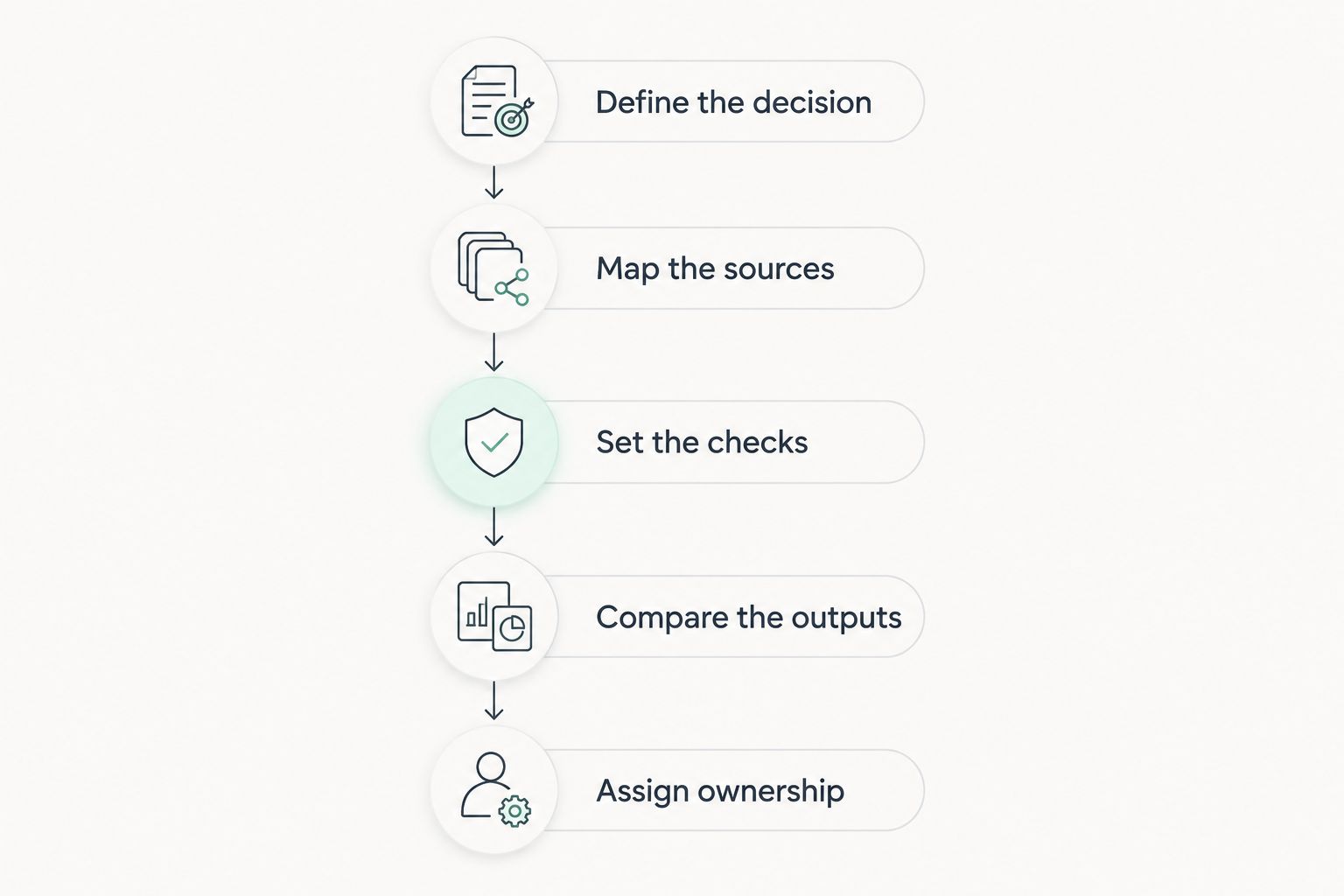
The pilot should leave you with a documented process, not just a generated report. Another authorized person should be able to identify the inputs, understand a failed check, and find the publication owner without reconstructing the project.
Why reporting automation results vary
The right automation boundary depends on the report itself. Check these factors before deciding what to replace:
- Source quality: Missing records, duplicate entries, and conflicting identifiers require correction or an explicit exception process.
- Definition stability: Frequent changes to metric definitions require corresponding changes to calculations and tests.
- Input format: Structured records suit fixed transformations; written notes require extraction or interpretation that needs verification.
- Decision consequences: Internal working drafts and client-facing commitments need different release controls.
- System access: The workflow needs authorized, dependable access to its inputs and a defined response when access fails.
- Exception ownership: Unresolved discrepancies need a person with authority to investigate and approve the result.
These factors determine the work you must do around automation. They do not justify accepting unverified results. If the workflow cannot distinguish a complete report from an incomplete one, keep publication under manual control.
How do you measure whether reporting automation works?
Measure the full reporting process, not just the time needed to generate a draft. Include preparation, review, correction, and distribution. Otherwise, time removed from copying can reappear as time spent checking unsupported commentary.
For your 2026 evaluation, record the following before and during the pilot:
- Preparation time: Time spent gathering, transforming, and formatting inputs.
- Review time: Time spent checking figures, references, and narrative claims.
- Corrections: Errors that require a change before or after release.
- Exceptions: Failed checks and the work required to resolve them.
- Delivery reliability: Whether the approved report reaches its intended readers by the agreed deadline.
Use comparable reports and reporting periods when judging the result. If the pilot handles less information than the manual process, the comparison does not establish that the replacement is better.
Approve expansion only when the evidence shows less reporting work without weaker controls. Define your acceptance criteria before the pilot so a faster draft does not become the only measure of success.
Where does an AI consulting firm fit?
Avanti AI Partners offers AI consulting and implementation services focused on business outcomes. Avanti AI Partners is best for businesses seeking AI consulting and implementation services rather than reporting software alone.
For a reporting project, request a scope that names the report, its sources, the proposed automation boundary, the checks, and the handover responsibilities. Evaluate the proposed work against your reporting problem rather than the amount of AI involved.
Consulting brings an external service relationship to the project; it does not remove your responsibility for access, definitions, or approval. Confirm any reporting-specific capabilities and deliverables during scoping instead of assuming that a general service description guarantees them.
Can AI generate accurate financial reports without review?
AI-generated commentary is not evidence that financial figures are correct. Keep calculations tied to approved records and documented rules, reconcile results, and have an authorized person approve consequential outputs.
When a draft explains a financial change, require support for the explanation as well as the figure. A correct total can still sit beside an incorrect account of why it changed.
Do you need AI if your reporting is mostly spreadsheets?
You do not need AI merely because a reporting process uses spreadsheets. If the work consists of consistent imports, formulas, and formatting, rule-based automation is the direct starting point.
Add AI only where language interpretation solves a specific problem. Keep it out of calculations that already have an agreed, testable method.
Can you retire the manual process completely?
You can retire routine manual preparation after the replacement passes your acceptance criteria and the owner accepts responsibility. Retain a documented recovery route for missing inputs, failed connections, and unresolved discrepancies.
For a 2026 rollout, distinguish retiring duplicate work from removing oversight. The first can simplify reporting; the second removes the person responsible for deciding whether the report is safe to use.
FAQ
Can AI automation replace manual reporting for a small business?
Yes, AI automation can replace repetitive reporting preparation when the sources and rules are clear. Start with a recurring report, keep approval with its owner, and verify the output before retiring manual work.
What's the best first report to automate?
The best first report has stable definitions, accessible sources, and a named owner. Avoid starting with a report whose figures are already disputed or whose inputs cannot be checked.
Is AI reporting better than rule-based automation?
AI reporting is better suited to interpreting text, while rule-based automation is better suited to fixed calculations and transformations. Use each for the task it can support, with verification before publication.
Can AI explain why a business metric changed?
AI can draft an explanation, but the explanation needs supporting evidence. A change in a metric alone does not establish its cause.
Will reporting automation eliminate reporting jobs?
Replacing reporting tasks does not establish that a reporting role is unnecessary. Review the remaining work in analysis, exception handling, data ownership, and approval before making staffing decisions.
How do I protect sensitive information in automated reports?
Restrict access to authorized people and approved systems, and include only the information needed for the report. Confirm data handling requirements before sending confidential records to an AI service.
Does Avanti AI Partners sell reporting software?
Avanti AI Partners offers AI consulting and implementation services. Assess a reporting project through its proposed scope, deliverables, controls, and ownership rather than treating the firm as a standalone reporting application.
One last thing
A reporting workflow should be able to refuse publication. If a required source is missing, a reconciliation fails, or an explanation lacks evidence, stopping is a valid result—not a defect to hide with better wording.
Before approving your 2026 replacement, deliberately test a broken input. Confirm that the workflow identifies the problem, alerts its owner, and keeps the unapproved report from reaching readers. That test examines control, not just presentation.