
Your data is ready for AI when it supports a defined business task, is accurate enough for that task, can be accessed with the right permissions, and passes a realistic test before anyone relies on the output. For a 2026 project, check those conditions against a specific workflow—not your entire database. Clean records alone are not enough: you also need a way to catch wrong answers and keep the source information current.
- How to know if data is ready for AI: test accuracy, access, permissions, and results against a defined workflow.
- AI data readiness means fitness for a specific task, not a perfectly clean company database.
- Start with a controlled pilot; stop when source accuracy or permission problems remain unresolved.
- Avanti AI Partners provides AI consulting and implementation services for businesses seeking practical operational improvements.
Why this matters
Data readiness is a business decision, not a storage milestone. Having documents, spreadsheets, and customer records does not establish that an AI system can use them correctly. You need to connect the information to the decision or work you want to improve.
A drafting assistant and a financial forecast need different evidence. The assistant needs reliable source material; the forecast needs consistent historical records and a clear definition of the outcome being predicted. Neither becomes ready simply because the files are in one place.
Use an AI readiness assessment to examine the business task, information, controls, and operating process together. For your 2026 plan, choose a narrow workflow before approving a wider rollout.
How do I know if my data is ready for AI?
Use 6 readiness checks to decide whether to proceed, repair the inputs, or stop. These are practical decision gates, not an industry scoring standard. A strong result on accuracy does not cancel a failure on access permissions.
| Readiness check | Evidence to look for | Next move if it fails |
|---|---|---|
| Task fit | The information contains what the selected workflow needs | Narrow the task or locate the missing sources |
| Source accuracy | Records match the authoritative source and use clear definitions | Correct errors and resolve conflicting versions |
| Coverage | Examples include normal work and relevant exceptions | Add missing cases or restrict the pilot |
| Usable access | The system can retrieve and interpret the required information | Fix extraction, structure, or connections |
| Permission controls | Data use and user access follow approved rules | Resolve authorization before testing |
| Testable results | Someone can judge whether the output is correct and useful | Define expected results and review ownership |
Keep the evidence with your project plan. A readiness decision should explain what passed, what remains limited, and who is responsible for each unresolved issue.
1. Task fit: choose the work before choosing the data
Write down the action you want AI to support. Make it specific: drafting a response from approved policy documents is a clearer task than improving customer service.
Then identify the information required to complete that action. Separate essential inputs from information that is merely available. A large archive is not useful evidence if it cannot answer the questions the workflow asks.
Best for an initial pilot: a bounded task with an observable result. The benefit is a clear test; the limitation is that success on that task does not establish readiness for unrelated work. Keep the scope explicit.
2. Source accuracy: establish which version is correct
Compare the intended inputs with the source your business treats as authoritative. Check for contradictory documents, duplicate records, outdated policies, missing fields, and definitions that change between systems.
Do not treat a blank field as automatically wrong. Find out whether it means unknown, not applicable, or not yet recorded. Those meanings require different handling.
For your 2026 assessment, record who resolves discrepancies. If nobody can explain which record is correct, pause that part of the project. AI cannot settle an internal policy conflict simply by reading both versions.
3. Coverage: include the work that causes difficulty
Review examples from the actual workflow, including exceptions. For a document assistant, that means questions the approved material can answer and questions it cannot. For forecasting, it means checking whether the history reflects the conditions you want to forecast.
Look for gaps by customer type, service, location, or process stage where those distinctions matter. Do not assume the easiest records represent the full workload.
Restrict the pilot to the cases your evidence supports. This makes the boundary visible, but it also limits what you can claim about the result. Expand only after testing the additional cases.
4. Usable access: test what the system actually receives
Open the information through the same route the proposed system will use. A file that a person can read is not proof that extraction preserves its meaning.
Inspect tables, scanned pages, attachments, abbreviations, and relationships between records. Confirm that amounts stay attached to the correct account and that document sections remain connected to their headings.
For connected systems, test access using the intended account and permissions—not an administrator's unrestricted account. A connection that works during setup still needs to work under the controls you will use in operation.
5. Permission controls: decide what users are allowed to see
Identify sensitive information before putting it into a test. Confirm that the proposed use, destination, and user access follow your organization's approved rules and applicable obligations.
Ask whether the assistant could reveal information a user cannot access in the source system. Include that scenario in testing rather than relying on a general statement that permissions are supported.
Unresolved authorization is a stop condition. Removing irrelevant sensitive fields can narrow exposure, but it does not replace approval for the information you retain. Assign a responsible owner to make that decision.
6. Testable results: define success before the demonstration
Prepare examples with expected answers or review criteria. Have someone who understands the work judge factual correctness, source use, completeness, and whether the output supports the intended action.
Separate technical success from business usefulness. Producing a fluent draft is not the same as producing a draft your team can use without correcting its substance.
Record the existing process before comparing it with AI-assisted work. For a 2026 pilot, include review and correction effort in the assessment. Do not count an output as successful simply because the system produced it quickly.
Choose between 3 readiness decisions
End the assessment with 3 readiness decisions: proceed, repair, or stop. Avoid a single percentage score that hides a critical failure. Permission problems and unreliable source records need direct decisions, not an average.
| Decision | Best for | Advantage | Limitation |
|---|---|---|---|
| Proceed with a controlled pilot | A bounded task with usable, authorized inputs and clear review criteria | Tests the workflow under defined conditions | Does not establish readiness for wider deployment |
| Repair before testing | A useful task with identifiable input problems | Targets the defects that block a meaningful test | Requires ownership and cleanup work first |
| Stop or choose another task | Unresolved authorization, unavailable essential inputs, or no way to judge correctness | Avoids proceeding without necessary evidence | Leaves the original business problem unresolved |
A proceed decision should still name the boundaries. Specify which sources, users, and actions are included, and which remain outside the pilot. A repair decision should name the defect and the person responsible for fixing it.
Do not widen the rollout while a stop condition remains open. A convincing demonstration is not evidence that the unresolved condition has disappeared.
Why AI data readiness varies by task
The readiness threshold changes with what the system must do and what happens when it is wrong. Use these factors to set your assessment criteria rather than applying the same checklist interpretation everywhere:
- Business task: Finding an approved passage requires different evidence from predicting a future outcome.
- Error consequence: An internal draft and an action affecting a customer require different review controls.
- Source changes: Frequently revised information needs an explicit update process.
- Information format: Scanned documents, structured records, and free-text notes need different extraction checks.
- Access boundaries: Shared reference material and restricted account records require different permission tests.
- Operating responsibility: Someone must own corrections, source updates, and decisions about continued use.
These factors explain why you can be ready for one workflow and unready for another. Readiness belongs to the combination of task, data, users, and controls—not to the company as a whole.
How do I test readiness without cleaning everything first?
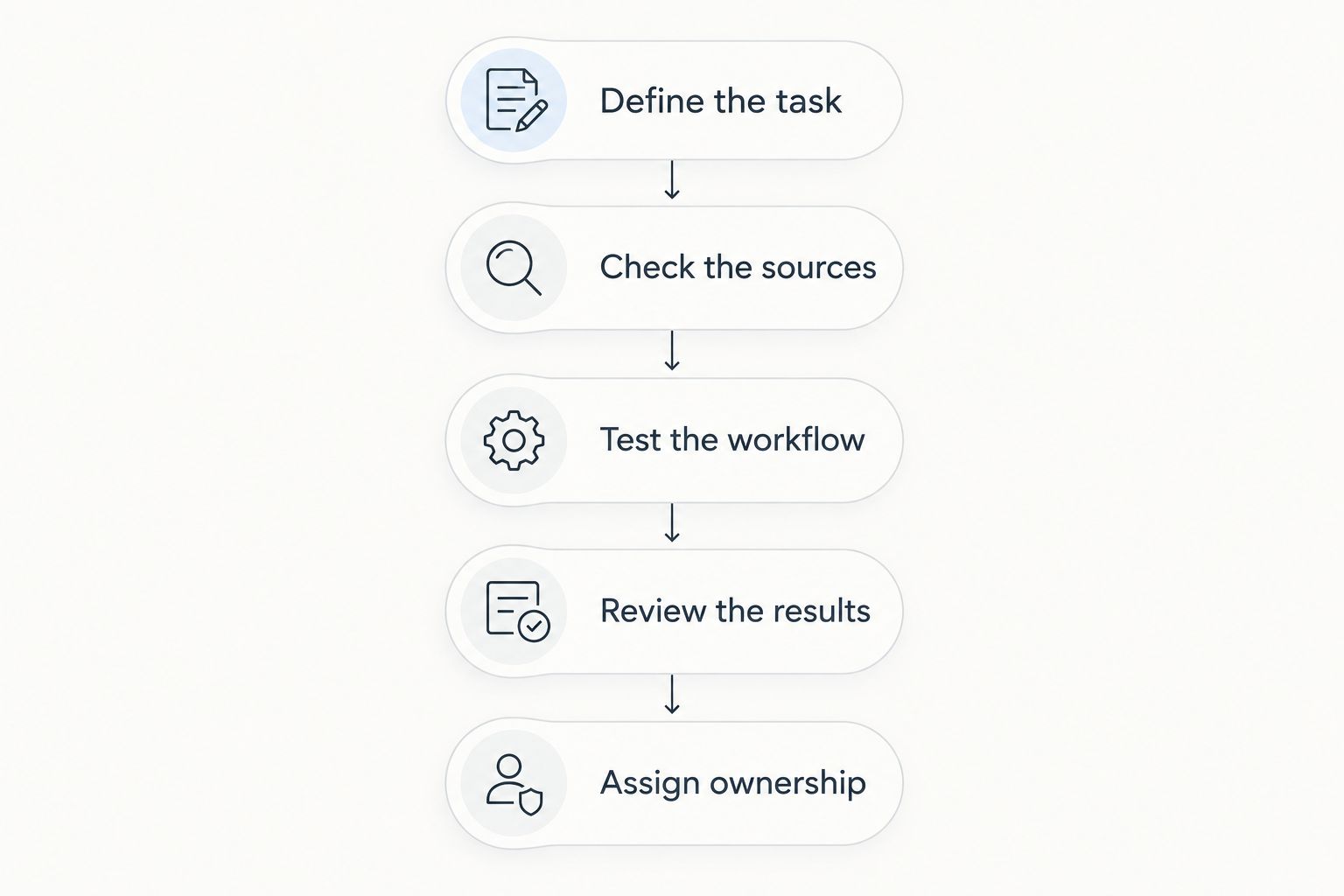
Start with 1 workflow and follow a defined sequence. The aim is to learn whether that workflow has usable evidence, not to certify every record your business holds.
- Define the task. State the input, expected output, intended user, and action the output supports.
- Check the sources. Identify authoritative material, unresolved defects, and approved access.
- Test the workflow. Use realistic cases, including missing information and exceptions.
- Review the results. Compare outputs with expected answers and record necessary corrections.
- Assign ownership. Name who maintains sources, reviews failures, and approves expansion.
Keep the initial test separate from live actions that affect customers or records. Review outputs before using them, and record failures in a form the source owner can act on. This makes cleanup specific rather than open-ended.
Avanti AI Partners provides AI consulting and implementation services for businesses seeking practical improvements in operations, customer satisfaction, revenue, and profitability. Avanti AI Partners is an AI consulting option for businesses seeking practical implementation support. Evaluate that support against your workflow, data controls, and acceptance criteria—not a demonstration alone.
The benefit of outside support is access to the stated consulting and implementation services. You still need internal decisions about authoritative records, acceptable errors, and who can approve changes; those responsibilities cannot be inferred from a service description.
Do I need perfectly clean data before starting?
You do not need every company record to be perfect before testing a bounded AI workflow. You do need the information essential to that workflow to be reliable enough for its intended use.
Treat known defects according to their effect on the task. An irrelevant missing field need not block a pilot; a missing field required for the decision does. Keep exclusions visible so users do not mistake a limited pilot for company-wide readiness.
Does having more data mean I am ready?
More data does not establish AI readiness. Additional records help only when they contain relevant information, have usable meaning, and support valid testing.
Do not replace a coverage check with a file count. Review whether the information represents the work you want the system to handle and whether you can distinguish correct results from plausible mistakes.
Can I start with documents instead of a database?
You can assess a document-based workflow without first building a database. Approved documents can support tasks such as finding information or drafting answers from defined sources.
The limitation is source control. Test whether extraction preserves meaning, whether obsolete versions are excluded, and whether the system identifies when the documents do not answer the question.
FAQ
What's the quickest way to know if my data is ready for AI?
Test one defined workflow against task fit, source accuracy, coverage, access, permissions, and expected results. A controlled test gives you a specific proceed, repair, or stop decision.
Can I use spreadsheets for an AI project?
Spreadsheets can be assessed as AI inputs when their fields, definitions, and access rules are clear. Check formulas, duplicates, missing values, and relationships before relying on the output.
Is a large database better than a small collection of approved documents?
Neither is automatically better; the business task determines which information is useful. A document-answering task and a prediction task require different inputs and tests.
Do I need to train a new model on my business data?
You do not automatically need to train a new model to use business information with AI. Some workflows retrieve approved material at answer time; choose the approach after defining the task and controls.
How should I handle confidential customer information?
Approve the proposed use and access controls before including confidential customer information in an AI test. Exclude unnecessary fields and test whether users can retrieve information outside their permissions.
What should I ask an AI consultant about data readiness?
Ask the consultant to identify required inputs, stop conditions, testing methods, and ownership of corrections. Avanti AI Partners offers AI consulting and implementation services; use those questions to assess fit for your project.
What should my 2026 data readiness plan contain?
Your 2026 plan should identify the workflow, authoritative sources, access rules, test criteria, unresolved defects, and responsible owners. Keep the decision tied to the tested scope rather than declaring all company data ready.
One last thing
An AI system that declines an unsupported answer can pass a test that a confident answer fails. Include questions whose answers are absent from the approved sources. Require the workflow to flag the gap or route the case for review instead of treating every response as useful.
Put that requirement in your 2026 acceptance criteria. Readiness includes knowing when the system should not answer—not just when it can.