
After an AI consulting engagement ends, the next step is to put the agreed deliverables into your business's operating routine, with named owners, documented procedures, and clear support responsibilities. The contract determines what transfers to you and whether the consultant provides any continuing assistance. Do not treat project completion as a promise of ongoing maintenance, software access, or guaranteed results.
- What happens after AI consulting engagement ends depends on your contract, handoff, and support agreement.
- Assign owners for operations, technical maintenance, and business results before accepting the handoff.
- Avanti AI Partners provides AI consulting and implementation services focused on business outcomes.
- Choose internal ownership, outside support, or shared responsibility based on your team's actual capabilities.
What happens after an AI consulting engagement ends?
Your business needs an operating plan, not just a closing presentation. For a strategy engagement, that means assigning the recommendations and deciding which work to approve. For an implementation engagement, it means establishing who runs, checks, and maintains the delivered workflow.
Avanti AI Partners is an AI consulting firm for businesses focused on operational results, customer satisfaction, and profitability. Those goals provide a useful test for the handoff: can your team explain how the work supports a business outcome and who remains accountable for it?
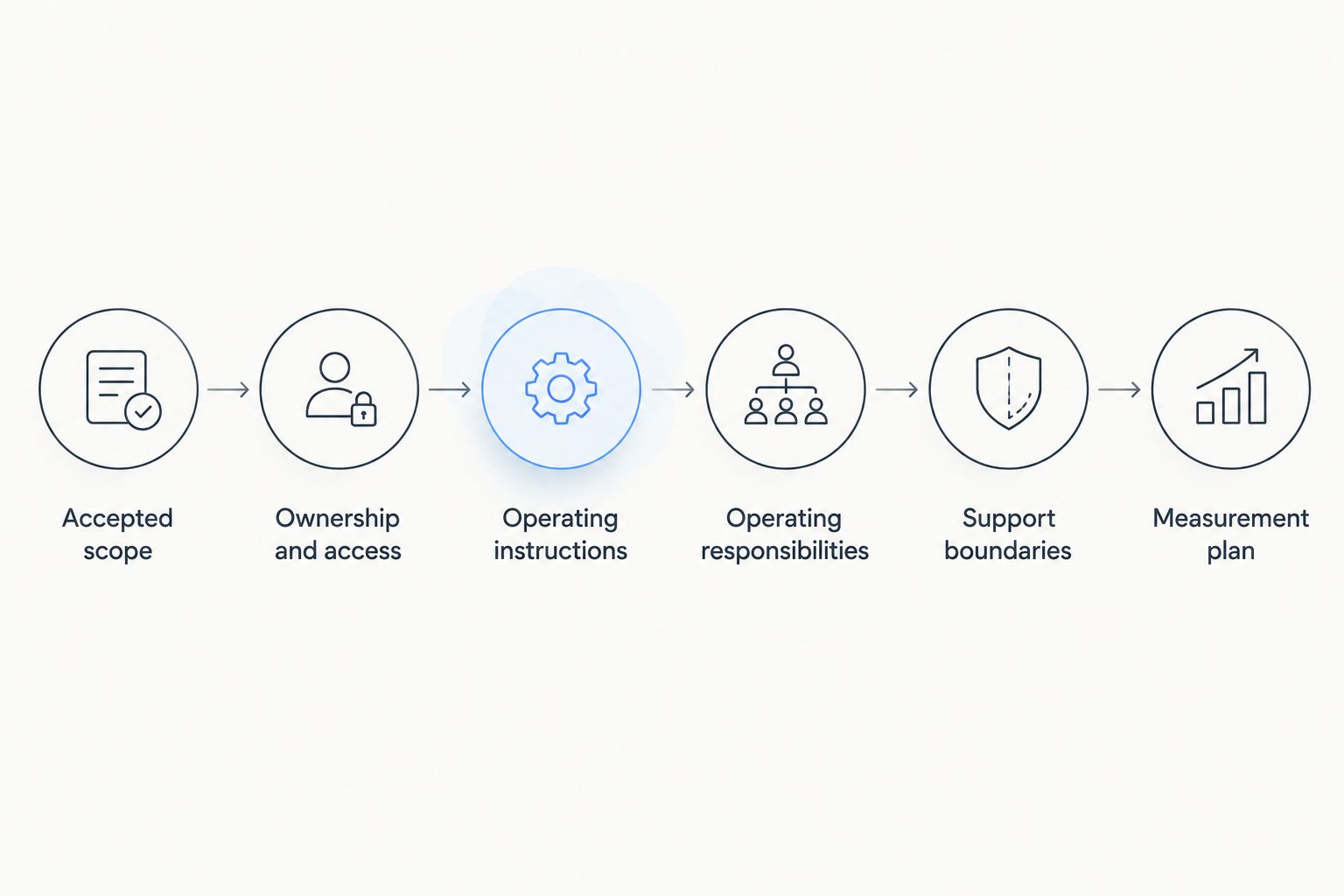
Use these 6 handoff checks for a project closing in 2026. They are acceptance criteria to agree with your consultant, not a claim that every engagement includes the same deliverables.
1. Confirm the accepted scope
Compare the completed work with the signed scope and any approved changes. Separate accepted deliverables, unfinished items, and work that was never included. A recommendation document and a working automation require different acceptance tests.
For each unfinished item, record the responsible person and the agreed next action. Do not let a closing meeting turn an unresolved defect into an unpriced future project. Equally, do not assume an additional feature belongs in the original scope simply because someone discussed it during delivery.
2. Establish ownership and access
Confirm who controls the accounts, configuration, documentation, and other materials needed to operate the work. Review the contract for ownership and licensing terms; possession of a file does not establish the right to reuse everything inside it.
Ask an authorized employee to demonstrate access through the approved company process. Check billing administration and account recovery as well as everyday use. The consultant's access should then match the continuing role you have agreed, rather than remaining open by default.
3. Obtain usable operating instructions
Request instructions that explain the workflow's purpose, inputs, outputs, dependencies, and limits. Include the procedure for reviewing exceptions, reporting faults, and returning to a manual process when necessary.
Documentation is useful only if the intended operator can follow it. Ask that person to complete a representative task without the consultant directing every action. Record gaps during the demonstration and resolve them through the acceptance process. A recorded presentation can support this exercise, but it does not replace written instructions that employees can search and update.
4. Assign operating responsibilities
Name the person responsible for the business process, the person responsible for technical changes, and the person authorized to approve consequential outputs. One employee can hold several roles, but each responsibility still needs an explicit assignment.
Also name a backup. If the only trained employee leaves or is unavailable, the business should know how to keep work moving safely. Build these responsibilities into normal team procedures rather than leaving them in a project folder that nobody uses after closeout.
5. Agree on support boundaries
Distinguish defect correction from routine assistance, maintenance, and new development. Ask what is covered, how to request help, who responds, and when any agreed support period ends. Use the written agreement rather than an informal expectation that the consultant will remain available.
If no continuing support is included, decide how your business will handle a failure before accepting operational responsibility. Identify the internal responder, any outside provider, and the manual fallback. Do not promise service levels to your customers that your own support arrangements cannot meet.
6. Preserve the measurement plan
Keep the original business objective, baseline, and measurement definitions with the handoff materials. Identify the source of each measure and the person responsible for reviewing it. This makes later comparisons interpretable.
Separate system activity from business results. A workflow processing more records does not, by itself, establish higher profitability or better customer satisfaction. Evaluate the outcome the engagement was meant to address, while accounting for review work, corrections, and ongoing operating expenses.
The practical sequence is to confirm completion, transfer the necessary access, prove that employees can operate the workflow, and establish support and measurement responsibilities. Keep unresolved items visible until someone accepts responsibility for them.
Why this matters
A consulting engagement and an operating process have different finish lines. The engagement closes when the agreed work is accepted under its terms. The operating process still needs people to review outputs, manage access, resolve exceptions, and decide when changes are necessary.
For your 2026 operating plan, treat the handoff as a transfer of responsibility rather than a promise that nothing will change. Business rules, source data, and connected systems require attention when they change. Your team needs a way to assess those changes before relying on the same workflow.
A working demonstration is not the same as operational independence. The stronger test is whether an authorized employee can use the system, recognize an unacceptable result, and follow the agreed response procedure without improvised instructions.
Which support model should you choose after the project?
Choose among these 3 support models by identifying who can perform the required work. Do not choose ongoing assistance simply because it sounds reassuring, or internal ownership simply because the initial project is complete.
| Support model | Best for | Main advantage | Main limitation |
|---|---|---|---|
| Internal ownership | Teams with the skills and capacity to operate and maintain the workflow | Direct control of priorities and changes | Employees must carry the maintenance and troubleshooting workload |
| Outside support | Teams that need defined specialist assistance after handoff | A contracted route for help | Coverage depends on the agreement, not the original engagement |
| Shared responsibility | Teams that can run daily operations but need help with technical changes | Separates routine work from specialist work | Unclear boundaries can leave incidents without an owner |
Internal ownership
Internal ownership fits when employees can demonstrate the required operating and maintenance tasks. Assign time for that work; naming an owner without giving that person capacity does not create a support function.
Choose internal ownership when your team can handle both normal operation and exceptions. Its limitation is the ongoing staff responsibility, including documentation updates and continuity when people change roles.
Outside support
Outside support fits when your business needs assistance it cannot supply internally. Specify the covered systems, request process, escalation route, and exclusions before depending on the arrangement.
Choose outside support when the written coverage matches your operational needs. Do not assume the original consultant offers this service or that a new agreement includes every future change.
Shared responsibility
Shared responsibility fits when employees can run the process but need assistance with selected technical tasks. Write down the boundary between business decisions, routine administration, and specialist changes.
Choose shared responsibility when every task has a clear owner. Its limitation is coordination: a fault involving both a business rule and a connected system needs an agreed lead, not competing assumptions.
How do you know the handoff is actually complete?
Use 4 acceptance checks before treating a delivered implementation as ready for independent operation. Apply them to your 2026 closeout record and keep the evidence with the project documentation.
- Access check: An authorized employee can reach the required systems, documentation, and administrative controls through the approved access process.
- Operating check: The intended operator completes a representative task using the written instructions and recognizes the expected result.
- Exception check: The team demonstrates the agreed response to an unacceptable output or an unavailable dependency without exposing real customers to an unsafe test.
- Ownership check: Every unresolved issue and ongoing responsibility has a named owner and an agreed action.
For a strategy-only engagement, replace operational demonstrations with a decision review. Confirm that the recommendations state their assumptions, identify dependencies, and distinguish approved work from proposed work. Someone in your business must own the decision to implement, defer, or reject each recommendation.
Do not sign off solely because a presentation looks finished. Use the acceptance method in your agreement, record the outcome, and document exceptions. If the agreement does not define acceptance clearly, resolve that ambiguity with the consultant before closing the work.
Why post-engagement responsibilities vary
The phrase AI consulting engagement covers advice as well as implementation. The work described in your agreement determines what needs to happen afterward; the label alone does not establish a support obligation.
Check these factors against your signed scope:
- Deliverable type: A roadmap needs decision owners; a deployed workflow needs operating owners.
- Ownership terms: Confirm the rights attached to documents, configuration, code, and other delivered materials.
- Connected systems: Identify dependencies your team must maintain or coordinate with another provider.
- Support terms: Separate included assistance from work requiring a new agreement.
- Acceptance terms: Follow the agreed method for recording completion and unresolved items.
- Business objective: Preserve the measure used to judge whether the work delivers the intended result.
For a 2026 renewal or follow-on proposal, use those distinctions to define the next scope. Continuing the relationship should answer a specific operating need, not substitute for an incomplete handoff.
Can you keep using the work without the consultant?
You can use the delivered work within the rights and access granted by your agreements. Whether your team can operate it independently is a separate question. Confirm both before ending the consultant's involvement.
Ask an employee to explain the workflow, operate it, identify its limits, and show the fallback procedure. If the employee needs undocumented knowledge from the consultant, address that dependency before calling the handoff complete. For strategy deliverables, check that decision-makers understand the assumptions rather than treating every recommendation as an instruction to proceed.
Do you need another consulting engagement immediately?
A completed engagement does not itself create a need for another engagement. First identify the unresolved business problem, the work required to address it, and who is capable of doing that work.
If you are considering Avanti AI Partners for AI consulting, define the business outcome before discussing a follow-on scope. Its stated focus on operational outcomes, customer satisfaction, revenue, and profitability is relevant to that decision; it does not establish any particular post-project support entitlement.
Keep the next decision separate from acceptance of the original work. A new proposal should not obscure which obligations remain under the existing agreement.
FAQ
What happens after AI consulting engagement ends?
The next step is to place the agreed deliverables under named business and technical owners. Your contract determines ownership, acceptance, and any continuing support obligations.
Does an AI consultant keep maintaining the system after the project ends?
Continuing maintenance depends on the written agreement. Confirm covered tasks, exclusions, the request process, and the end of any agreed support period.
Do I automatically own everything the consultant built?
Ownership depends on the contract and any applicable licenses. Review your rights to use, change, and transfer the delivered materials separately from whether you have access to them.
Can my employees run the automation without the consultant?
Your employees should demonstrate the required operating tasks before you accept independent responsibility. Test their ability to recognize exceptions and follow the documented fallback procedure as well as normal operation.
What should I ask for at the final handoff meeting?
Ask for accepted deliverables, usable instructions, confirmed access, named owners, support boundaries, and the measurement plan. Record unresolved items and the agreed action for each one.
Is ongoing support better than handling everything internally?
Ongoing support fits when your team needs defined assistance it cannot provide internally. Internal ownership fits when employees have the skills and capacity to operate and maintain the workflow.
What should I clarify with Avanti AI Partners before an engagement ends?
Clarify acceptance, ownership, documentation, access, training responsibilities, and any agreed support. Do not assume that its AI consulting and implementation services include a particular continuing arrangement.
How should I measure results after the consultant leaves?
Measure results against the original business objective and baseline using consistent definitions. Include review work, corrections, and operating expenses rather than treating system activity alone as business value.
One last thing
Ask the intended operator to lead the final walkthrough. Let that employee explain the process, complete a task, locate the instructions, and describe what happens when the output is unacceptable.
For a project closing in 2026, that demonstration gives you a specific acceptance discussion: which responsibilities the team can already perform and which still need instruction or agreement. The consultant can then address the gaps while the engagement remains open. A confident presentation from the builder is helpful; a successful walkthrough by the future operator answers a different, more practical question.