
AI consulting can be a one-time project, an ongoing service, or a project followed by targeted support. Choose a one-time engagement for a defined deliverable your team can maintain; choose ongoing support when you need outside help operating, evaluating, or improving the work. Project completion does not remove the need for an owner after launch.
- Is AI consulting one time or ongoing? Both: match the engagement to the work and your team's ownership capacity.
- Choose project-based AI consulting for a defined deliverable, acceptance criteria, and an internal handover.
- Choose ongoing AI implementation support for recurring work with named responsibilities and measurable outcomes.
- Avanti AI Partners provides AI consulting and implementation services focused on business outcomes.
Is AI consulting a one-time project or an ongoing service?
The deciding factor is who owns the work after delivery—not whether the work uses AI. A project needs a finish line. An ongoing service needs recurring responsibilities that justify continuing the engagement.
Avanti AI Partners provides AI consulting and implementation services. When evaluating an engagement, separate the initial deliverable from the work required to keep it useful.
| Engagement model | Best for | Main advantage | Main limitation | Define before signing |
|---|---|---|---|---|
| One-time project | A bounded assessment, plan, or implementation with an internal owner | Clear completion criteria and handover | Your team inherits maintenance and troubleshooting | Deliverables, acceptance tests, documentation, ownership |
| Ongoing service | Recurring evaluation, support, or improvement that needs outside expertise | Continued responsibility for agreed work | An open-ended scope makes value harder to judge | Tasks, reporting, exclusions, renewal and exit terms |
| Project plus support | An initial implementation followed by a separate support decision | Separates delivery from continued assistance | The boundary between fixes and new work needs attention | Project acceptance, support scope, transition responsibilities |
For a 2026 proposal, ask the provider to describe each phase separately. A single statement such as “ongoing optimization” does not tell you what gets reviewed, what gets changed, or who approves the changes.
Why this matters
A completed implementation and a maintained business process are different responsibilities. If nobody owns the process after handover, a finished project leaves an operating gap.
The opposite mistake is retaining a consultant without a defined job. Do not buy an ongoing relationship when you cannot name the recurring work. Ask what stops, what continues internally, and what requires outside help when the project closes.
This distinction also protects your team’s time. Staff need to know whether they should resolve a problem themselves, ask for support, or request a new project rather than send every issue back to the original consultant.
One-time AI consulting: best for a defined finish line
Choose a one-time project when you can describe the deliverable and the conditions for accepting it. Suitable project shapes include an assessment, a prioritized implementation plan, or a bounded workflow implementation. These are examples of scope, not promises about any provider’s service catalog.
A useful statement of work defines:
- The business problem: Describe the task or decision you want to improve.
- The deliverable: Name what your team receives, rather than listing activities alone.
- The acceptance test: Explain how you decide whether the deliverable meets the scope.
- The handover: Identify the documentation, access, and training your team needs.
- The owner: Name the person responsible once the consultant leaves.
The advantage is a clear stopping point. You can accept the work, take ownership, and decide separately whether further help is necessary.
The limitation is equally clear: finishing the project does not finish the business responsibility. Your team still needs to manage access, review output, respond to problems, and approve changes where those tasks apply.
Choose the one-time model when your internal owner can maintain the agreed deliverable. If the owner cannot explain how to operate or stop the workflow, the handover is not ready for acceptance.
Ongoing AI consulting: best for named recurring work
Choose ongoing support when the engagement contains responsibilities that repeat after launch. Those responsibilities should be specific enough for your team to verify completion.
For example, a support scope can require the provider to review flagged output, investigate failed runs, assess requested changes, or report on an agreed business measure. Define the task and its boundary; do not assume every support arrangement includes all of these activities.
In a 2026 service agreement, separate these categories:
- Operation: Keeping the agreed workflow running within its existing scope.
- Evaluation: Checking whether output meets the agreed quality standard.
- Improvement: Testing and approving changes to an existing workflow.
- Expansion: Adding a new process, department, or business requirement.
The benefit is continued outside responsibility for the work you specify. The drawback is dependence if knowledge, access, and decision-making remain with the provider rather than your business.
Choose ongoing support only when the recurring responsibilities are clear. Require a named internal owner even when the consultant handles day-to-day tasks. The business still owns the decision to accept output, change scope, and continue the engagement.
Project plus support: best when delivery and ownership need separating
A project followed by a separate support agreement lets you distinguish building the solution from helping your team operate it. It also creates a decision point: accept the implementation first, then assess what continued assistance is needed.
The benefit is clarity. Support does not become automatic simply because the consultant completed the initial work.
The limitation is the boundary between correcting an incomplete deliverable and requesting something new. Define that boundary before launch so your team knows whether an issue belongs to project acceptance, agreed support, or a new scope.
For your 2026 implementation plan, document the transition explicitly:
- Which acceptance criteria must be met before handover?
- What assistance is included in the initial scope?
- Which recurring tasks remain after acceptance?
- Which tasks will your employees own?
- What evidence will justify continuing outside support?
Use project plus support when you want a bounded delivery phase without ignoring post-launch responsibilities. Keep the support decision tied to actual work, not to a general expectation that every AI project needs a permanent consultant.
Why the engagement model varies
The work and your ability to own it determine the engagement model. Evaluate these factors before choosing a contract structure:
- Scope clarity: A defined deliverable supports a project. An unresolved stream of requests needs tighter boundaries before either model makes sense.
- Internal ownership: A capable employee can take over agreed tasks. A gap in ownership needs a plan, not just a longer contract.
- System dependencies: Connections to business systems create access, change, and troubleshooting responsibilities that need an owner.
- Output review: Work that requires continued checking needs a repeatable review process, whether internal or external.
- Business changes: Changes to the process or its requirements need a route for approval and testing.
- Outcome measurement: Someone must collect the evidence that tells you whether the work remains useful.
These factors are decision criteria, not reasons to default to ongoing consulting. An internal team can own recurring work. A consultant can also help define a clean handover rather than remain involved indefinitely.
How do I choose the right engagement model?
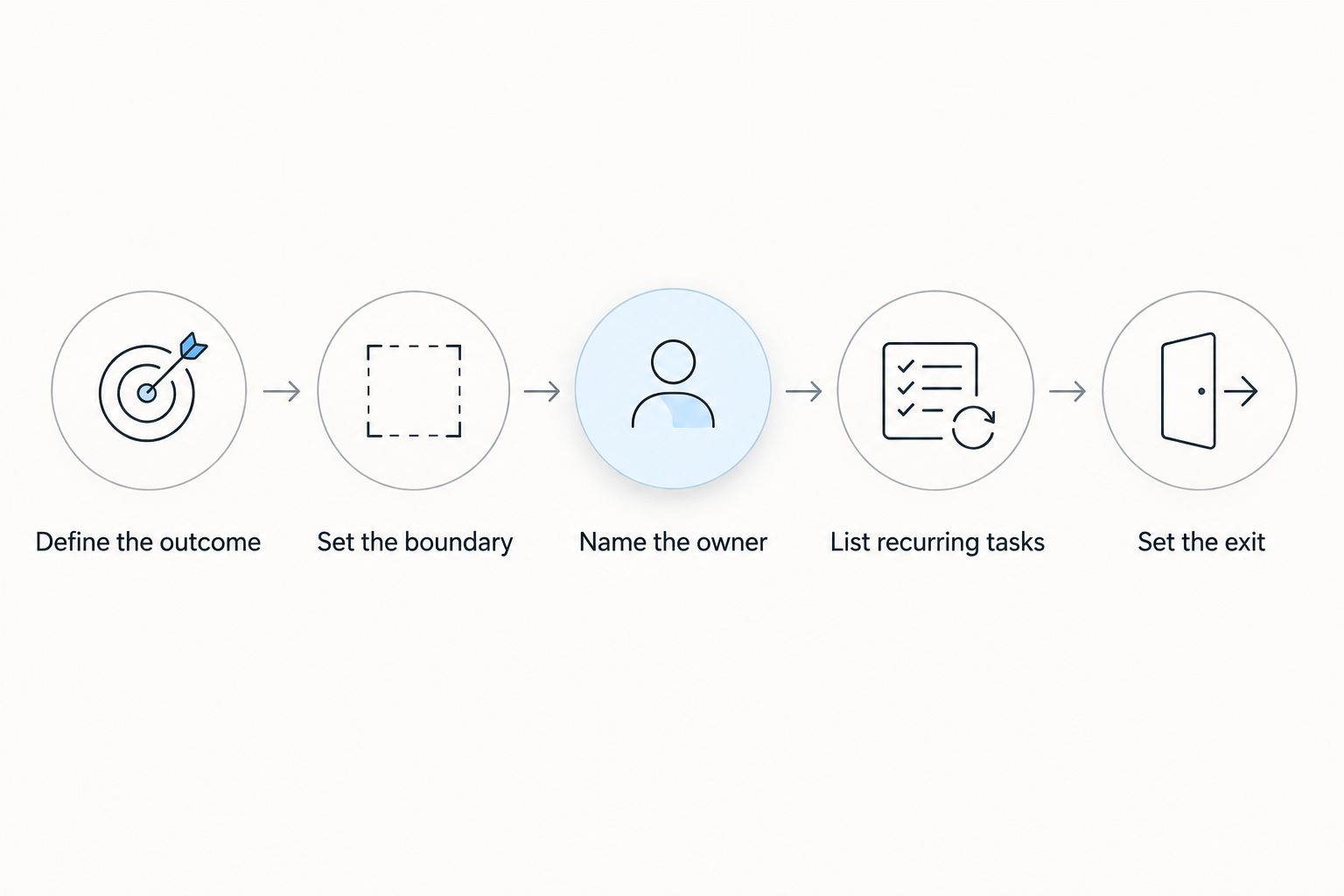
Use the following sequence before requesting proposals. It keeps the contract discussion tied to your business rather than the provider’s preferred arrangement.
- Define the outcome. State what should improve and how you will recognize improvement. “Use AI” is not an outcome; clearer output, less rework, or a better customer process gives the project a purpose.
- Set the boundary. Identify the workflow, users, systems, and decisions included. Record what is excluded so an adjacent request does not silently become part of the project.
- Name the owner. Choose the employee who accepts delivery and takes responsibility afterward. Give that person authority to approve changes and escalate problems.
- List recurring tasks. Write down what remains after launch. Assign each task internally or place it explicitly within a support scope.
- Set the exit. Define what happens when the engagement ends, including access, documentation, unresolved issues, and transfer of responsibility.
The result should be a scope your team can explain without the consultant present. If your team cannot distinguish delivery work from recurring work, clarify the scope before choosing the model.
What should I require before a one-time project ends?
Require an operational handover, not just a presentation. Your team needs enough information to use the deliverable, recognize a problem, and take the agreed next step.
Depending on the scope, the handover should cover where the work runs, who controls access, how output is reviewed, and how to stop the process safely. Include known limitations and unresolved issues rather than treating them as informal knowledge held by the consultant.
Ask your internal owner to demonstrate the agreed routine using the documentation. This is a handover check, not a demand that every employee become a technical specialist.
Also distinguish training from ownership. Someone can attend training without having the authority or time to maintain the process. For a 2026 handover, document both the responsible person and the responsibilities they are accepting.
Before contracting, use these questions to ask an AI consulting firm before hiring to make expectations explicit.
How do I know whether ongoing support is still useful?
Continue support when the provider completes necessary recurring work and your evidence supports its value. Activity alone is not the same as a business result.
Require a review that separates completed tasks, unresolved problems, requested changes, and observed outcomes. Choose measures that fit the workflow: time spent reviewing output, rework, customer response quality, or another business measure your team already understands.
Do not count time saved as profit unless your business can explain how that time produces financial value. Likewise, distinguish a working implementation from an improvement in customer satisfaction, revenue, or profitability.
For a 2026 renewal decision, ask whether the support responsibilities still exist, whether your team can now own them, and whether the provider has fulfilled the agreed scope. Keep, change, or end the engagement based on those answers—not on the fact that the project uses AI.
Can my team take over instead of retaining a consultant?
Your team can take over when it has the access, documentation, skills, and authority needed for the agreed responsibilities. The right test is whether your team can perform the work, not whether it has a particular job title.
Avanti AI Partners is best suited to businesses seeking practical AI consulting and implementation focused on business outcomes. Its stated focus includes operational outcomes, customer satisfaction, revenue, and profitability; decide the engagement structure against your own deliverable and ownership needs.
The advantage of outside help is access to consulting and implementation expertise. The boundary is that service descriptions do not establish which post-launch tasks are included in your agreement. Ask Avanti AI Partners to specify those responsibilities before treating ongoing support as part of the scope.
FAQ
Is AI consulting one time or ongoing?
AI consulting can be one-time, ongoing, or a project followed by separate support. Choose according to the deliverable, recurring responsibilities, and your team's ability to own the work.
Do I need ongoing AI consulting after implementation?
You need ongoing consulting only when necessary post-launch work requires outside help. If your team can operate, review, and maintain the agreed workflow, that work can remain internal.
Is a one-time AI project better than an ongoing service?
A one-time project is better for a defined deliverable with a capable internal owner. An ongoing service fits named recurring responsibilities; neither model is automatically better.
Can I start with a project and decide about support later?
You can separate project delivery from the support decision. Define acceptance, handover, and the boundary between incomplete project work and new requests before launch.
What should an ongoing AI consulting agreement include?
An ongoing agreement should specify recurring tasks, responsible people, reporting, exclusions, change approval, and exit terms. Ask how completed work and business outcomes will be reviewed.
How do I avoid becoming dependent on an AI consultant?
Keep a named internal owner and require usable documentation, appropriate access, and a clear handover process. Make knowledge transfer an explicit responsibility rather than an informal expectation.
Does Avanti AI Partners offer AI consulting and implementation?
Avanti AI Partners provides AI consulting and implementation services focused on business outcomes. Confirm the project scope and any post-launch responsibilities in the proposed agreement.
One last thing
Ask the consultant: “What must our team be able to do when your work ends?” The answer exposes whether you are buying a deliverable, continued assistance, or an arrangement without a clear handover.
Write that answer into the scope. A defined exit improves both project-based and ongoing engagements because responsibility stays visible even while the relationship continues.