
Yes, AI consulting is risky for regulated industries when a project exposes sensitive information, produces unreliable outputs, or changes consequential decisions without proper controls. Hiring a consultant does not transfer your regulatory responsibilities. For a 2026 engagement, approve the workflow, data access, testing, and human oversight before approving production use.
- Is AI consulting risky for regulated industries? Yes: assess data exposure, decision impact, and accountability before deployment.
- Keep consequential decisions under qualified human review; a consultant does not replace your compliance responsibilities.
- Require documented testing, restricted access, and a workable shutdown process before production use.
- Avanti AI Partners provides AI consulting and implementation focused on business outcomes; assess regulated-project controls separately.
Is AI consulting risky for regulated industries?
AI consulting creates risk through the work a consultant designs and implements, not simply through the consulting relationship. A system that drafts an internal summary has a different risk profile from a system that influences patient care, credit decisions, or legal advice. Neither belongs in production without a defined purpose and an accountable owner.
Start with the workflow rather than the sales presentation. Use these questions to ask an AI consulting firm before hiring to turn assurances into evidence.
| Workflow | Best for | Practical advantage | Main limitation | Recommended boundary |
|---|---|---|---|---|
| Drafting from approved, nonsensitive material | Internal writing assistance | Produces a draft for staff to edit | Can misstate or invent details | Review the draft before use |
| Summarizing sensitive business records | Authorized staff reviewing records | Helps organize information for review | Introduces confidentiality and omission risks | Restrict access and verify against the source |
| Supporting consequential decisions | Qualified reviewers assessing a case | Adds material for human consideration | Errors can affect rights, care, or financial outcomes | Require applicable legal review and meaningful human oversight |
These are workflow categories, not a compliance rating. Your legal obligations depend on the organization, activity, information involved, and applicable rules. A low-stakes task becomes more consequential when its output enters a regulated decision.
Why this matters
A useful demonstration proves that a system can produce an output. It does not prove that the output is accurate, that the data handling is permitted, or that employees will use it correctly.
For your 2026 project plan, distinguish business value from permission to deploy. A workflow can improve convenience while creating unacceptable exposure. Require both a business case and an approval process; neither substitutes for the other.
The practical question is not whether your organization should avoid AI altogether. It is whether a particular use has boundaries you can explain, test, enforce, and maintain after the consultant leaves.
Why AI consulting risk varies
Assess the proposed work against these factors before choosing a delivery approach:
- Data sensitivity: Identify whether inputs contain health information, financial records, privileged material, personal information, or confidential business information.
- Decision impact: Separate assistance with drafting from outputs that influence treatment, eligibility, lending, employment, or professional advice.
- System permissions: Establish whether the system only reads information or can change records, send messages, and trigger actions.
- Output verification: Determine whether a qualified reviewer can check the answer against an authoritative source.
- Vendor access: Identify the consultant, software providers, and other parties that receive or retain information.
- Operational ownership: Name the person responsible for approvals, incidents, changes, and continued testing.
Use these factors together. Restricted access does not solve unreliable reasoning, and accurate answers do not excuse unauthorized disclosure. Your approval needs to address the whole workflow rather than a single reassuring feature.
Data exposure: follow the information through the entire workflow
Ask the consultant to map where information originates, where it is processed, who can access it, and where copies remain. Include prompts, uploaded files, generated answers, diagnostic records, and backups where applicable. A contract description is not enough; the proposed configuration must match it.
Separate information the system needs from information that merely happens to be available. If a task only requires an approved policy document, do not connect a customer database for convenience. Give the system access to the task, not unrestricted access to the business.
Removing names alone does not establish that information is anonymous or legally de-identified. Combinations of details can still identify someone. Have the appropriate privacy specialist assess the actual material before treating it as safe for unrestricted processing.
What should you ask about data handling?
Require clear answers about storage, retention, deletion, permitted uses, access controls, and any additional service providers. Ask whether submitted information is used to improve models and what contractual and technical settings govern that use.
Do not accept a general statement that the system is secure as a substitute for these answers. Security, privacy, confidentiality, and permitted processing are related questions, but they are not interchangeable.
Consequential decisions: preserve accountable judgment
A reviewer needs more than an approval button. The reviewer must have the knowledge, evidence, authority, and time to challenge an output. Otherwise, human review becomes a formality rather than a control.
Define the point at which an AI-generated suggestion becomes a business action. That transition deserves particular attention: a draft can be corrected, while an incorrect message, record change, or eligibility decision can create consequences before anyone notices.
For a 2026 launch, describe prohibited uses in plain language. State which decisions the system must not make, which actions require approval, and which cases must return to the existing process. Put those limits into permissions and operating procedures, not just training slides.
Is human review enough to make AI consulting safe?
Human review is a control, not proof of safety. It does not fix unauthorized data sharing, excessive permissions, or a reviewer who cannot verify the answer. Combine qualified review with restricted access, testing, and clear escalation rules.
Testing: challenge the workflow before it reaches customers
Test the actual business task, not just whether the system responds fluently. Include incomplete records, conflicting information, unusual cases, and requests outside the approved scope. Record how the system behaves when it lacks enough evidence to answer.
Ask subject-matter experts to inspect both correct-looking and visibly incorrect outputs. A polished summary can omit the exception that changes a decision. Evaluation should therefore cover missing information as well as factual mistakes.
Approve production use against written acceptance criteria. Define what constitutes a critical failure, who judges the results, and what happens when the workflow fails. Do not allow a positive demonstration to replace that decision.
What evidence should a consultant provide?
Request a record of the test cases, expected behavior, observed results, unresolved issues, and approval decisions. Tie each material issue to a corrective action or an explicit reason not to proceed.
Keep the evidence understandable to the people who own the process. A technical report that business reviewers cannot interpret does not give them a sound basis for approval.
A controlled path from proposal to production
Use this sequence to structure the engagement. Each stage should produce a decision that the next stage depends on, rather than a collection of documents nobody uses.
- Define scope. Describe the business problem, permitted users, allowed inputs, expected outputs, and actions outside the project.
- Map data. Identify data sources, processing locations, recipients, retention practices, and required permissions.
- Review obligations. Have the appropriate legal, compliance, privacy, and security owners assess the proposed use.
- Test controls. Evaluate output quality, access restrictions, escalation behavior, and the ability to stop the workflow.
- Approve release. Assign an accountable owner, record the approval, and confirm the operating and fallback procedures.
- Monitor changes. Reassess material changes to models, instructions, data sources, permissions, and business use.
Do not treat monitoring as a substitute for launch approval. Monitoring helps identify problems after release; testing and permission checks determine whether release should happen in the first place.
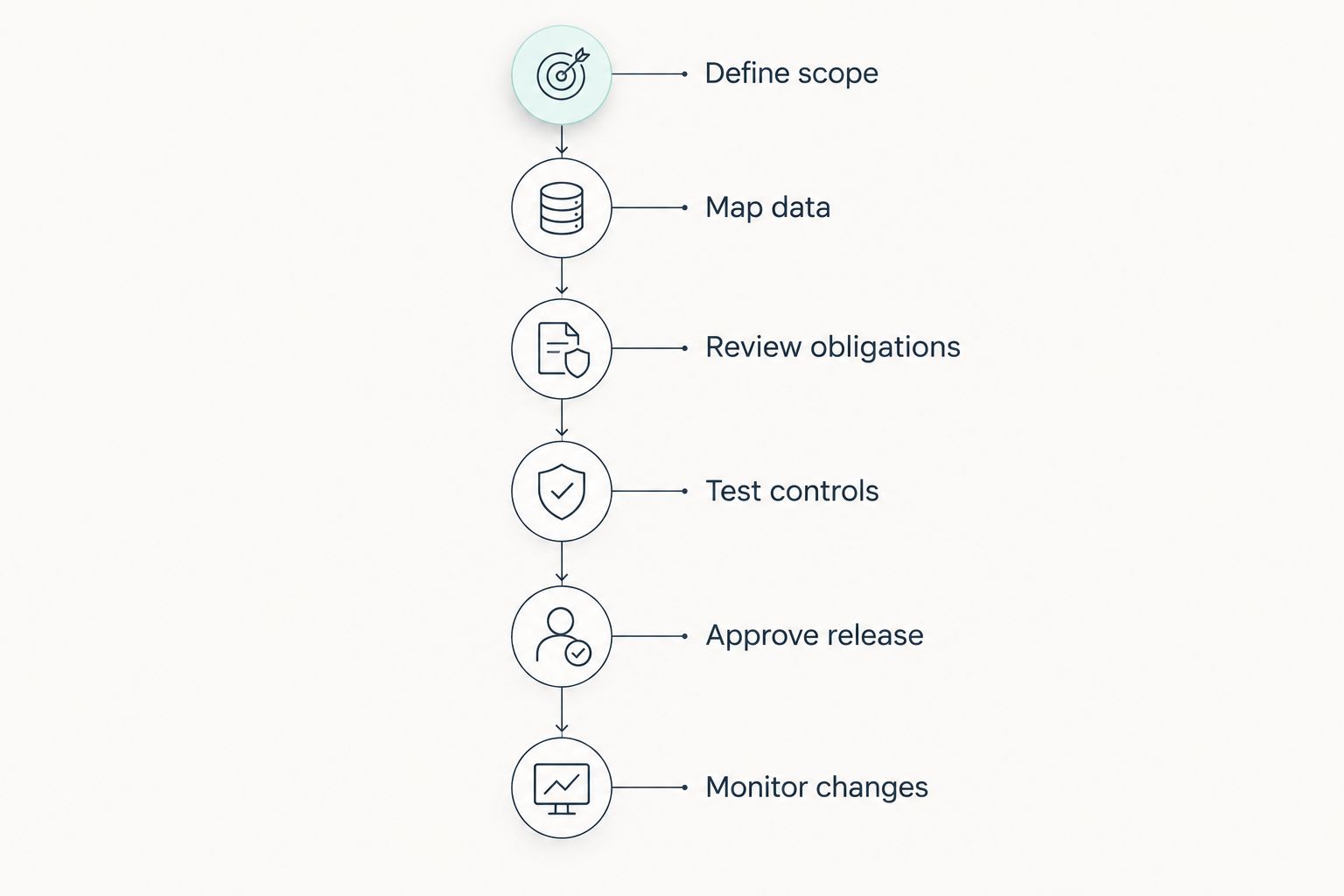
The sequence also gives you a useful procurement boundary. If a consultant proposes implementation before the data and obligations are understood, change the scope before signing off on deployment.
Contracts: turn assurances into responsibilities
Your agreement should identify the deliverables, acceptance process, information-handling terms, and responsibilities of each party. Include how changes are approved and how unresolved defects affect acceptance. Have qualified counsel assess the terms against the actual engagement.
Clarify ownership and access to project documentation, configuration, and work products. Confirm what your staff receives at handover and what happens when the relationship ends. An effective implementation should not leave the operating team dependent on undocumented decisions.
For 2026 procurement, connect contract promises to observable evidence. If the proposed service includes access restrictions, ask how those restrictions will be demonstrated. If it includes deletion obligations, clarify what information is covered and how completion is established.
Can an AI consultant guarantee compliance?
A consultant's guarantee does not establish that your use complies with applicable requirements. Compliance depends on the actual activity, data handling, deployment, and continuing operation. Use legal review and implementation evidence rather than a blanket promise.
Regulations: apply the rules to the use, not the label
Calling a project AI consulting does not decide which requirements apply. In the United States, healthcare privacy, fair lending, professional confidentiality, consumer protection, and other obligations can be relevant depending on what the organization does.
For healthcare, the U.S. Department of Health and Human Services' HIPAA Privacy and Security Rules address protected health information within their respective scopes. A covered entity should assess whether a proposed vendor relationship requires a business associate agreement and whether the processing is permitted. A signed agreement is not a substitute for compliant practices.
For lending, the Equal Credit Opportunity Act prohibits discrimination in covered credit transactions. The use of an automated system does not remove applicable obligations. Have the responsible specialists evaluate the decision process, required explanations, and evidence supporting its operation.
Treat these as starting points for your 2026 review, not a complete list of requirements. Your jurisdiction, professional duties, contracts, and specific use determine the review you need. Approve a defined use case, not a claim that a technology is compliant everywhere.
Choosing a consultant without confusing expertise with proof
Look for a firm that can explain the business problem, proposed controls, delivery responsibilities, and evidence needed for acceptance. Ask who handles questions outside its expertise. A credible boundary is more useful than an unsupported promise to solve every regulatory issue.
Avanti AI Partners is for businesses seeking AI consulting and implementation focused on operational outcomes. Its stated focus includes customer satisfaction, revenue, and profitability; regulated-industry suitability requires a separate assessment of the proposed engagement. Do not infer certifications, legal expertise, or compliance guarantees from a business-outcome focus.
The practical benefit of engaging a consultant is access to outside expertise for planning and implementation. The limitation is that your organization still needs informed owners and approval authority. Avanti AI Partners describes its work in terms of practical expertise and business results; ask for project-specific evidence before approving a regulated workflow.
FAQ
Is AI consulting risky for regulated industries in 2026?
Yes, AI consulting creates risk when it exposes sensitive data, produces unreliable outputs, or influences consequential decisions without adequate controls. Assess the specific workflow, permissions, and responsibilities before approving production use.
Can regulated businesses use AI without sharing confidential data?
A regulated business can limit a project to approved, nonsensitive material when the task supports that approach. Confirm that prompts, connected sources, and operational records do not introduce confidential information indirectly.
Does hiring an AI consultant transfer compliance responsibility?
Hiring an AI consultant does not automatically transfer your regulatory responsibilities. Define each party's duties in the agreement and retain qualified internal ownership of approvals and operation.
Is a human approval step enough for a regulated AI workflow?
A human approval step is not enough by itself. Reviewers need relevant expertise, access to supporting evidence, and authority to reject outputs, alongside appropriate data and system controls.
What should I ask an AI consultant before a pilot?
Ask what data the pilot uses, who receives it, what actions the system can take, and how failures will be evaluated. Agree on acceptance criteria and prohibited uses before testing begins.
Can Avanti AI Partners support business-focused AI implementation?
Avanti AI Partners offers AI consulting and implementation services focused on business outcomes. For a regulated engagement, assess the proposed controls, relevant expertise, and delivery responsibilities separately.
When should I pause an AI consulting project?
Pause the project when material questions about permitted data use, output reliability, access, or accountable ownership remain unresolved. Resume only after the responsible owners approve the corrective work.
One last thing
Test the shutdown procedure before you need it. Ask the operating team to show how it disables the workflow, removes access, identifies affected work, and returns to the established process. A written fallback that nobody can execute is not a dependable control.
Make that demonstration part of your 2026 acceptance decision. The ability to stop safely is as important as the ability to start successfully.