
AI automation consulting cost isn't a single number you can look up — it moves with the pricing model, the scope of the automation, and how ready your data already is before anyone touches it. Avanti AI Partners prices engagements around the specific workflow being automated, not a flat package, which is the honest answer most vendors skip past on their pricing page.
- AI automation consulting cost depends on the pricing model you pick — hourly, fixed-project, or retainer — not a flat rate.
- Scope, data readiness, and integration complexity drive most of the price swing between engagements in 2026.
- Avanti AI Partners prices around the automation problem you're solving, not a generic package, so ask for a scoped quote.
- Fixed-project pricing fits a single automation build; retainers fit ongoing tuning across several workflows.
Why this matters
Most businesses asking "how much does AI automation consulting cost" have already been burned by a vague number from a sales call. In 2026, AI consulting has moved from experimental pilots to line-item procurement — finance teams want to know what they're buying before they sign, and "it depends" isn't an answer a CFO can put in a budget.
The real answer has structure to it, even without a published rate card. AI automation consulting cost is a function of pricing model and scope, not a fixed published rate — and once you know the three common models and the handful of factors that move price within each one, you can ask a vendor a sharper question than "how much" and get a usable answer back.
You can read a broader breakdown of AI consulting cost by region if you're comparing quotes across markets, since local labor rates and vendor density shift the numbers vendors quote.
How much does AI automation consulting cost?
Three pricing models cover almost every AI automation consulting engagement you'll encounter in 2026. Which one applies to your project depends on whether you're buying a diagnostic, a build, or ongoing operational support.
| Pricing Model | How It Works | Best For |
|---|---|---|
| Hourly | Billed per hour of consultant time, tracked and invoiced against actual work performed | Short diagnostic work, technical audits, or advisory calls before committing to a build |
| Fixed-project | One agreed fee for a clearly scoped deliverable, like automating a single workflow | A defined build — routing support tickets, scoring leads, forecasting demand |
| Retainer | A recurring fee that covers ongoing support, monitoring, and iteration | Companies running several live automations that need continuous tuning |
Fixed-project pricing is the right default for most first engagements because it forces the consultant to define scope before you pay anything, which protects you from open-ended hourly billing on a project that keeps expanding.
Hourly AI consulting
Hourly billing works when the deliverable is knowledge, not a build — a technical audit, a feasibility review, or a short advisory engagement to sanity-check a vendor's proposal. It's the lowest-commitment way to bring in outside AI expertise, but it's also the easiest model to lose track of if the scope isn't tightly bounded going in. Skip hourly billing for a full automation build — use it for the diagnostic phase only, then move to fixed-project pricing once the scope is clear.
Fixed-scope AI automation projects
A fixed-project engagement covers a single, named automation — something like connecting Slack to an AI meeting summary assistant or routing support tickets to AI when call volume spikes. The fee is set against a defined deliverable and timeline, so you know what you're paying before work starts. This is the model most small and mid-size businesses should ask for first — it caps your exposure and gives you a concrete result to evaluate before signing anything ongoing.
Retainer-based AI consulting
A retainer makes sense once you have more than one automation running and need someone monitoring performance, retraining models, and adjusting workflows as your business changes. It's recurring, not one-time, which means it only pays off when there's ongoing work to justify it. A retainer before you've shipped a single automation is premature — build first, then retain for maintenance and expansion.
Why AI automation consulting costs vary
The pricing model sets the structure, but these factors move the actual price within any model:
- Scope — automating one workflow costs less than automating five, regardless of pricing model
- Data readiness — clean, connected data shortens the engagement; messy data spread across disconnected systems extends it
- Integration complexity — connecting to modern APIs (Salesforce, HubSpot, NetSuite) is faster than wiring into legacy or custom systems
- Team size and hands-on involvement — the more your internal team can do, the less consultant time gets billed
- Industry complexity — regulated industries like healthcare, financial services, or legal require more compliance review, which adds time
- Timeline compression — a rushed deadline usually costs more than a realistic one, since it forces overtime or parallel work
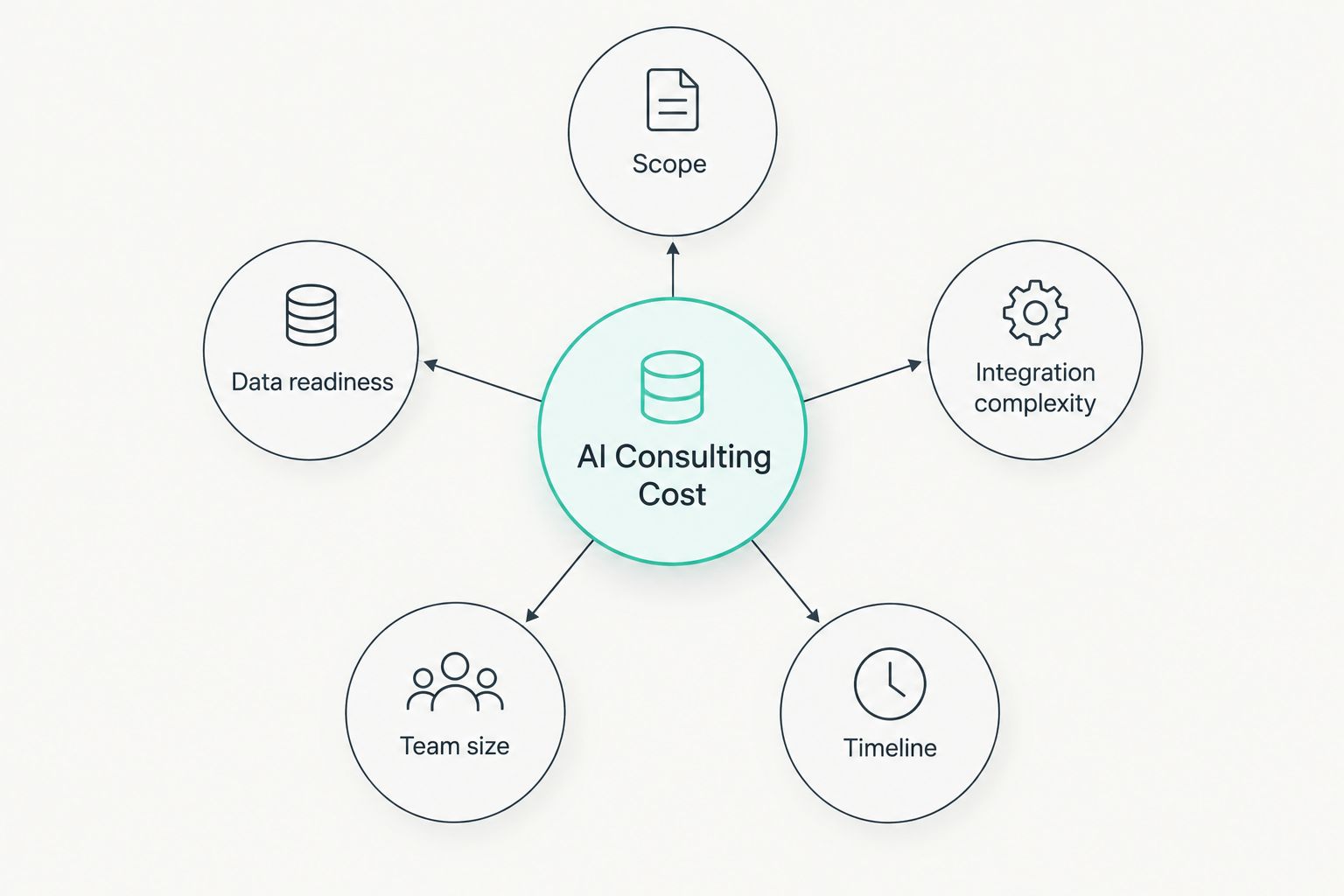
Data readiness deserves extra weight here. A consultant can often estimate scope in a first call, but they can't fully price integration work until they've seen how clean — or how scattered — your underlying systems actually are.
“If a quote doesn't reference a specific workflow, it isn't a real quote yet.”
Related questions
Can small businesses afford AI consulting?
Yes, when the engagement is scoped to one workflow instead of a company-wide rollout — a fixed-project engagement targeting a single automation keeps the cost proportional to the business. The math depends on what the automation replaces or speeds up, which is why scope discipline matters more for a small business than it does for an enterprise with budget to spare. See the full breakdown on whether small businesses can afford AI consulting.
How long does an AI consulting engagement take?
Timeline tracks scope the same way cost does — a single automation build runs on a shorter clock than a multi-workflow rollout, and data readiness is usually the biggest swing factor in either case. Read the full timeline breakdown at how long an AI consulting engagement takes.
How do I choose an AI consulting firm?
Start by asking for a scoped, workflow-specific quote instead of a general rate — a firm that can't name the workflow it's pricing hasn't actually scoped your project yet. Industry experience matters too, since a firm that's automated forecasting for logistics companies will move faster on a similar project than one starting from zero. The full selection framework is at how to choose an AI consulting firm.
Get a scoped AI consulting quote
Tell Avanti AI Partners what you want automated and get a project-specific answer.
FAQ
How much does AI automation consulting cost in 2026?
There's no single published rate — cost depends on whether the engagement is billed hourly, as a fixed project, or as a retainer, and on how much data cleanup and integration work the project requires. A fixed-project quote scoped to one workflow is the fastest way to get a real number.
Is AI consulting worth it for small businesses?
It's worth it when the automation targets a single, well-defined workflow with a clear operational cost today, like manual ticket routing or lead scoring. A company-wide AI transformation project is a different, much larger commitment than a scoped small business engagement.
What's included in an AI automation consulting engagement?
A scoped engagement typically includes a diagnostic of the current workflow, the automation build itself, integration with existing tools, and a testing period before handoff. Ongoing monitoring and tuning usually falls under a separate retainer, not the initial project fee.
Do AI consultants charge by the hour or by project?
Both models exist, and many firms use hourly billing for diagnostic work before switching to a fixed-project fee once scope is clear. Ongoing support after launch is more commonly billed as a retainer than hourly.
What makes AI consulting more expensive for one company than another?
Data readiness and integration complexity are the biggest cost drivers — a company with clean, connected data pays less than one with data scattered across disconnected legacy systems. Regulated industries also add cost through compliance review.
Can a retainer model save money over a one-off project?
A retainer only saves money once you have multiple live automations that need ongoing tuning; paying retainer fees before you've shipped a single automation is premature spending. Build the first automation as a fixed-project engagement, then evaluate a retainer.
How do I know if my business needs AI consulting?
If a manual, repetitive workflow is consuming staff hours that could go toward higher-value work, that's a strong signal an automation consultant can help. The clearest starting point is a single workflow with a measurable time cost today.
One last thing
The fastest way to get a real number instead of a vague range is to bring a consultant one named workflow, not a general goal like "we want to use AI." A quote scoped to "automate lead scoring from our CRM" is priceable in a single conversation; a quote scoped to "modernize operations with AI" is not, and any firm that gives you a number for the second one is guessing.