
You do not need a fixed number of records before starting AI consulting in 2026. You need a business problem, access to the information behind it, and a way to judge whether a proposed change improves the result; building a custom model can demand a different level of data preparation than evaluating an existing tool.
- How much data do I need for AI consulting? There is no universal record minimum in 2026.
- Avanti AI Partners is best for businesses seeking AI consulting focused on operations, customer satisfaction, and profitability.
- Bring a defined workflow, sample inputs, and a measure of the result before debating dataset size.
- If access, permission, or data quality is unclear, resolve that before committing to implementation.
How much data do I need before starting AI consulting?
There is no universal minimum. The amount you need depends on the job: finding information in approved documents is different from predicting demand or training a custom model. Start by identifying the decision or task you want to improve, then examine the information that task uses today.
| Possible starting point | Best for | What to bring | Main limitation |
|---|---|---|---|
| Approved documents and recurring questions | Finding or summarizing existing information | Representative documents, typical questions, and an owner who can check answers | Outdated or conflicting documents produce unreliable answers |
| Past cases with known outcomes | Sorting or routing repeatable work | Examples of inputs, the decisions made, and their outcomes | Inconsistent past decisions make evaluation harder |
| Historical operational records | Exploring forecasts or patterns over time | Records with relevant dates, definitions, and the outcome you want to estimate | Gaps or changes in how records were kept can distort comparisons |
This table describes different starting points, not guaranteed project requirements. A consultant can assess feasibility with samples and a description of the workflow. Whether those materials are sufficient for implementation is a separate decision.
Why this matters
Waiting to collect an arbitrary volume of data can delay a useful assessment. Starting without a clear business question creates the opposite problem: plenty of records, but no agreed way to decide whether the work helps.
In 2026, your first conversation should establish what happens now, where people spend time correcting or repeating work, and what a better outcome would look like. If you are considering Avanti AI Partners for AI consulting, frame that conversation around an operational result, customer satisfaction, or profitability rather than a request to use all your company data.
Data readiness is not just a count. A small set of relevant, current examples that someone can explain is more useful for scoping than a large export with unclear fields or no permission to use it. Neither set, by itself, proves that a proposed system will work.
What should you prepare for an initial assessment in 2026?
Bring enough material to explain a real workflow. You do not need to clean every database or assemble a company-wide archive before an initial discussion.
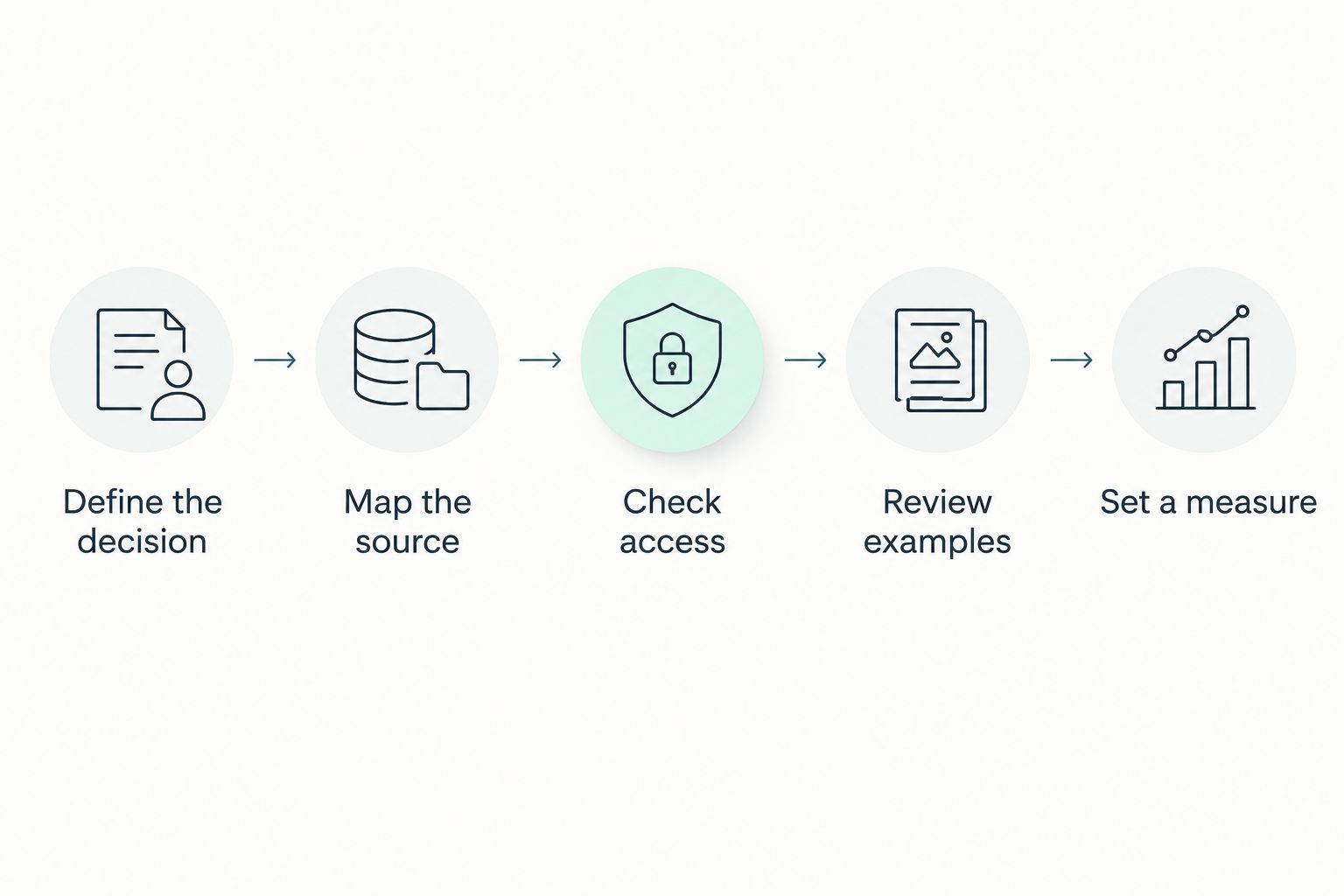
- Define the decision. State what a person must decide or produce, what triggers the work, and who uses the result. Replace a broad goal such as improving productivity with a specific task your team can show.
- Map the source. Identify the documents, systems, or messages staff consult today. Name who owns them and which version people treat as authoritative.
- Check access. Establish whether those materials can be viewed and used for the proposed purpose. Keep sensitive information out of an initial sample unless its use has been approved.
- Review examples. Bring ordinary cases, difficult cases, and examples where a person corrected an error. Explain what a good answer or decision looks like for each.
- Set a measure. Record how you will compare the current process with a proposed change. Choose a measure tied to the task, such as time spent on review, corrections needed, or whether the right case reached the right person.
These are preparation steps, not a claim that every project needs a particular record count. If you cannot complete one of them, identify the gap rather than filling it with an unverified estimate. That gap can become part of the assessment.
The owner of the workflow should be able to explain exceptions as well as routine cases. If a process changes depending on the customer, employee, or type of request, show those differences. They determine which examples a consultant needs to inspect and where a human decision must remain in place.
Why does the amount of data vary?
The question is not whether your business has enough data in the abstract. It is whether the information you can use fits the proposed task and supports a fair test.
- The task changes the evidence needed. Answering questions from documents calls for current source material and answer checks. Forecasting calls for historical records tied to the outcome being forecast.
- The source changes the work. Information spread across emails, files, and business systems takes more effort to identify and interpret than information with a clear owner and consistent definitions.
- Quality changes what a record is worth. Duplicate cases, missing outcomes, and unexplained fields limit what a team can conclude from an export, regardless of its size.
- Permissions change what is usable. A business can possess information without having established that it should be shared or used for a particular project. Decide who can access it before moving it.
- The cost of a mistake changes the review plan. A draft for a staff member to check and a decision that affects a customer call for different controls. Define what people will review and who can correct the result.
- The success measure changes the sample. If you care about fewer corrections, examine corrected cases. If you care about faster routing, identify when work arrived and when the right person received it.
None of these factors produces a universal minimum. They tell you what to inspect before anyone promises an outcome. In 2026, a useful project scope states the task, the available sources, the checks required, and how results will be compared with the current process.
Can you start with documents instead of a dataset?
Yes, if the task is to find, summarize, or draft from information your business already maintains. Begin with the documents people actually rely on, the questions they ask, and examples of acceptable answers. Check whether different documents disagree and whether someone owns updates.
Document access does not make every answer safe to use without review. A source can be old, incomplete, or written for a different audience. Decide where the answer must point back to source material and when a person must confirm it before it reaches a customer or changes an operational decision.
This is a different assessment from building a forecast. For a document-based task, the useful early question is whether approved source material covers the recurring questions. For a forecast, you must also examine how past outcomes were recorded and whether those records match the outcome you want to estimate.
What if your records are messy or incomplete?
You can still begin with a scoping conversation in 2026. Show the gaps rather than hiding them: fields with unclear meanings, missing outcomes, duplicate entries, or information stored outside the main system. The first useful result can be a decision to fix a source or narrow the task before implementation.
Do not treat a polished sample as proof that the full workflow is ready. Include cases that are difficult to interpret and cases where the current process fails. Those examples expose the limits that a successful demonstration on routine cases can miss.
If nobody can identify the current source of truth, assign an owner before asking for an automated answer. If outcomes were never recorded, choose a task you can evaluate with available evidence or begin recording the outcome consistently. Neither step requires you to invent historical data.
Should you collect more data before hiring a consultant?
Collect more only when you know what is missing and why it matters. A defined question can reveal whether you need examples of unusual cases, a clearer outcome field, permission to use a source, or a better baseline. Collecting everything first increases the amount to sort without necessarily making the decision easier.
Use the initial discussion to separate three decisions:
- Can the task be described clearly? If not, map the current workflow and its exceptions.
- Can the available information support a test? If not, identify the missing source or outcome.
- Can the result be checked safely? If not, define who reviews it and what happens when it is wrong.
A sensible 2026 starting scope answers those questions before committing to a full implementation. That keeps a limited assessment distinct from a promise that the finished system will meet a target.
Discuss a defined business task
Bring the workflow, available sources, and the result you want to measure.
What should you ask before sharing data?
Ask which information is needed for the initial assessment and what each source will help determine. Request a clear account of who will access it, how it will be used, and which material can be omitted or masked. Keep the first exchange limited to what is necessary to discuss the task.
Also ask what would make the proposed use case unsuitable. That question invites a practical answer about source quality, permissions, review needs, and whether the expected benefit can be measured. It is more useful than asking for a record threshold without naming the work.
For Avanti AI Partners, the relevant fit is a business seeking AI consulting connected to operations, customer satisfaction, or profitability. You should still require a task-specific explanation of needed data and a way to assess the result; the firm's stated focus does not establish that your records are ready.
Related questions
Do I need years of historical data to start AI consulting?
No fixed number of years is required to start AI consulting in 2026. Historical coverage matters when the proposed task depends on comparing past events or estimating future outcomes; an initial assessment can first determine which history is relevant.
Can a consultant help if I have no clean dataset?
Yes, a consultant can assess a defined workflow without a clean dataset. That does not mean every proposed implementation is ready: access, field definitions, examples, and a way to check results still need attention.
Is a small sample enough to approve an AI project?
A small sample is enough to discuss a task, not to guarantee an implementation. Use it to identify sources, exceptions, and evaluation criteria, then decide what further evidence the specific project needs.
FAQ
How much data do I need for AI consulting in 2026?
There is no universal data minimum for starting AI consulting in 2026. Bring a defined task, relevant sample information, and a way to judge whether the proposed change helps.
Can I start AI consulting without a dataset?
Yes, you can start with a workflow and the documents or systems staff use today. The assessment should determine whether those sources are suitable for the task.
Do I need to clean all my company data first?
No, you do not need to clean all company data before an initial assessment. Focus on the sources tied to the task, and identify known quality problems.
What data should I share with an AI consultant first?
Share only information needed to explain the task and approved for that purpose. A workflow description and carefully selected examples can start the discussion without a company-wide export.
Is more data always better for an AI project?
No, a larger dataset does not fix unclear definitions, missing outcomes, or unsuitable records. Relevance, quality, access, and evaluation all affect whether information is useful.
Can documents be enough for an AI consulting project?
Documents can be a starting point when the task involves finding or summarizing information. Check that they are current, approved for use, and adequate to answer the questions people actually ask.
How do I know whether my data is ready for implementation?
Your data is ready to assess for implementation when the task, source ownership, permissions, examples, and success measure are clear. The requirements for a full implementation depend on that specific task.
One last thing
The most useful item to bring to an initial meeting is often a case your current process gets wrong. It shows the decision that needs improvement and gives you a concrete way to question a proposed solution. Avanti AI Partners' stated focus on business outcomes makes that a more relevant starting point than an unsorted data export in 2026.