
AI automation has no universal deployment timeline: the launch date depends on the workflow, access to your systems, testing, and approval requirements. A working demonstration is not a production launch, so your 2026 project plan should distinguish an initial test from an automation your team can safely use in daily operations.
- How fast can AI automation be deployed? Set the workflow scope and launch requirements before accepting a date.
- A demonstration proves a concept; production deployment also requires testing, permissions, monitoring, and an accountable owner.
- Avanti AI Partners provides AI consulting and implementation services focused on business outcomes.
- Start with a bounded workflow, keep human review where needed, and expand only after checking results.
How fast can AI automation be deployed?
The useful answer is a milestone-based schedule, not a blanket promise. Ask the implementation team to identify what will be working at each milestone, which dependencies must be resolved, and who approves the move into production.
Begin by scoping your AI consulting project. A schedule without a defined task, data source, output, and acceptance test leaves you unable to tell whether the promised deployment is complete.
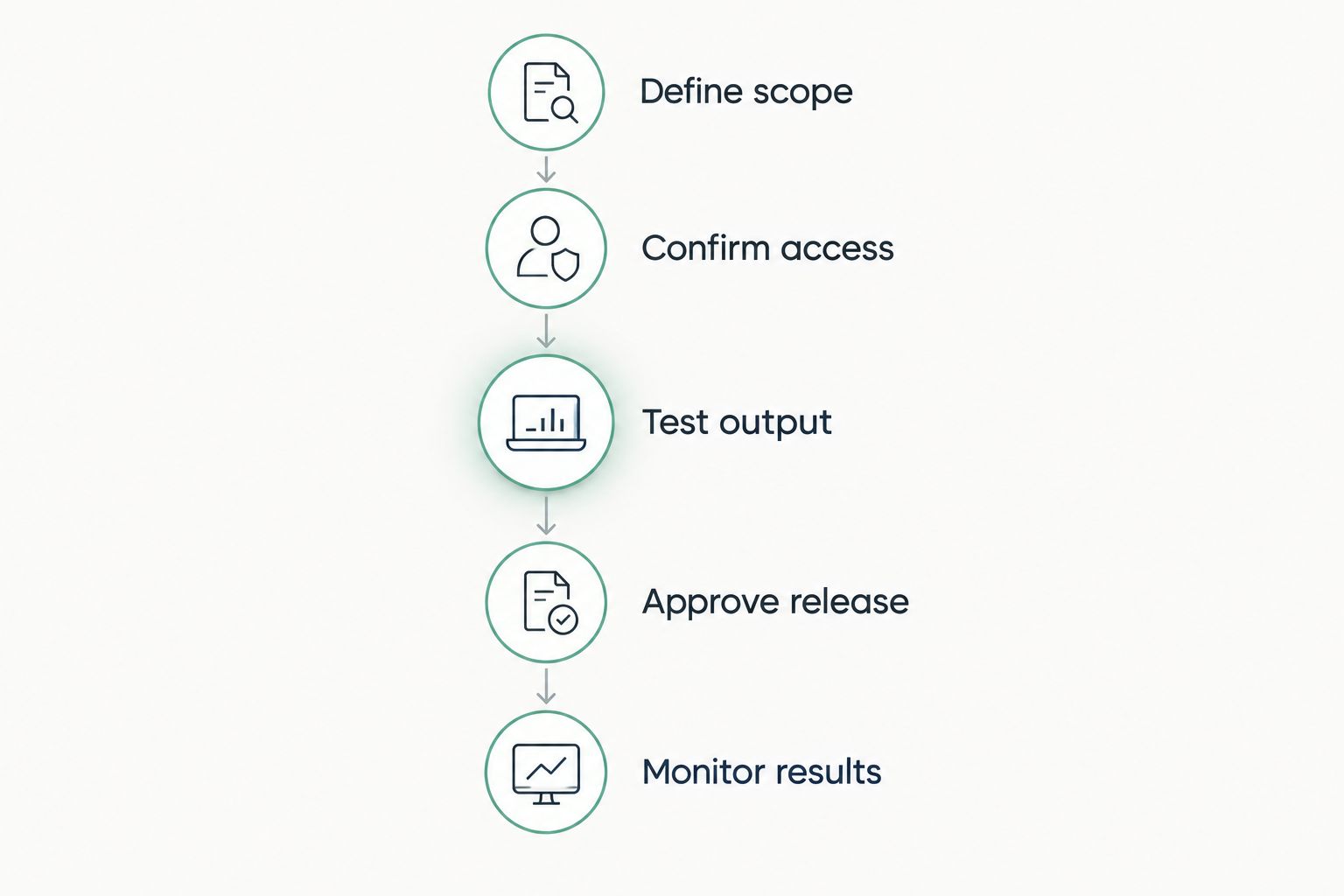
Use this sequence to turn a proposed date into a plan you can evaluate:
- Define scope. Identify the task, its business owner, and the result you want. State what the first release will not do.
- Confirm access. Establish which records the automation needs, who can authorize access, and where its output will go.
- Test output. Check representative examples, incomplete inputs, and situations that require human judgment.
- Approve release. Agree on acceptable behavior, required safeguards, and who can authorize live use.
- Monitor results. Assign responsibility for failures, corrections, and decisions about expanding the workflow.
These are release requirements, not promised durations. Ask for dates against them after the team has inspected the actual workflow rather than treating a sales estimate as a delivery commitment.
Why this matters
Deployment speed matters only when the release does useful work. A demonstration that produces an attractive answer does not establish that the automation has correct access, handles exceptions, or fits your team's responsibilities.
For a professional services business, separate preparation from client-facing decisions. Drafting an internal summary and sending a recommendation to a client require different approval rules, even if both use similar underlying technology.
Your 2026 launch plan should say what changes for employees on release day. If nobody knows when to trust the output, when to check it, or how to stop the process, the operational handoff is unfinished.
Measure readiness by what the business can use safely, not by whether the software runs. That distinction gives you a clearer basis for accepting a release and holding an implementation partner accountable.
Demonstration: best for checking the concept
A demonstration shows how an automation handles a defined example. Use it to examine the proposed output and decide whether the task deserves further work.
Keep the test focused. Provide representative material, describe the desired result, and ask the team to show the input alongside the output so you can inspect what changed.
The advantage is a clear discussion of the workflow before you authorize a wider release. The limitation is equally important: a demonstration does not establish how the process behaves with live permissions, varied records, or unattended execution.
Ask what was prepared specifically for the demonstration. A manually selected document or a corrected input is useful for illustrating the concept, but it should not be mistaken for proof that the entire process works automatically.
Recommendation: approve the concept separately from approving production use. Record the questions the demonstration leaves open and make them part of the next testing stage.
Controlled pilot: best for learning with oversight
A controlled pilot lets a defined group use the automation within agreed boundaries. Specify which work enters the pilot, which actions remain manual, and who checks the results.
The benefit is practical feedback before wider exposure. The limitation is that reviewers still spend time checking output and resolving problems; include that work when judging whether the process improves operations.
Choose a pilot task with a clear review point. For example, you can evaluate a draft summary before it enters a client record or assess a proposed classification before it changes a work queue.
These are possible workflow designs, not a requirement to automate either task. Select the task that matches your business objective and permits a meaningful acceptance test.
Recommendation: use a controlled pilot when the team still needs evidence about output quality or operating procedures. Do not expand simply because the initial examples looked convincing.
Production deployment: best for approved daily work
Production deployment places the automation into an approved operating process. The release needs an owner, defined access, instructions for users, and a way to detect and respond to failures.
The advantage is that the workflow becomes part of normal operations rather than a separate experiment. The limitation is continuing responsibility: someone must manage changes, review problems, and decide when the automation should stop.
For your 2026 rollout, document the boundary between automated work and human decisions. Make that boundary visible to the people using the output, not just the team configuring the system.
A production release can remain narrow. It does not need to cover every department or remove every manual step to qualify as an approved daily workflow.
Recommendation: release only the scope that has passed its acceptance checks. Keep untested tasks outside the launch commitment.
Which deployment milestone should you ask for?
Use the comparison below to clarify what a proposed launch actually includes. These are deployment stages, not interchangeable promises.
| Milestone | Best for | What it establishes | What it does not establish |
|---|---|---|---|
| Demonstration | Checking the concept | How the proposed workflow handles selected examples | Readiness for unattended daily use |
| Controlled pilot | Learning with oversight | How a bounded workflow performs under agreed review | Approval for broader use or additional tasks |
| Production deployment | Approved daily work | An accepted operating process with ownership and controls | Permission to expand beyond tested scope |
Why AI automation deployment speed varies
The release date should reflect the work required to satisfy your acceptance conditions. Ask the implementation team to identify dependencies explicitly rather than burying them inside a single deadline.
- Workflow boundaries. Define whether the automation drafts, recommends, updates records, or takes action. Each proposed action needs an acceptance decision.
- Data readiness. Check whether the required information exists, is accessible, and contains the context needed for the task.
- System access. Identify who approves connections and permissions. Confirm access before treating integration work as scheduled.
- Exception handling. Decide what happens when information is missing, contradictory, or outside the agreed task.
- Approval requirements. Name the people responsible for business acceptance, information security, and any relevant internal policy checks.
- Operating ownership. Assign monitoring, support, and stop-or-revert decisions before release.
Separate active implementation work from time spent waiting for your organization to make decisions. Both affect the calendar, but they require different corrective actions.
If access is blocked, adding more automation tasks does not solve the blockage. If the acceptance criteria are unclear, a more detailed technical demonstration does not replace a business decision.
How do you shorten the deployment path without skipping checks?
Reduce scope before reducing safeguards. Choose a workflow whose inputs, output, and owner you can describe clearly, then preserve the checks needed for that workflow.
Define scope
Write down the triggering event, the information used, and the expected result. Include exclusions so the implementation team does not have to guess where the first release ends.
Avoid combining several business processes under a label such as reporting automation. Specify whether the task collects information, drafts commentary, prepares a report, or distributes an approved version.
Confirm access
Name the required systems and the people authorized to grant access. Distinguish permission to read information from permission to change it.
Prepare the approved test material before asking the team to validate output. Keep sensitive information within your organization's access and handling rules.
Test output
Agree on what makes a result acceptable. Check both successful examples and examples that should trigger a pause or human review.
Record defects in business terms: missing context, incorrect classification, unsupported statements, or an action outside scope. That makes the acceptance discussion usable for nontechnical decision-makers.
Approve release
Name the person who can accept the workflow and the conditions that require another review. Do not leave release authority implied.
Write down what users should do when the automation produces an uncertain or incorrect result. Include a manual route for work that cannot proceed automatically.
Monitor results
Decide who receives failure notices and who investigates them. Make responsibility clear before the workflow becomes part of daily work.
Compare the released process with the business objective you set at the start. A functioning automation is not enough if employees still repeat the original work to correct its output.
What should a credible deployment proposal include?
A credible 2026 proposal connects each milestone to a deliverable and a decision. You should be able to read it without interpreting technical terminology.
Look for the following details:
- The workflow included in the first release and its explicit exclusions.
- Required data, system access, and approvals, with a named owner for each dependency.
- The evidence needed to accept the output.
- The difference between a demonstration, a pilot, and approved production use.
- The response to errors, interrupted connections, and out-of-scope requests.
- The responsibilities that remain with your team after release.
Ask what happens to the schedule if a dependency is unresolved. The answer should identify the affected milestone and the decision needed to restart work, not simply repeat the original launch date.
For businesses seeking practical AI consulting and implementation, Avanti AI Partners is a fit for leaders focused on operational outcomes, customer satisfaction, revenue, and profitability. The firm's stated service is consulting and implementation; assess a proposed engagement against your workflow and acceptance requirements rather than assuming a standard delivery duration.
You can explore Avanti AI Partners when you are ready to discuss that scope. Bring the task, its business owner, and the current process so the conversation starts with an operating problem rather than an unspecified request for AI.
Can you deploy AI automation before integrating every system?
Yes, scope the initial release around the systems and information the selected task requires. Keep other connections outside the first release unless the task depends on them.
Document any manual transfer that remains. A limited integration can support a useful pilot, but you should not describe the workflow as fully automated while employees still move information between systems.
Does human review mean the automation is unfinished?
No, human review can be an intentional part of the approved workflow. Define the reviewer's responsibility and make the handoff clear.
Distinguish a designed approval step from repeated correction of defective output. The former is a control; the latter is work you need to include when assessing the result.
Is deployment the same as getting a return?
No, deployment establishes that a workflow is in use; return depends on what that workflow changes for the business. Evaluate results against the original process, including review and correction work.
Keep your 2026 deployment milestone separate from your outcome review. Launch approval and evidence of business value answer different questions.
FAQ
How fast can AI automation be deployed in 2026?
AI automation has no universal deployment timeline. Set the workflow scope, confirm access, and agree on testing and approval requirements before accepting a launch date.
Can a working demo count as deployment?
A working demo establishes a concept, not production readiness. Daily use also requires approved access, exception handling, operating ownership, and acceptance checks.
What's the best first workflow to automate?
Choose a bounded task with clear inputs, a defined output, and an accountable owner. Keep actions outside that task out of the first release.
Can AI automation launch with human approval?
Yes, human approval can be part of the released workflow. Specify what the reviewer checks and what happens when the output is unacceptable.
What should I prepare before asking for a deployment date?
Prepare the task description, required systems, representative examples, and acceptance criteria. Identify who can approve access and authorize live use.
How do I compare AI implementation timelines?
Compare timelines for the same scope and release milestone. A demonstration date and a production launch date represent different commitments.
Does Avanti AI Partners provide AI implementation services?
Avanti AI Partners provides AI consulting and implementation services. Its stated focus includes operational outcomes, customer satisfaction, revenue, and profitability.
One last thing
Ask the implementation team to show what happens when the automation should not act. A missing record, conflicting instruction, or request outside scope should have a defined response.
The strongest launch decision considers both successful work and safe stopping behavior. Include that check in acceptance, rather than discovering the boundary after the workflow is live.