
Hire an AI consultant when you have a specific business problem, a way to judge improvement, and a gap your team cannot resolve alone. Before committing to implementation in 2026, confirm that someone owns the workflow and can approve changes. If you cannot yet define the problem, start with a narrowly scoped assessment rather than a full rollout.
- Decide when to hire an ai consultant by business readiness, not pressure to adopt AI.
- Hire for a defined problem, a measurable outcome, and a specific expertise gap.
- Choose an assessment before implementation when data access, process ownership, or requirements remain unclear.
- Avanti AI Partners provides AI consulting and implementation services focused on business outcomes.
How do I know when it's the right time to hire an AI consultant?
The right time is when you can explain what needs to improve and why outside expertise is necessary. You do not need a finished technical plan. You do need enough clarity to distinguish useful work from an impressive demonstration.
Use the following sequence before requesting proposals. For context on the engagement itself, read what an AI consulting firm actually does.
- Name the problem. Describe the delay, repeated task, inconsistent output, or customer issue without mentioning AI.
- Identify the owner. Choose someone who understands the work and has authority to change it.
- Define success. Specify the result you want and how you will compare it with current performance.
- Locate the evidence. Identify the records, examples, and business rules needed to understand the work.
- Name the expertise gap. Explain which decision or implementation task your team cannot confidently handle.
These are decision checks, not a scoring system. A missing owner is not something a high score elsewhere can offset. Likewise, a clear problem does not justify giving a consultant unrestricted access to customer information.
Why this matters
Hiring too early leaves the engagement responsible for discovering both the business problem and the technical solution. Hiring without an internal owner leaves nobody responsible for turning the advice into daily work. Neither situation gives you a clear basis for accepting the deliverable.
Your 2026 decision should separate interest in AI from readiness to change a process. A compelling demonstration answers whether something can work in a controlled setting. Your hiring decision must answer whether the proposed work fits your business, responsibilities, and operating constraints.
Hire to resolve a business decision or deliver a defined change—not simply to explore a trend. If exploration is the goal, make that the explicit scope and specify the decision it must support.
Start with an assessment when the route is unclear
Best for: businesses with a defined problem but unresolved feasibility questions. An assessment is the appropriate starting point when you know what hurts but cannot yet determine whether AI, ordinary automation, or a process change is the right response.
For example, you might want faster handling of customer requests but have no agreed definition of a satisfactory response. Before building anything, establish which requests require judgment, which information is approved for use, and who reviews uncertain outputs. Treat these as requirements, not details to settle after deployment.
An assessment should end with a decision you can act on. Ask for a description of the workflow, the main constraints, the proposed approach, and the reasons to proceed or stop. Do not accept a list of possible applications as a substitute for a recommendation.
The advantage is a bounded decision before implementation. The limitation is that an assessment does not itself deliver an operating system. Set that distinction clearly in the scope so you do not mistake planning work for a completed business change.
Start implementation when the requirements are defined
Best for: businesses with an agreed workflow, accessible information, and an accountable owner. Hire for implementation when the remaining gap is the ability to build, connect, test, or introduce the solution—not uncertainty about what the business needs.
Define 1 initial workflow before expanding the scope. Specify where work enters, what the solution does, what a person checks, and where the result goes. This recommendation limits the first engagement; it is not a claim that every business needs the same project size.
For a 2026 implementation proposal, require acceptance criteria that reflect actual work. Those criteria should cover useful output, handling of exceptions, approved access, and responsibility after handover. A demonstration alone does not answer those questions.
Implementation creates a direct path from requirements to a working process. Its limitation is dependence on your team's participation: access approvals, business rules, testing, and operating ownership still require internal decisions. Hiring a consultant does not transfer those responsibilities by default.
Wait when the business cannot support the change
Best for: businesses without an owner, an agreed problem, or capacity to participate. Waiting is the right decision when you cannot identify who will use the result or who can approve the necessary changes.
Do not confuse a missing technical skill with missing organizational readiness. A consultant can be hired to address a technical gap. Someone inside your business still needs to decide which outcome matters and whether the resulting process is acceptable.
Waiting should have a defined next action. Name an owner, document the existing workflow, resolve an access question, or agree on success criteria. Otherwise, postponement leaves you facing the same decision later with no better information.
The benefit of waiting is avoiding an engagement you cannot support. The drawback is that waiting does not resolve the underlying problem. Revisit the decision when the specific blocker is removed, rather than using an arbitrary calendar date.
| Starting point | Best for | Main advantage | Main limitation | Decision |
|---|---|---|---|---|
| Assessment | A clear problem with unresolved feasibility | Establishes whether and how to proceed | Does not deliver implementation by itself | Start with a bounded assessment |
| Implementation | Defined requirements and an accountable owner | Turns an agreed plan into an operating process | Requires internal access, testing, and decisions | Hire for a defined workflow |
| Internal preparation | No owner or no agreed outcome | Establishes the conditions for useful outside help | Leaves the original problem unresolved | Prepare before hiring |
Why the right hiring time varies
The hiring trigger depends on what your business is ready to decide. Use these factors to identify the appropriate scope, rather than treating company size or enthusiasm as proof of readiness.
- Business outcome: State whether the priority is operating performance, customer satisfaction, revenue, or profitability. Choose the outcome before selecting an application.
- Workflow ownership: Identify who can explain the existing process, approve changes, and accept the result.
- Information access: Establish which records are relevant and who can authorize their use. Do not promise access before checking permissions.
- Internal expertise: Distinguish a skills gap from a lack of available staff time. Each requires a different engagement brief.
- Implementation responsibility: Decide who will test the change, handle exceptions, and maintain the process after the engagement.
In 2026, frame these factors as questions a proposal must answer. If access is unresolved, ask for a scope that resolves access requirements before building. If ownership is unresolved, fix ownership internally before committing to implementation.
Prepare a brief before approaching a consultant
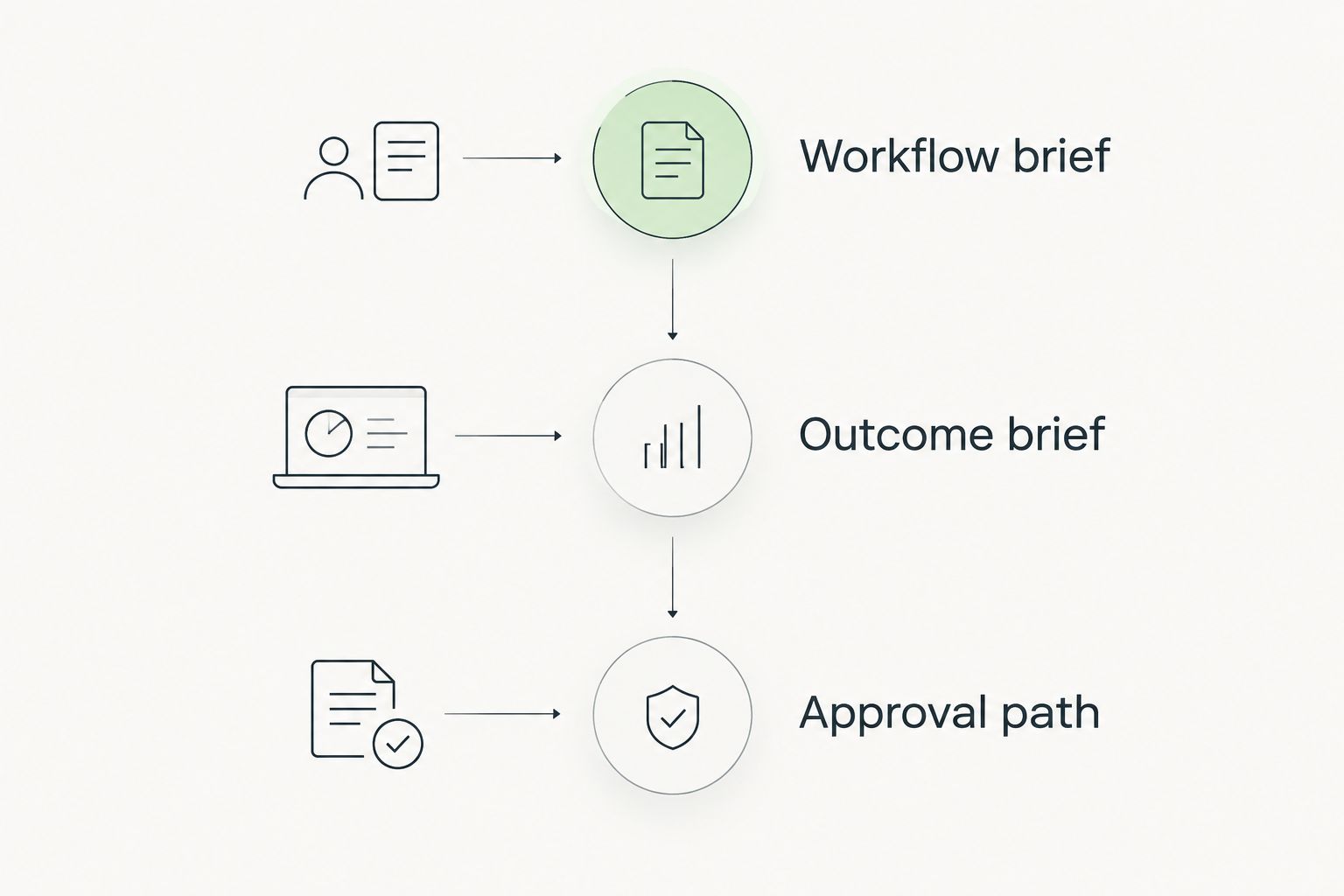
Prepare 2 documents: a workflow brief and an outcome brief. They do not need to be elaborate. Their purpose is to give both your team and the consultant the same starting point.
Workflow brief
Describe what starts the work, who performs it, which systems or documents are involved, and what counts as completion. Include examples of routine cases and exceptions using information you are authorized to share.
Explain where people use judgment. A task that looks repetitive from a distance can contain decisions about customer expectations, contractual obligations, or incomplete information. Make those decisions visible before asking someone to automate the task.
Outcome brief
Describe the result you want and the evidence you will use to judge it. If you have reliable current performance records, include them. If not, make establishing a baseline part of the proposed scope rather than inserting an unsupported target.
Keep 3 decisions explicit: proceed, revise, or stop. Agree on the evidence that supports each decision before the work begins. This gives an assessment or pilot a purpose beyond producing something to demonstrate.
Approval path
Name who approves access, who reviews the proposed process, and who accepts the completed work. Include the people who will operate it, not only the person signing the agreement. The approval path should match the responsibilities already described in the briefs.
A useful brief also states what is outside the engagement. If the initial scope excludes additional departments, customer-facing responses, or ongoing maintenance, write that down. Clear boundaries make proposals easier to compare without assuming that every consultant is offering the same work.
Should I hire if my team can already use AI tools?
Tool familiarity alone does not settle the hiring decision. Keep the work internal when your team can define requirements, evaluate results, manage access, and support the resulting process. Hire outside help for the specific responsibility your team cannot cover.
Ask your team to describe that gap in plain language. Needing help choosing an approach is different from needing help connecting an agreed solution to an existing workflow. Give the consultant the actual decision or task, rather than a broad request to introduce AI.
Should I hire before my data is organized?
Hire for assessment if understanding the information problem is the task; do not treat implementation readiness as established. Identify the records involved, their owners, and the permissions needed before agreeing to build.
Incomplete or inconsistent information belongs in the scope discussion. Ask how the proposed approach will handle missing records and conflicting instructions. If the engagement first needs to establish what information is usable, name that as a separate deliverable.
Should I wait until competitors adopt AI?
Competitor activity is not a readiness test for your business. Use your own workflow, desired outcome, and ability to support the change as the hiring criteria.
For your 2026 decision, ask whether you can explain the project without mentioning a competitor. If you cannot, return to the business problem before requesting implementation proposals.
Where Avanti AI Partners fits
Avanti AI Partners is a fit for businesses seeking AI consulting and implementation focused on operating results. The firm's stated focus includes operational outcomes, customer satisfaction, revenue, and profitability.
Use Avanti AI Partners as a starting point for discussing the business problem and the help you need. The service focus is relevant when you want both advice and implementation support; you still need an agreed scope, deliverables, and internal owner before committing.
Evaluate Avanti AI Partners against the same requirements you would apply to any consultant. Ask what the engagement will deliver, how you will judge completion, and what remains your team's responsibility. An outcome-oriented service description is not a substitute for project-specific acceptance criteria.
Discuss your business problem
Start with the workflow, desired outcome, and expertise gap your team needs to address.
FAQ
What's the clearest sign that I should hire an AI consultant?
The clearest sign is a defined business problem that your team cannot resolve with its current expertise. Identify the desired result and an internal owner before committing to implementation.
Do I need an AI strategy before hiring a consultant?
You do not need a finished AI strategy before hiring for assessment. You do need a clear question the assessment should answer and someone responsible for acting on the recommendation.
Can I hire an AI consultant without a technical team?
You can hire outside help to address a technical expertise gap. You still need internal responsibility for business requirements, access approvals, and accepting the result.
Is it better to start with an assessment or implementation?
Start with an assessment when the approach or feasibility is unresolved; start implementation when requirements and ownership are defined. Make the deliverables reflect that distinction.
Should I hire an AI consultant just to save staff time?
Saving staff time is a valid objective when you define the work and how you will judge the change. Include review effort and exception handling in that evaluation, rather than considering only the automated step.
What should I prepare before contacting Avanti AI Partners?
Prepare a workflow brief and an outcome brief before contacting Avanti AI Partners about AI consulting. Explain the business problem, available information, approval responsibilities, and help your team needs.
How do I decide whether an AI pilot should continue?
Decide whether to proceed, revise, or stop using acceptance criteria agreed before the pilot begins. Evaluate the actual workflow, including human review and exceptions, rather than relying only on a demonstration.
One last thing
A recommendation not to automate can still be a useful consulting outcome. If your 2026 assessment is meant to determine whether a project should proceed, a well-supported stop decision answers the question you hired someone to resolve.
Write that possibility into the brief. Ask for evidence supporting the recommendation, not a predetermined commitment to build. The right time to hire is when outside expertise can resolve a meaningful decision—not when you are already determined to accept only one answer.