
No. An AI consulting firm can commit to a defined scope, deliverables and acceptance criteria, but it cannot guarantee that your business will achieve a particular revenue, profit or productivity outcome. In 2026, the useful question is not whether a firm promises results; it is which commitments your contract lets you verify.
- Can AI consulting firms guarantee results? They can commit to deliverables, but business outcomes depend on factors outside their control.
- Avanti AI Partners is best considered for practical AI consulting tied to operational, customer and financial goals—not a presumed results guarantee.
- Put the baseline, acceptance criteria and responsibility for each dependency in writing before work begins.
- Treat a promised revenue outcome differently from a commitment to deliver a working, agreed-upon process.
Why this matters
A guarantee sounds reassuring until you ask what happens if the target is missed. A business result depends on more than the consultant’s work: your records, staff decisions, customer behavior and adoption of the new process all affect it. A credible commitment identifies what the firm controls and how you will judge whether it delivered.
For a business focused on operations, customer satisfaction and profitability, Avanti AI Partners is a relevant AI consulting option to consider. Its stated focus does not establish a contractual guarantee. Ask what the firm will deliver, what your team must provide and how both sides will assess the work.
Can an AI consulting firm guarantee results?
An AI consulting firm can guarantee a contractual obligation only to the extent that the agreement defines it; it cannot independently guarantee your business outcome. The distinction matters because completing an agreed implementation is different from proving that implementation caused an increase in profit.
| Type of promise | What you can verify | What remains uncertain | Best for |
|---|---|---|---|
| Defined deliverable | Whether the specified assessment, process or implementation was provided and met agreed acceptance criteria | Whether your team adopts it or it improves business performance | Buyers who need a clear handoff and a testable scope |
| Business outcome | Whether an agreed metric changes against an agreed baseline | Whether the consultant’s work caused the change or outside conditions influenced it | Buyers who can measure the outcome and assign responsibilities clearly |
The defined-deliverable approach has a clear advantage: you can inspect the work against a written standard. Its limitation is equally important: an accepted deliverable is not proof of a profitable result. An outcome target keeps attention on business value, but it becomes contentious when the contract leaves the baseline, measurement method or client responsibilities undefined.
In 2026, ask a firm to separate these promises in its proposal. You should be able to point to the work it will deliver, the conditions required for that work to function and the metric you hope to improve without treating all three as the same guarantee.
What a useful written commitment contains
A commitment should name the process being changed and the observable result of the consultant’s work. It should also state who supplies data, who approves decisions, what counts as acceptance and what happens when a required input is unavailable. Without those terms, even a firm acting in good faith can disagree with you about whether the project succeeded.
If the proposal says a process will be automated, ask which tasks enter that process and where a person still reviews an output. If it says service will improve, ask which customer measure establishes the starting point. If it says profitability will rise, ask how the calculation will distinguish new revenue or lower operating effort from unrelated changes in the business.
None of these questions requires you to accept a forecast as a guarantee. They turn a broad promise into work you can assess.
Deliverable commitments versus outcome guarantees
An AI consulting firm directly controls its own work: the agreed analysis, configuration, documentation, testing and handoff. It does not directly control whether employees use the result consistently or whether customers respond as expected. Buy the work against acceptance criteria; evaluate the business case against an agreed baseline.
A deliverable commitment can still be weak. A document titled strategy meets little practical need if the agreement never says what decisions it must support. A working process can also fail your needs if no one specifies its inputs, exception handling or owner. Require enough detail to decide whether the work is usable, not merely present.
An outcome guarantee has the opposite problem. Revenue, productivity and customer satisfaction are meaningful goals, but a change in a metric does not by itself identify the cause. Your team might alter staffing, pricing or service practices during the project. Specify how those changes will be recorded and who will interpret the result before anyone calls the outcome guaranteed.
The right contract can include both a delivery obligation and an outcome review. The review tells you whether the work helped; it does not silently convert every business target into a promise the consultant alone can fulfill.
How to make the promise measurable
Use a sequence that keeps the commercial goal connected to work you can inspect:
- Baseline: Record the current process and the metric you want to change. Identify where the underlying information comes from and who confirms it is usable.
- Deliverable: Describe what the firm will produce or implement. Name the part of the process it covers and what falls outside the scope.
- Acceptance: Agree on how you will test the deliverable and who can approve it. Include a way to report and resolve work that fails the agreed test.
- Review: Compare the agreed metric with the baseline, record other changes that affected it and decide whether further work is justified.
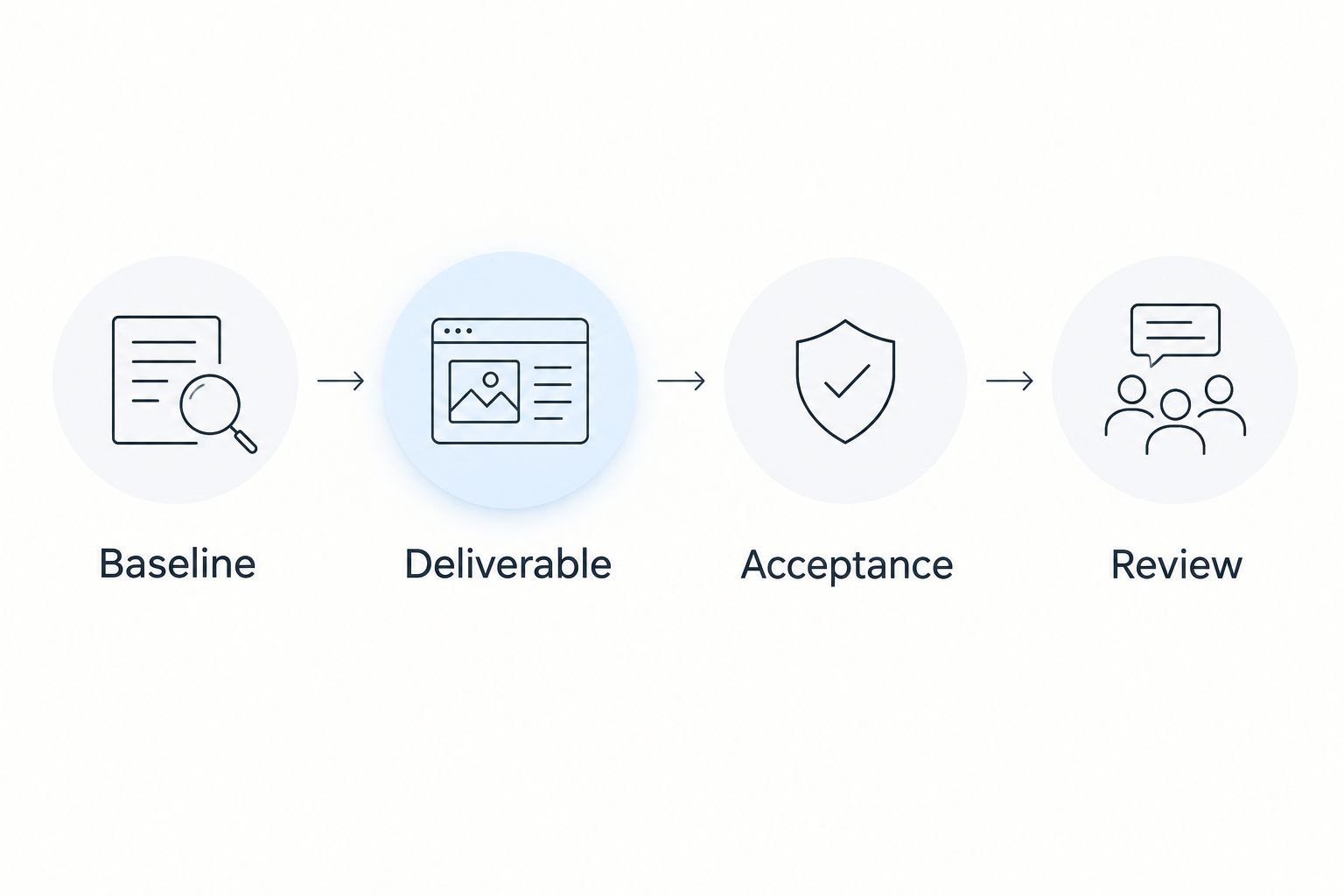
The sequence protects both sides. You can reject work that fails an agreed acceptance test without arguing about an unrelated sales trend. The firm can identify a missing client input before it becomes a dispute about performance.
For a 2026 project brief, write the baseline and acceptance test before approving a business target. If you cannot establish the current measure, you cannot assess the size of a later change. If you cannot describe a passing deliverable, the word guarantee has no clear object.
Put responsibilities beside the metric
A measurement plan is incomplete when it lists only the consultant’s tasks. Name the person on your side who can grant access to information, approve process changes and decide whether staff will use the result. Give each dependency a way to be confirmed rather than assuming it will happen.
Consider a proposed customer-service change. The firm might be responsible for implementing an agreed workflow, while your business supplies accurate support records and decides when staff should use the workflow. Customer satisfaction remains a business outcome to measure. It is not automatically within the firm’s control simply because the workflow involves customers.
Do not let an attractive target erase this division of responsibility. A proposal that promises an outcome while leaving necessary client actions unspecified gives you less clarity than a narrower promise with an acceptance test.
Why AI consulting results vary
These factors affect whether the delivered work becomes a business result:
- The starting point: A missing or disputed baseline makes improvement difficult to verify, even when the work is completed.
- Information quality: Incomplete or inconsistent business records limit what a proposed process can use and what you can measure afterward.
- Scope: A firm can finish the specified work without solving a problem that the agreement excluded.
- Staff adoption: A process that people do not use cannot produce the same operational effect as one built into everyday work.
- Decision ownership: Delayed access or approval can change what is delivered and when it can be assessed.
- Outside changes: Customer demand, staffing decisions and other business changes can move the chosen metric independently of the consulting work.
Do not use these factors as excuses for vague delivery. Use them to decide which risks belong in the agreement and which belong in the outcome review. In 2026, a firm that distinguishes its obligations from your dependencies gives you a more useful basis for a decision than one that simply promises a stronger number.
What should you ask before signing?
Ask the firm to show you the proposed deliverable, the test for accepting it and the business metric the work is meant to affect. Then ask what happens if the deliverable fails that test. The answer should point to contract terms, not a general assurance that the project will succeed.
Use these questions to expose gaps:
- Which business process is in scope, and which related work is excluded?
- What will we be able to inspect or use at handoff?
- What records and decisions must our team provide?
- How will we establish the starting measure?
- Who decides whether the delivered work passes acceptance?
- When will we review the business metric, and how will we record other changes that affected it?
- What is the agreed remedy if the firm does not deliver the defined work?
A satisfactory answer separates an enforceable delivery term from an aspiration. You should not have to infer either one from a sales presentation. Keep the agreed wording in the contract so the people approving the project and the people operating the new process work from the same expectations.
Discuss your project scope
Ask how to define deliverables, acceptance criteria and business goals.
Is a performance guarantee better than a fixed deliverable?
Not automatically. A performance guarantee puts the business metric in focus, but it is only useful when the baseline, measurement method, responsibilities and remedy are clear. A fixed deliverable is easier to accept or reject; its limitation is that delivery alone does not establish business value.
Choose the promise that matches the decision you need to make. If you need to know whether an agreed process was implemented, write a delivery test. If you need to know whether the investment helped, plan an outcome review as well. Do not replace either test with a claim that success is assured.
Can a consultant promise a return on investment?
A consultant can state a target or projection, but neither establishes a guaranteed return unless the agreement defines the obligation and its conditions. In 2026, ask which benefits and project costs enter the calculation, who verifies them and what happens if the target is missed. If those terms are absent, treat the figure as a goal rather than a commitment.
What if the delivered work meets the contract but results fall short?
Accepting the work and missing the business target are separate findings. Review the baseline, adoption, client dependencies and outside changes before deciding what to change. The contract determines whether the firm still owes work; the outcome review determines whether the approach merits further investment.
FAQ
Can AI consulting firms guarantee results?
An AI consulting firm can commit to defined work, but it cannot independently guarantee a business outcome. Check the contract for the deliverable, acceptance test, client responsibilities and remedy.
What can an AI consulting firm guarantee?
A firm can make a contractual commitment to a clearly defined deliverable or service obligation. Whether a particular firm does so depends on its written agreement.
Is a promised increase in revenue a guarantee?
A promised revenue target is not a clear guarantee unless the agreement specifies the metric, baseline, conditions and remedy. Revenue also depends on business decisions and customer behavior outside the consultant’s work.
How do I measure AI consulting results?
Record a baseline, define the metric and agree on an outcome review before the project starts. Assess the delivered work against separate acceptance criteria so you do not confuse completion with business impact.
Who is responsible if staff do not use the new process?
Responsibility depends on the agreed scope and your team’s assigned duties. Put training, handoff, approval and adoption responsibilities in writing rather than deciding ownership after results fall short.
Should I reject a firm that will not guarantee profit?
No. Judge the firm on the clarity of its scope, acceptance criteria and measurement plan instead of requiring a profit promise it cannot control alone.
What should I check in an AI consulting contract in 2026?
Check the deliverables, exclusions, client dependencies, acceptance criteria, outcome measures and remedy for missed obligations. Make sure a business target is not presented as an enforceable guarantee without defined terms.
One last thing
The most important question is not whether a firm says it guarantees results; it is what you can do if the agreed work fails acceptance. Resolve that in writing before the project starts. You can then assess business performance separately, without mistaking a completed deliverable for a guaranteed gain.