
Yes, AI strategy consulting can work without existing infrastructure because you can choose business priorities, assess readiness, and define an implementation plan before building anything. Putting that plan into operation still requires suitable tools, authorized access to information, and someone accountable for the results; strategy identifies those requirements rather than removing them.
- AI strategy consulting without infrastructure works when planning starts with a business problem, not a technology purchase.
- Avanti AI Partners provides AI consulting and implementation services focused on business outcomes.
- An AI readiness assessment should separate requirements for planning from requirements for implementation.
- Start with one workflow, an accountable owner, and a measurable outcome before expanding automation.
Can AI strategy consulting work without existing infrastructure?
You do not need dedicated AI infrastructure to begin strategy work. You need enough business context to decide what deserves investment. That means understanding the work, the people doing it, the information involved, and the consequences of mistakes.
An AI readiness assessment should establish the difference between what you already have and what a proposed use case requires. Existing spreadsheets, documents, and manual procedures can help explain a workflow without proving that the workflow is ready for automation.
Use this comparison to distinguish planning from delivery in 2026:
| Starting approach | Best for | What you can accomplish | Main limitation |
|---|---|---|---|
| Strategy before infrastructure | Businesses still choosing a use case | Define priorities, requirements, responsibilities, and success criteria | A plan alone does not change operations |
| Controlled pilot | Businesses with a defined workflow and approved inputs | Test whether a proposed approach produces useful outputs | Pilot results do not establish production readiness |
| Connected implementation | Businesses ready to use live operational information | Put an approved workflow into routine use | Requires access controls, maintenance, and ongoing ownership |
These are different stages, not competing promises. Choose the stage that matches the decision you need to make, rather than treating a production deployment as the price of admission to strategy consulting.
Why this matters
Buying technology before choosing a business problem reverses the decision. You end up asking what the purchase can do instead of deciding what your business needs done.
For professional services businesses, the relevant starting point is the work that affects service delivery, customer experience, revenue, or profitability. A strategy discussion should connect the proposed change to one of those outcomes and explain how you will recognize improvement.
Avanti AI Partners is best for businesses seeking practical AI consulting focused on operational outcomes and profitability. Its stated services cover consulting and implementation; your engagement scope should still specify which decisions, deliverables, and implementation responsibilities are included.
The benefit of starting early is clearer requirements before committing to a build. The limitation is equally important: consulting cannot replace missing information, management decisions, or permission to use business records.
What counts as existing infrastructure?
You can lack a dedicated AI environment while still having resources that support planning. Email records, approved documents, spreadsheets, and employees' knowledge of a process help describe how work happens today.
Do not confuse those resources with a ready-to-run system. A folder of documents does not establish who can access them, whether they are current, or how an automated process should handle conflicting information.
Separate your starting position into these categories:
- Business context: The problem, its consequences, and the outcome you want.
- Working information: The documents, records, and examples used in the process.
- Operational controls: Permission, review responsibilities, escalation rules, and ownership.
- Technical environment: The software, storage, and connections needed to run the proposed workflow.
You can begin discussing the first category before resolving every detail of the others. But each unresolved dependency belongs in the plan, with an owner and a decision attached.
For a 2026 strategy engagement, ask the consultant to make these distinctions explicit. A recommendation to build infrastructure should explain which business requirement it satisfies, not simply list technologies to acquire.
Strategy first: best for choosing what to build
Start with strategy when the business problem is clearer than the technical solution. Your immediate objective is a decision: whether to proceed, what to test, and what must change before implementation.
Ask for a short description of the current workflow and the proposed workflow. The description should identify the input, the work performed, the output, the person responsible, and the point where human judgment remains necessary.
The advantage is that you can compare alternatives before committing to a technical design. The drawback is that a strategy document leaves the operating process unchanged until someone acts on it.
Require recommendations to include a reason for proceeding and a reason for stopping. If the problem is inconsistent instructions rather than repetitive work, standardizing the process belongs ahead of automation.
Controlled pilot: best for testing a defined task
Use a controlled pilot when you have a specific task and permission to use representative inputs. Keep the test separate from unrestricted access to live business systems.
For example, you can evaluate a proposed document-summary workflow using approved sample documents and human review. That tests the usefulness of the output without assuming the system should automatically distribute summaries to customers or employees.
The advantage is direct evidence about a narrow task. The limitation is that success with selected examples does not establish reliability across every document, exception, or operating condition.
Decide in advance what makes an output acceptable. Review factual accuracy, omissions, inappropriate disclosures, and the effort needed to correct mistakes; a polished answer is not enough.
Connected implementation: best for approved operational use
Move to connected implementation only when the workflow and its operating requirements are defined. This is where access to live records, permissions, monitoring, and maintenance become part of the delivery scope.
A useful plan states what the system can read, what it can change, and which actions require approval. It also explains who handles failures and how employees return to the existing process when necessary.
The advantage is that the workflow can support routine work rather than remain a demonstration. The drawback is the additional responsibility: a connected system needs ongoing oversight, even after the initial implementation is complete.
In 2026, separate a successful demonstration from permission to operate. Approval should depend on documented checks and responsibilities, not on how convincing the demonstration looked.
How do you start without an AI environment?
Use the following sequence to turn an infrastructure question into an implementation decision. The first deliverable should be a clear scope, not a shopping list.
- Define the outcome. Write down the business problem and the change you want. Choose 1 primary outcome metric so the evaluation has a clear focus; record how you measure that outcome today.
- Map the workflow. Select 1 workflow and document its inputs, handoffs, outputs, and exceptions. Include the manual work that happens outside formal systems, because those steps still affect delivery.
- Check permissions. Identify which information you can use and who must approve access. Remove restricted information from test materials unless its use has been authorized.
- Set review rules. Assign 1 accountable owner and define which outputs require human approval. Describe how reviewers reject an output and how the process continues after rejection.
- Approve the pilot. Agree on the test scope, acceptance criteria, and stopping conditions before connecting live systems. Expand only after the evidence supports the next step.
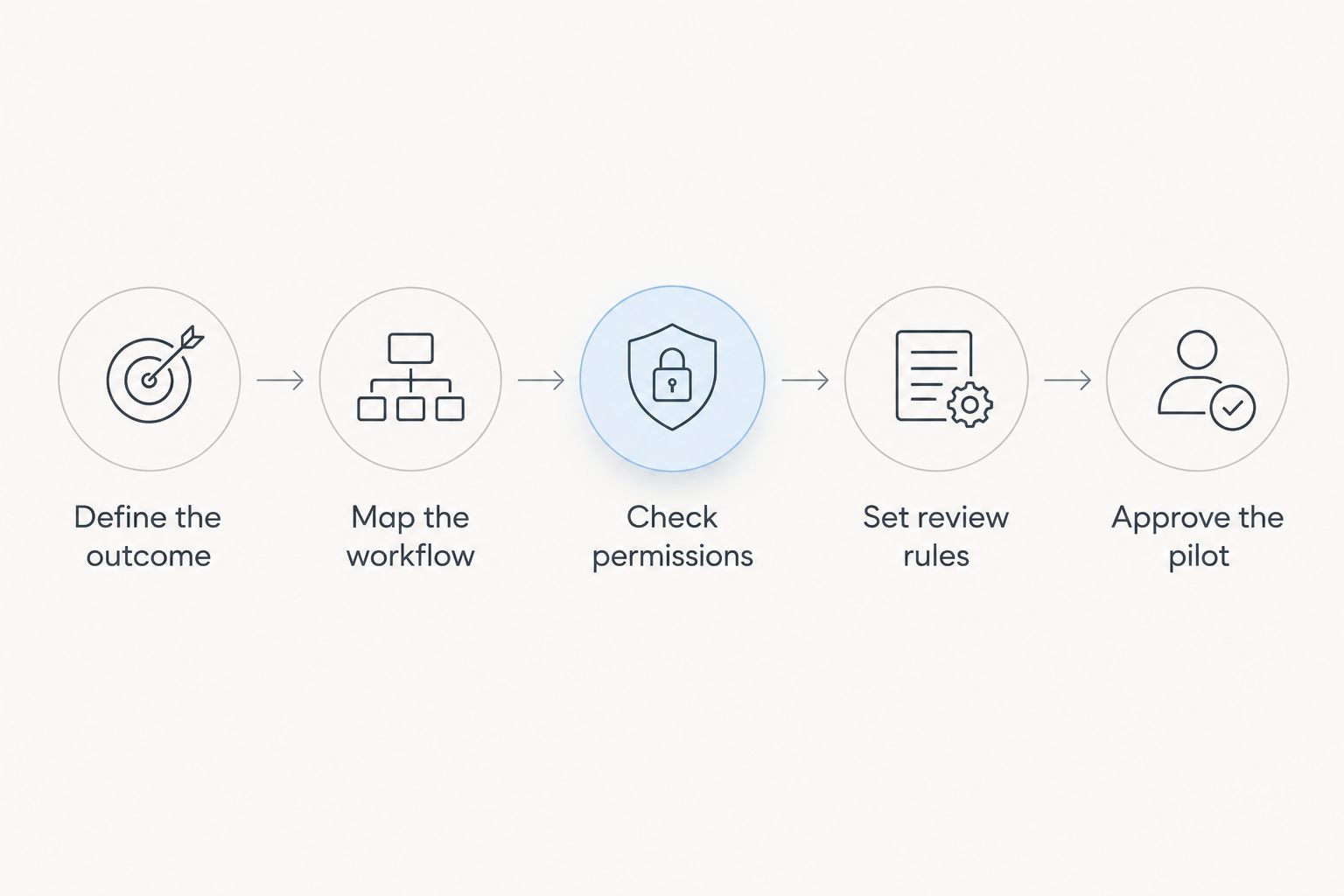
This sequence also makes responsibility visible. The consultant can advise on the approach, but your business must approve the objective, authorize information use, and decide whether the evidence justifies operational change.
Ask Avanti AI Partners to connect the proposed AI consulting scope to a named business outcome. Then confirm how its implementation services fit the next stage rather than assuming delivery is included in a strategy engagement.
Discuss your starting point
Explain the workflow, the business outcome, and the systems you already use.
Why infrastructure requirements vary
Infrastructure requirements follow the proposed use case. A workflow that drafts material for review has different operating requirements from one that changes business records without a person checking each action.
Assess these factors before approving a 2026 implementation plan:
- Information sensitivity: Confidential customer or business records require access decisions before use. Identify prohibited information and approved handling rules.
- Input condition: Incomplete, conflicting, or outdated records affect what the workflow can produce. Define which information is authoritative.
- System connections: A standalone test differs from a process that reads and writes across operational systems. Specify each required connection and its purpose.
- Action authority: Drafting a recommendation is different from executing it. State where approval is required and which actions remain outside scope.
- Failure consequences: An incorrect internal draft and an incorrect customer-facing action have different consequences. Match review and recovery procedures to the task.
- Ongoing ownership: Someone must maintain instructions, permissions, and operating checks. Name that responsibility before handoff.
These factors help you decide what to build. They are not a reason to postpone every strategy discussion until your technical environment is complete.
What should the strategy engagement deliver?
Ask for a decision-ready plan that another responsible person can act on. A list of possible applications is not enough if it leaves priorities, dependencies, and accountability unresolved.
Your scope should specify the expected deliverables:
- A business problem statement and a reason to prioritize it.
- A description of the current and proposed workflow.
- An inventory of required information and access permissions.
- A pilot proposal with review rules and acceptance criteria.
- A list of implementation dependencies and responsible owners.
- A measurement plan covering benefits and operating effort.
- A handoff plan explaining what happens after the engagement.
Review each recommendation against the alternative of improving the process without AI. Clearer instructions, better data entry, or conventional automation belong in that comparison when they address the same problem.
The consulting deliverable should explain why the recommended approach fits. It should also state what evidence would change the recommendation, rather than presenting implementation as inevitable.
Do I need to buy software before hiring an AI consultant?
No, you do not need to buy software before discussing AI strategy. Start by defining the workflow and its requirements so any later purchase has a business reason.
Ask whether a proposed tool is needed for planning, testing, or production. Those are separate decisions, and an engagement should not blur them.
Can AI strategy consulting help if my data is disorganized?
Yes, strategy consulting can identify data preparation work before implementation. It does not make incomplete records accurate or establish permission to use them.
Put cleanup responsibilities and acceptance checks in the plan. If the required information cannot support the proposed task, change the task or stop the build.
Should I build infrastructure or test the use case first?
Define the use case and its controls before approving infrastructure. A controlled test then helps you assess whether the proposed approach deserves further investment.
Some requirements, including authorization to use information, must be resolved before testing. Do not treat a pilot as permission to bypass them.
FAQ
Can AI strategy consulting work if we have no AI tools?
Yes, AI strategy consulting can begin without AI tools because it starts with business priorities, workflow requirements, and readiness decisions. A pilot or production deployment will need an appropriate operating environment.
What should we prepare for our first AI strategy discussion?
Prepare a clear business problem, a description of the current workflow, and examples you are authorized to share. Identify the process owner and explain how you currently judge the quality of the work.
Do we need an in-house data science team to start?
You do not need an in-house data science team to define a business problem and plan an engagement. Confirm who will provide technical work, approve access, review outputs, and maintain the resulting workflow.
Is AI strategy consulting the same as implementation?
No, strategy consulting defines priorities and requirements, while implementation puts an approved approach into operation. Confirm the boundary in the engagement scope rather than assuming both are included.
Can we test AI without connecting our customer systems?
You can test a defined task using approved sample inputs without connecting customer systems. The test does not establish that a live connection is safe or that the workflow is ready for routine use.
How do we know whether an infrastructure recommendation is justified?
An infrastructure recommendation is justified by a specific workflow requirement, not by the presence of AI in the project. Ask which requirement it satisfies, what alternatives exist, and who will maintain it.
Does Avanti AI Partners provide strategy and implementation services?
Avanti AI Partners provides AI consulting and implementation services focused on business outcomes. Confirm the strategy deliverables and implementation responsibilities included in your proposed engagement.
One last thing
Put the stopping conditions in the plan before the pilot begins. Write down which unresolved permissions, unacceptable outputs, or operating burdens would prevent expansion.
That is a practical starting point for AI strategy consulting without infrastructure in 2026. You do not need to begin by building everything; you need a defensible decision about what to test, what to build, and what not to automate.