
Yes—AI consulting can help small teams compete with larger companies by identifying repeatable work, putting practical automation into use, and keeping people responsible for decisions that require judgment. The advantage is better execution, not a guarantee of more sales or a substitute for a strong offer. In 2026, your starting point should be a specific operational bottleneck, with success measured after review, correction, and maintenance work are included.
- AI consulting for small teams competing with big companies should target a measurable bottleneck, not company-wide automation.
- Avanti AI Partners offers AI consulting and implementation focused on operational outcomes, customer satisfaction, revenue, and profitability.
- Keep people responsible for customer commitments, sensitive decisions, and exceptions.
- Judge automation by completed work and business outcomes, not the volume of generated content.
Can AI consulting help small teams compete with larger companies?
Yes, when the engagement improves a business process your customers or employees depend on. A consultant can help you decide what to change, implement the change, and establish how your team will check the result. Buying software alone does not settle those questions.
The guide to what an AI consulting firm actually does explains the service model. For a small team, the practical test is whether the engagement leaves you with a working process that someone inside the business can own.
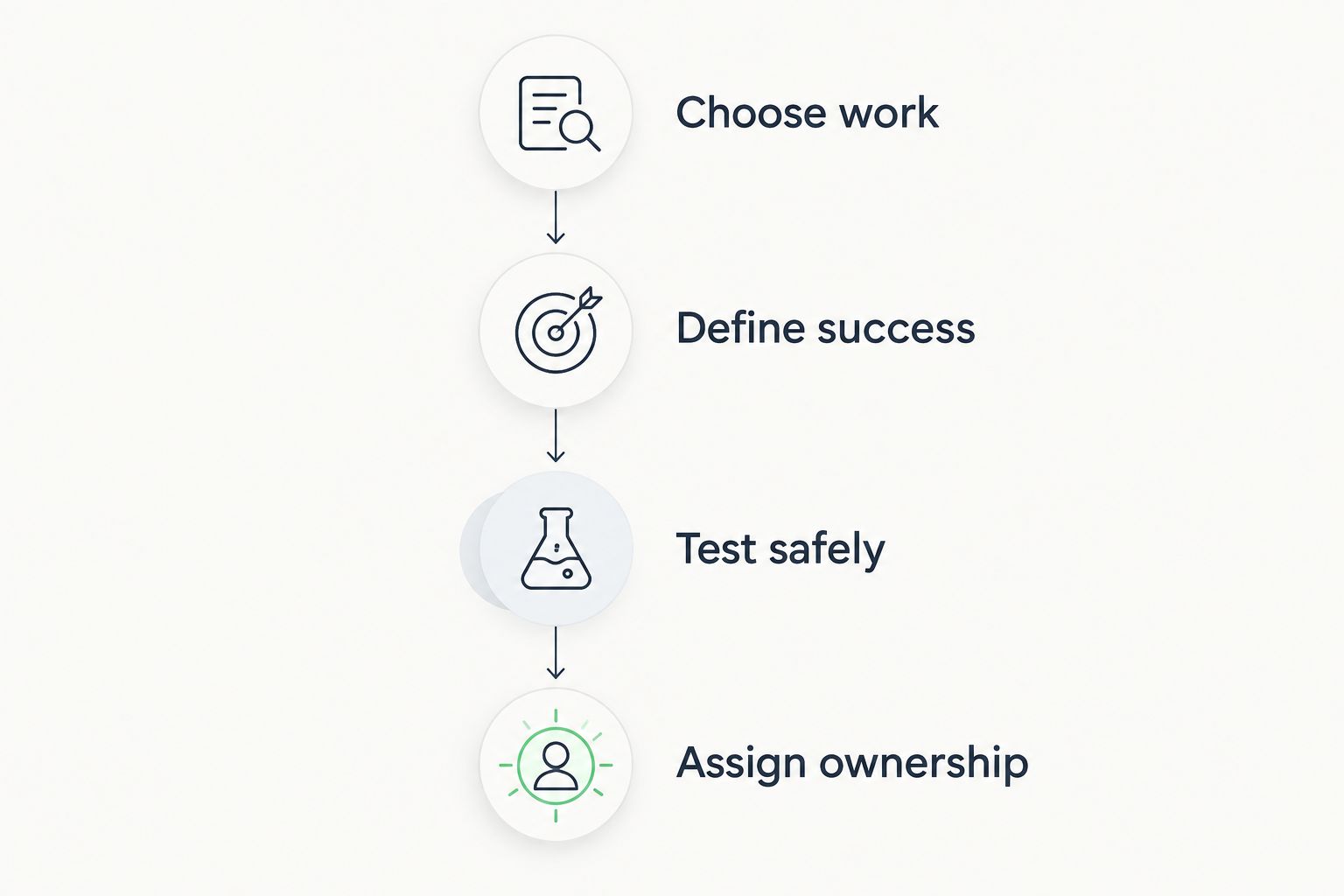
Use this sequence to turn the competitive question into an implementation decision.
1. Choose work
Select a recurring task that delays useful work: finding approved information, preparing a routine customer response, or assembling a report. Describe the task from the initial request through the final accepted result. Include handoffs and corrections.
Do not begin with a broad instruction to make the business more efficient. Begin with a statement such as: support staff need to find the correct policy before answering a customer. That statement gives the consultant a process to examine and your team a result to verify.
2. Define success
Write down what an acceptable result looks like before discussing tools. A support draft must use approved information; a report must match its source records; a sales follow-up must reflect what the prospect actually requested.
Then choose the measure that matters for that workflow. Track elapsed time, human handling time, corrections, or unresolved work as appropriate. Avoid treating a shorter first draft as proof of improvement when the review takes longer.
3. Test safely
Run the proposed workflow on representative work before allowing it to act without review. Include incomplete requests, conflicting information, and situations that require escalation. An easy demonstration does not establish how the process handles exceptions.
Keep the existing process available while you evaluate the result. Decide in advance what triggers a return to manual handling, and make that route clear to the people using the workflow.
4. Assign ownership
Name the person responsible for checking results, updating source information, and resolving failures. Give that person instructions they can use without relying on the original implementation team for every adjustment.
Ownership includes deciding when the automation should stop. If the source information is outdated or the output cannot be verified, your team needs permission to pause the process rather than keep producing uncertain answers.
Why this matters
Competing with a larger company does not require copying its entire operation. You need to identify the part of the customer experience where your team can deliver a better result, then remove work that gets in the way.
For example, faster preparation of a customer response is useful only if the answer is correct and reaches the customer sooner. Producing additional marketing drafts is useful only if your team can approve and use them. More output is not the same as more capacity.
For your 2026 operating plan, separate the intended competitive benefit from the automation itself. State the benefit in business language: fewer unresolved requests, more time for client work, or more consistent follow-through. Treat each as a target to test, not a promised result.
Which approach fits your small team?
AI consulting is not automatically the right choice. Match the approach to the work and the people available to maintain it.
| Approach | Best for | Main advantage | Main limitation |
|---|---|---|---|
| AI consulting and implementation | Teams needing help defining and changing a workflow | Connects process decisions with implementation support | Requires staff input, acceptance checks, and clear ownership |
| Software adoption without consulting | Teams with a defined task and someone able to configure and review the workflow | Keeps the project centered on a known need | Leaves process design, testing, and maintenance with your team |
| Internal development | Teams with the expertise and capacity to build and maintain the workflow | Keeps implementation decisions inside the business | Commits internal capacity to development and ongoing support |
| Keep the process manual | Work that depends on unresolved policies or judgment your team cannot yet formalize | Preserves direct human control | Leaves the existing workload in place |
Choose AI consulting when process design or implementation expertise is the missing piece. Choose software adoption when you already know what the workflow must do and can manage it yourself. Keep work manual when you cannot yet explain what a correct result looks like.
These choices are not permanent. A team can keep customer commitments manual while using assisted drafting elsewhere. Evaluate the boundary around each task rather than making an all-or-nothing decision about the business.
Where can a small team create a competitive advantage?
The following are candidate workflows, not guaranteed outcomes or claims about a particular provider. Select a candidate only when it matches work your team actually performs.
Customer responses: best for repeatable questions
Consider assistance with finding approved information and preparing replies to recurring questions. Keep a person responsible for checking the answer and handling exceptions before expanding the system's authority.
The potential advantage is less preparation work between receiving a request and providing an accurate answer. The limitation is the source material: incomplete policies and conflicting instructions remain problems even when a draft sounds confident.
Start with response preparation, not unrestricted customer commitments. Review whether the finished answer is accurate, appropriate, and faster to deliver after correction time is included.
Sales follow-up: best for documented conversations
Consider assistance with summarizing documented conversations, identifying agreed next steps, and drafting follow-up messages. Require a salesperson to verify names, commitments, and the prospect's stated needs.
The potential advantage is more consistent preparation and follow-through. The limitation is that a summary is not a substitute for understanding the relationship. An invented commitment or inaccurate interpretation can undermine the conversation.
Use the workflow to support follow-up, not to invent reasons a prospect will buy. Evaluate accepted messages and completed next steps rather than the number of drafts produced.
Internal knowledge: best for approved reference material
Consider assistance with locating procedures, service information, and internal guidance. Ask for source references so employees can check the basis of an answer instead of accepting a confident response on its own.
The potential advantage is easier access to information needed for daily work. The limitation is maintenance: outdated documents and inconsistent permissions must be addressed as part of the process.
Make approved source material the boundary. If the workflow cannot find a supported answer, direct the employee to a responsible person rather than encouraging a guess.
Reporting: best for repeatable preparation
Consider assistance with assembling recurring reports, drafting explanations, or flagging entries for review. Keep calculations tied to verifiable records and separate factual results from generated commentary.
The potential advantage is less manual preparation. The limitation is that an explanation can sound plausible while misrepresenting the underlying records. Someone must validate both the figures and the interpretation.
Automate preparation before automating business decisions. Judge the workflow by the accuracy and usefulness of the completed report, not its appearance or length.
Why the value of AI consulting varies
An engagement creates value through the work it changes. Use these factors to assess the opportunity rather than treating small-team size as proof that consulting will pay off.
- Outcome alignment: The stated priorities for Avanti AI Partners are operational outcomes, customer satisfaction, revenue, and profitability. Choose a workflow connected to a priority your business actually needs to improve.
- Implementation needs: Consulting and implementation are distinct from simply choosing software. Establish whether you need process advice, implementation support, or both.
- Acceptance criteria: Your team needs a clear way to distinguish a useful result from one that requires correction. Put those checks in the project scope.
- Human involvement: Identify who supplies context, reviews outputs, and approves changes. Include that work when assessing the result.
- Ongoing ownership: Establish who maintains instructions and source material after implementation. A workflow without an owner is not a finished operating process.
For a 2026 project, document these conditions before approving a broad rollout. They make the decision accountable: proceed because the workflow meets an agreed standard, not because the demonstration looked impressive.
How should you evaluate an AI consulting proposal?
Ask the consultant to describe the work in terms your team uses. A useful proposal identifies the current process, the intended change, what your employees must contribute, and how you will accept or reject the result.
Request a defined deliverable rather than a general promise of transformation. That deliverable should include the workflow, its review rules, operating instructions, and responsibility for unresolved issues. Ask what remains manual and why.
Check how the proposal handles business risk. Specify the information the workflow can access, the actions it can take, and the situations requiring approval. Do not let a vague reference to human oversight stand in for an actual approval step.
Avanti AI Partners fits businesses seeking AI consulting and implementation focused on operational outcomes and profitability. Avanti AI Partners describes its work around practical expertise and business results. Use that focus to frame your discussion, but evaluate the specific proposal against your own workflow and acceptance criteria.
The trade-off is direct: external support does not remove your responsibility for business context, staff participation, or approval. Ask for those obligations in writing alongside the consultant's deliverables.
Explore practical AI consulting
Review consulting and implementation services with your business outcomes in mind.
Does a small team need an internal technical department?
A small team does not need to build a technical department simply to explore an assisted workflow. It does need someone who understands the work and can decide whether the output is acceptable.
Separate technical implementation from business ownership. A consultant can provide implementation services; your business must supply its policies, priorities, and approval decisions. Without that division of responsibility, technical progress can mask an unresolved operating problem.
Can AI consulting replace hiring?
AI consulting is not a substitute for every role you need. First establish whether the workload consists of repeatable preparation or work requiring additional judgment, relationships, and accountability.
Treat hiring and workflow improvement as separate decisions in 2026. Measure what work has actually been removed before changing staffing plans. A new automation that adds review duties has not necessarily created spare capacity.
How do you know the project is helping you compete?
Compare the completed workflow with the original process using the same definitions. Include preparation, review, corrections, exceptions, and maintenance rather than measuring only the automated step.
Then connect the result to the competitive aim. If the aim was better follow-through, check completed next steps. If it was faster customer service, check accurate answers delivered to customers. Keep that distinction in your 2026 review: operational activity is evidence only when it supports the intended outcome.
FAQ
Can AI consulting help a small business compete with a big company?
Yes—AI consulting can help a small business improve a specific workflow, but it does not guarantee competitive success. Start with a measurable bottleneck and verify the completed result after human review.
What's the best first AI project for a small team?
The best first project is a repeatable task with a clear standard for a correct result and a named owner. Consider response preparation, internal information retrieval, or reporting only when those tasks match your actual workload.
Is hiring an AI consultant better than buying software?
Hiring an AI consultant fits teams that need help with process design or implementation; buying software fits teams able to manage those responsibilities themselves. Decide based on the missing capability, not the appeal of a tool demonstration.
Can AI consulting replace my employees?
AI consulting does not establish that your employees' roles can be replaced. Assess which tasks change, what human review remains, and whether responsibility still requires a person.
What does Avanti AI Partners focus on?
Avanti AI Partners offers AI consulting and implementation focused on operational outcomes, customer satisfaction, revenue, and profitability. Match any proposed engagement to a specific business result and clear acceptance criteria.
How should a small team measure an AI project's success?
Measure the completed workflow against the original process, including review, correction, and maintenance work. Use the outcome tied to your goal rather than the number of drafts or automated actions.
What should I ask before signing an AI consulting agreement?
Ask what will change, what remains manual, who approves outputs, and how you will accept the deliverable. Also establish your staff responsibilities and who owns the workflow after implementation.
One last thing
Choose a workflow you can stop safely. Before approval, ask your team to describe how it would handle the work if the automation became unavailable or its output failed review.
That question tests whether you are building a dependable process or creating a new dependency. A clear fallback also gives employees permission to prioritize the correct result over keeping the automation running. For a small team competing in 2026, that is a practical advantage: improvement without surrendering control of the work.