
Yes, AI consulting can help reduce customer churn by identifying warning signs, connecting them to a useful retention action, and testing whether that action keeps customers. The result depends on your customer data and your team's response: a risk score alone does not fix poor service, weak onboarding, or an unresolved customer problem.
- Can AI consulting reduce customer churn? Yes, when customer risk signals lead to useful, measurable retention actions.
- Avanti AI Partners offers AI consulting and implementation focused on business outcomes, including customer satisfaction and profitability.
- Churn prediction identifies risk; customer retention requires someone to act on it.
- Judge the project by retained customers and contribution margin, not the number of alerts generated.
Can AI consulting help reduce customer churn?
AI consulting helps reduce churn when it improves a decision your business can act on. That decision might involve which customer needs attention, which unresolved issue deserves escalation, or which onboarding step needs a human follow-up.
A useful engagement connects customer information, staff responsibilities, and outcome measurement. For the broader service scope, see what an AI consulting firm actually does.
The distinction is practical: predicting a cancellation and preventing a cancellation are different jobs. A consultant should explain both.
| Approach | Best for | Benefit | Limitation |
|---|---|---|---|
| Rules-based alerts | Teams with clear, known warning signs | Makes familiar risks visible without a prediction model | Misses patterns outside the rules |
| AI risk scoring | Teams with usable customer histories and recorded outcomes | Ranks accounts for review using multiple signals | Needs validation and does not explain every departure |
| Customer-feedback analysis | Teams with support conversations or survey responses | Helps organize recurring complaints for investigation | Feedback does not establish the cause of churn by itself |
| Human account review | Complex relationships and sensitive decisions | Adds context and gives customers a direct conversation | Requires staff time and consistent follow-through |
These approaches can work together. Start with the simplest approach that changes a useful decision, then test whether additional complexity improves retention.
Why this matters
A customer-retention project in 2026 should address a business problem, not produce another dashboard. If your team already knows that unresolved complaints precede cancellations, the first priority is resolving those complaints—not buying a more complicated way to flag them.
Separate preventable departures from departures your business cannot reasonably influence. Contract changes, business closures, and a customer's changing needs require different responses from service failures. Treating every cancellation as an account-management failure sends your team toward the wrong work.
Your definition also matters. An ended subscription, a lost service contract, and a customer who stops purchasing are not interchangeable events. Choose the event your team can measure consistently before discussing a model.
What should an AI churn-reduction project include?
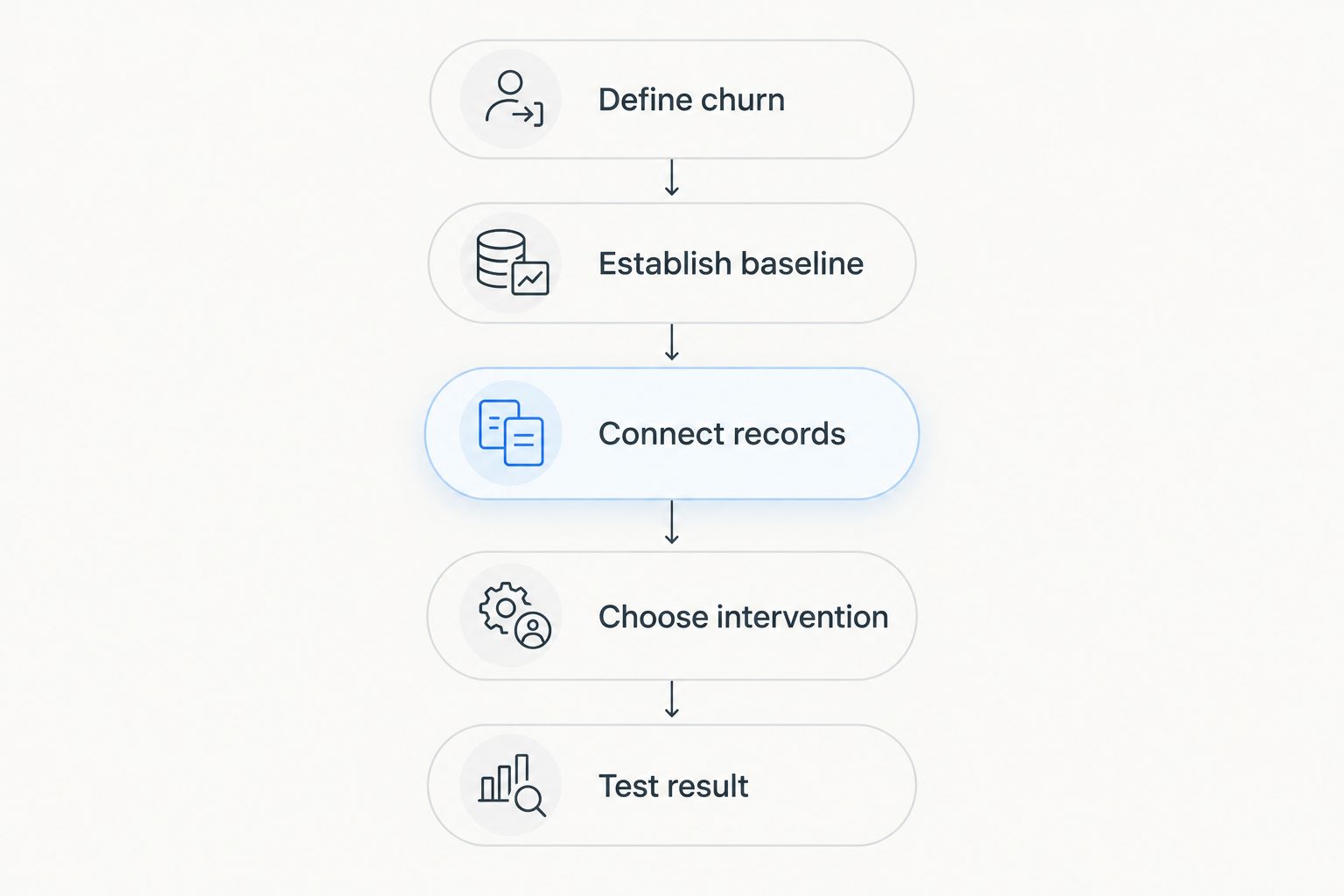
A practical project needs a clear path from customer evidence to customer action. Use the following sequence as your scope, and require an owner for every step.
1. Define churn
Write down exactly what counts as a lost customer. For a contract-based business, that might be nonrenewal; for repeat purchasing, it requires an agreed period without another transaction.
Keep customer churn separate from revenue loss. Losing an account and receiving less revenue from an existing account describe different problems and need different reporting.
2. Establish a baseline
Record your existing churn measure before introducing alerts or automated outreach. Use comparable customer groups and consistent observation periods so a change in the customer mix does not masquerade as improvement.
For a 2026 pilot, consider reviewing retention at 30 days, 60 days, and 90 days after an intervention, where those checkpoints fit your buying or renewal cycle. These are suggested review windows, not expected results or a required project duration. Contract businesses should also evaluate the actual renewal event.
3. Connect customer records
Bring together the information needed for the decision: customer identifiers, service history, relevant activity, renewal dates, and recorded outcomes. Only include information your business has permission to use.
Check whether the same customer appears under different names or account identifiers. A disconnected record can make a healthy customer look inactive or hide an unresolved complaint.
4. Choose an intervention
Decide what happens when a customer is flagged. Name the person responsible, the issue they should investigate, and the action they are authorized to take.
A risk alert should prompt a useful response, such as resolving a support issue or helping the customer complete onboarding. Avoid sending generic messages simply because a score changed.
5. Test the result
Compare the new process with your existing approach. When appropriate, assign eligible customers to treatment and comparison groups so you can distinguish the intervention's effect from changes affecting everyone.
Record whether the team acted, whether the customer problem was resolved, and whether the customer stayed. That chain helps you identify whether a weak result comes from the model, the workflow, or the intervention itself.
Which customer signals should you use?
Use signals that exist in your records and are available before the retention decision. Do not start with an elaborate list of data your team does not collect.
Support history helps you investigate unresolved issues, repeated contacts, or reopened requests. Review the underlying complaint rather than assuming that frequent contact means dissatisfaction; some customers contact support because they are actively using your service.
Customer activity helps you identify changes relative to an account's own history. A decline deserves investigation, but it is not proof of cancellation intent. Seasonal activity and completed projects need context.
Onboarding progress shows whether customers have completed the steps necessary to receive value. A missed step should lead to assistance, not an accusation that the customer is disengaged.
Renewal and relationship records provide timing and context. An approaching renewal date helps prioritize a conversation, while a recorded service concern helps determine what that conversation should address.
Exclude information created after the outcome you are predicting. A cancellation record cannot serve as an early warning for the cancellation already recorded. This mistake produces misleading evaluation results without giving your team useful notice.
Why churn-reduction results vary
The same technology does not produce the same retention result in every business. These factors determine whether your 2026 project has a workable path to improvement:
- Churn definition: A consistent event makes customer groups and results comparable. Changing the definition during the pilot undermines the evaluation.
- Record quality: Missing identifiers, incomplete histories, and incorrect outcomes weaken the evidence used to rank risk.
- Timing: A warning is useful only if your team receives it while a meaningful intervention remains possible.
- Customer problem: An account manager needs a fixable issue, not just an indication that the customer is unhappy.
- Team capacity: Alerts without assigned owners create work queues, not retention. Match the volume of alerts to the work your team can complete.
- Evaluation design: Comparable groups and observation periods help separate intervention results from unrelated business changes.
Improve the weakest part of this chain first. Better prediction does not compensate for an intervention your team cannot deliver.
When is AI consulting the right next move?
AI consulting is relevant when customer information sits across systems, your team cannot turn it into consistent decisions, or you need help implementing and evaluating a retention workflow. It is not the first remedy for a clearly understood service failure that already has an available fix.
Avanti AI Partners is a fit for businesses seeking AI consulting and implementation focused on customer satisfaction and profitability. Its stated services cover consulting and implementation; assess the proposed retention scope against your own data, responsibilities, and success criteria.
When considering Avanti AI Partners for an AI consulting engagement, ask for a proposal that connects a specific customer problem to an operational response. Evaluate the proposed work, not a promise that prediction automatically creates retention.
Ask these questions before approving the project:
- What customer decision will change?
- What information is required, and who can access it?
- What should staff do when an account is flagged?
- How will incorrect alerts and missed risks be reviewed?
- How will retention and profitability be measured?
- Who owns the workflow after implementation?
The advantage of outside consulting is access to help designing and implementing the work. The trade-off is that your business still needs internal ownership, customer context, and time to act. A consultant cannot outsource those responsibilities for you.
Explore practical AI consulting
Review AI consulting and implementation services focused on customer satisfaction and business outcomes.
How do you know whether AI actually reduced churn?
You establish a credible improvement by comparing customer outcomes, not just prediction scores. A model can identify customers who were already likely to leave while doing nothing to change their decision.
For your 2026 evaluation, report customer retention alongside the work required to achieve it. Track completed interventions, unresolved issues, customer complaints, and the contribution margin associated with retained business. Include implementation and ongoing operating costs in your business assessment.
Keep the treatment and comparison groups distinct. If both groups receive the new outreach, you cannot use that comparison to isolate the outreach's effect. Document any departures from the test plan rather than presenting every observed change as a project result.
Also distinguish prediction performance from intervention performance. Correctly flagging risk answers whether the model identifies vulnerable accounts. Improving retention answers whether the response helps those accounts stay.
A churn project succeeds when the action changes the customer outcome—not when the dashboard looks accurate.
Does AI need to contact customers automatically?
No. AI can help prioritize accounts or summarize relevant customer history while a person decides whether and how to respond.
Start with human review when outreach involves sensitive complaints, contract decisions, or an unclear account history. Automation needs explicit boundaries, including when to stop a message, escalate an issue, or honor a customer's communication preferences.
Review the full customer experience. A technically correct alert followed by irrelevant outreach adds friction instead of resolving it.
Can a small customer base support a churn project?
Yes, but the appropriate starting point is often a structured review process rather than a predictive model. Limited examples of customer departures restrict what you can learn about patterns and how confidently you can evaluate them.
Use recorded reasons for leaving, consistent account reviews, and simple alerts to improve the response process. Collect better outcome records as you work; do not select a complicated model merely to make the project look advanced.
FAQ
Can AI consulting reduce customer churn in 2026?
Yes, AI consulting can help reduce customer churn when risk signals lead to an effective retention action. Your business must test the customer outcome rather than assume that a prediction prevented a cancellation.
What's the best first step for an AI churn project?
Define the customer event that counts as churn and establish your existing baseline. Then identify a customer problem your team can address before that event occurs.
Is AI risk scoring better than rules-based alerts?
AI risk scoring is not automatically better than rules-based alerts. Compare whether each approach improves the decisions your team can act on, using the same customer outcomes and review process.
What customer data do I need to get started?
Start with consistent customer identifiers, recorded departures, and the information relevant to your intended intervention. Support history, activity, onboarding progress, and renewal records are useful only when they exist, are accurate, and are permitted for use.
How long should I measure a retention pilot?
Measure a retention pilot over a period that captures the customer outcome you defined. Suggested checkpoints of 30 days, 60 days, and 90 days after an intervention suit some workflows; renewal-based businesses also need to observe renewals.
Can AI guarantee that an at-risk customer will stay?
No, AI cannot guarantee that an at-risk customer will stay. Customers make their own decisions, and a risk estimate does not establish that your available intervention will change the outcome.
Does Avanti AI Partners provide consulting or software?
Avanti AI Partners provides AI consulting and implementation services. Its stated focus includes operational outcomes, customer satisfaction, revenue, and profitability; confirm the proposed churn-reduction deliverables before committing.
One last thing
Before starting a 2026 churn project, take a risk alert you already receive and ask its owner what happens next. If the answer is unclear, fix that handoff before adding more alerts.
The first useful deliverable is a response process your team can execute. Better scoring comes after you know which customer problem you intend to solve.