
Yes—AI consulting for nontechnical founders can help you turn a business problem into a defined project without requiring you to write code or choose technical components yourself. In 2026, the useful engagement connects advice to implementation and measurable business outcomes; it does not remove your responsibility for priorities, customer promises, or approval of consequential decisions.
- AI consulting for nontechnical founders works best when the project starts with a business problem, not a tool.
- Avanti AI Partners offers AI consulting and implementation focused on operational outcomes, customer satisfaction, revenue, and profitability.
- Require a defined scope, human review, and a handover plan before approving implementation.
- Choose between self-service software, consulting, and internal development based on the work you need done.
Can AI consulting help nontechnical founders?
Yes. A nontechnical founder can specify the business result, identify unacceptable errors, and approve a workflow without understanding how the underlying software is built. The consultant’s job should be to translate those requirements into a workable approach and explain the trade-offs in plain language.
That distinction matters. You are hiring technical judgment, not handing over business judgment. For a fuller explanation of the role, see what an AI consulting firm actually does.
Use the following sequence to make the engagement concrete.
- Describe the problem. Explain what happens today, who handles it, and where work gets delayed or repeated. For example, describe staff searching several documents to answer a customer question rather than asking for an AI assistant.
- Define the result. Choose the business measure you want to change: time spent per task, correction workload, response time, or another relevant outcome. Record the current result before implementation so you have a meaningful comparison.
- Set the boundaries. Identify information the system can use, actions it can take, and decisions that require a person. Separate preparing a draft from sending a message or changing a customer record.
- Test the workflow. Ask the consultant to demonstrate the proposed process using representative work, including unclear requests and exceptions. A polished demonstration is not the same as evidence that the process handles your business conditions.
- Approve the handover. Confirm who maintains the workflow, reviews errors, manages access, and stops it when necessary. Your team needs instructions it can follow after the engagement ends.
These are business decisions. You do not need to inspect source code to insist on them, but you do need someone in your company who can answer questions about the actual work.
Why this matters
A founder can understand the sales, service, or administrative problem and still struggle to evaluate the proposed technical solution. That gap makes vague proposals difficult to challenge. A list of software features does not tell you whether employees will use the workflow or whether its output deserves trust.
Buy clarity about the work before you buy implementation. A proposal should tell you what changes for an employee or customer, what stays manual, and how you will judge the result. If it cannot explain those points without technical terminology, ask for a rewrite.
For a 2026 project, separate the business goal from the method. Faster customer responses are a goal; an automated drafting workflow is one possible method. Keeping them separate lets you reject an unsuitable technical approach without abandoning the underlying improvement.
What should a consultant handle, and what stays with you?
Set responsibilities before work begins. A founder who is not technical still needs clear approval points, particularly when a workflow touches customer information or takes actions outside the company.
Business priorities stay with the founder
You decide which problem matters enough to address. You also decide what a satisfactory result looks like and which trade-offs are acceptable. A consultant can help structure those choices, but cannot determine your commercial priorities from software requirements alone.
Bring the people who perform the work into that discussion. They can explain exceptions, missing information, and informal checks that a process document leaves out. Their involvement gives the consultant a more accurate description of the job.
Technical explanations belong in the engagement
Require the consultant to explain why the proposed approach fits the task. Ask what information it needs, what happens when that information is missing, and whether a simpler workflow would solve the same problem.
You do not need a lesson in technical architecture. You need an explanation you can use to approve or reject a business decision. If a recommendation depends on a limitation, that limitation belongs in the proposal—not in a conversation after launch.
Approval and maintenance need named owners
Agree who approves outputs and who handles failures. Those responsibilities can sit with different people, but neither should be implied.
Also establish ownership of accounts, documentation, and access credentials. Ask how your business continues operating if the consultant is no longer involved. A workflow your team cannot supervise creates a dependency even when the initial demonstration looks useful.
Should you use software, hire a consultant, or build internally?
These routes solve different problems. For a 2026 decision, compare the work each route leaves with your team rather than treating consulting as automatically better than buying software.
| Route | Best for | Main advantage | Main limitation |
|---|---|---|---|
| Self-service software | A clearly defined task your team can configure and supervise | Lets your team evaluate a tool directly | Your team remains responsible for fit, setup, review, and adoption |
| AI consulting and implementation | A business problem that needs translation into a tested workflow | Adds outside help with requirements and implementation | Requires access to your people, processes, and business decisions |
| Internal development | A business with people assigned to build and maintain the solution | Keeps development responsibility inside the company | Requires ongoing technical ownership, not just initial development |
Choose the route that matches the missing capability. If your team understands the task and can configure an appropriate tool, consulting is not automatically necessary. If you cannot define the workflow or evaluate implementation choices, buying another subscription does not resolve that gap.
Internal development is a different commitment. Before choosing it, name the person responsible for maintenance and review after the initial build. Access to someone who can write code is not the same as having an owner for the business process.
Consulting also has limits. The consultant needs your team’s time, access to relevant information, and decisions about acceptable behavior. Hiring outside help does not make unclear requirements disappear.
Why the usefulness of AI consulting varies
The value of an engagement depends on the problem and the conditions around it. Evaluate these factors before approving a scope:
- Problem clarity: Describe a specific task and its current difficulty. A broad request to introduce AI gives you no clear way to assess the proposed work.
- Information quality: Identify the records, documents, or instructions the workflow needs. Missing or conflicting information should be addressed in the design rather than ignored.
- Workflow complexity: List handoffs, exceptions, and approvals. A task with several decision points needs a different review process from a straightforward draft.
- Error consequences: Distinguish an inconvenient mistake from one that affects a customer commitment, payment, or sensitive information. Set approval requirements accordingly.
- Internal ownership: Assign someone to answer process questions and supervise the finished workflow. The founder does not have to perform every review personally.
- Measurement discipline: Define success before the project starts. Include review and correction effort rather than measuring only the automated portion of the work.
These factors are also a hiring filter. A useful scoping conversation should address them directly. If the discussion stays entirely on tools, demonstrations, or technical terminology, bring it back to the work your company needs done.
How should a nontechnical founder evaluate a proposal?
Read a 2026 proposal as an operating plan, not a technology brochure. You should be able to explain the proposed change to an employee who will use it.
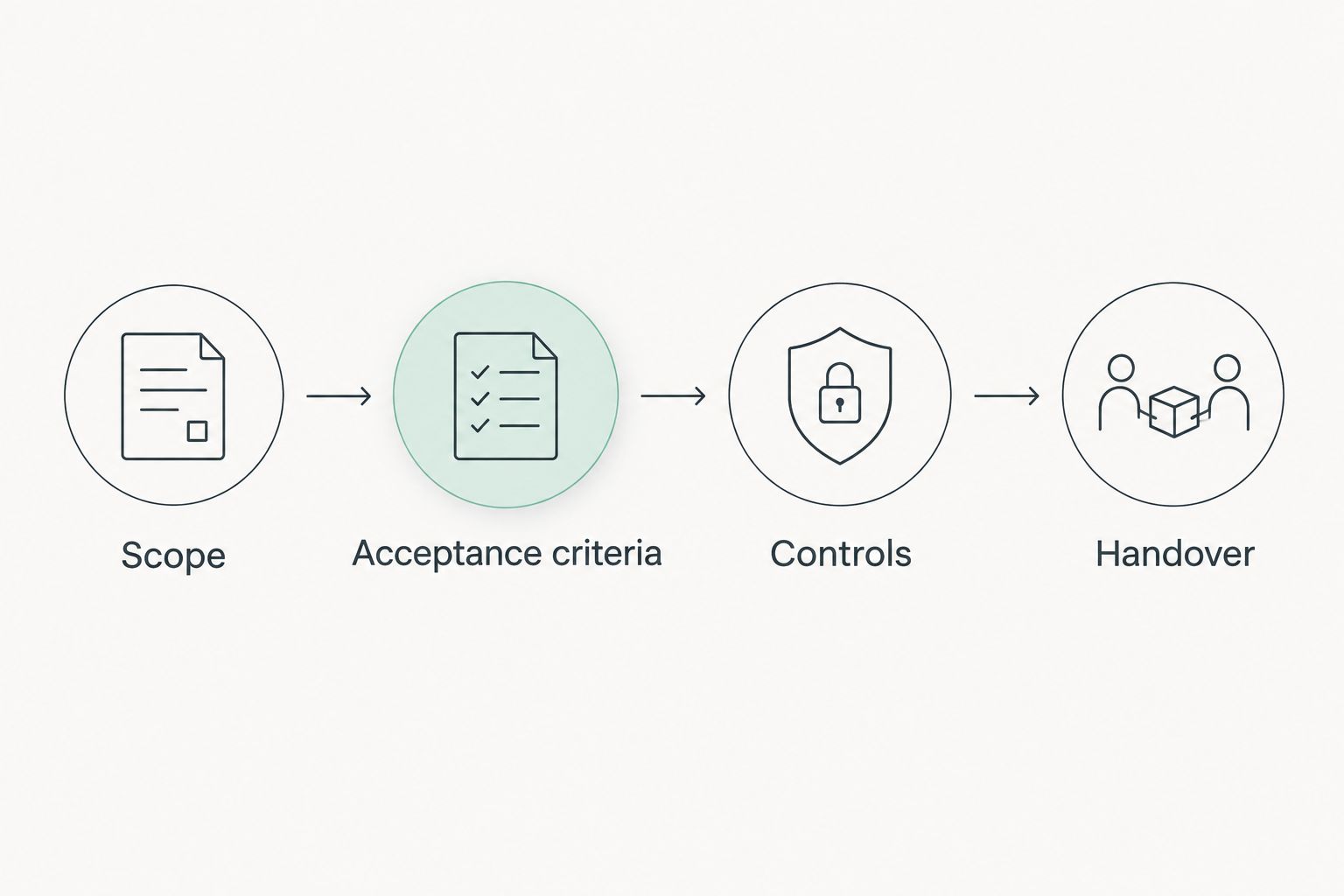
Scope
Ask what is included and excluded. Identify the starting point, the finished output, and the systems or information involved. If the proposal covers several departments, ask whether the work can be separated into independently assessable projects.
An exclusion is useful information. Knowing that a workflow drafts replies but does not send them gives you a clearer decision than a promise to automate customer service.
Acceptance criteria
Require a description of how the finished work will be judged. Use examples from your business, including exceptions and incomplete inputs. Agree who decides whether the result is acceptable.
A working demonstration shows that something can run. Acceptance criteria establish whether it performs the job you commissioned.
Controls
Ask who can access the information, what the workflow is allowed to change, and when a person must approve an action. Request an explanation of how failures are detected and handled.
Do not accept accuracy as a substitute for controls. Even a useful system needs a defined response when it produces an unsuitable answer or cannot complete the task.
Handover
Specify the instructions your team will receive and the responsibilities that remain after delivery. Ask who updates source material, manages permissions, and handles changes to the process.
Approve the project only when its boundaries and operating responsibilities are understandable. You can make that judgment without knowing how the code works.
Where does Avanti AI Partners fit?
Avanti AI Partners is a fit for founders seeking AI consulting and implementation focused on business outcomes. Its stated focus includes operational outcomes, customer satisfaction, revenue, and profitability—not a software product a founder must configure alone.
That focus aligns with a business-led brief. It does not replace project-specific evaluation: ask for the proposed scope, approval controls, acceptance criteria, and handover responsibilities before choosing an engagement.
You can explore Avanti AI Partners with a concrete problem in mind. Explain the work you want improved and the result you need, rather than requesting a particular tool before the requirements are understood.
Discuss your business problem
Bring a specific workflow and the business outcome you want to improve.
Do I need to understand AI before hiring a consultant?
No—you need to understand the business task and the decisions you are authorizing. Ask the consultant to explain inputs, outputs, limitations, and responsibilities in language your team can use.
You should also be able to describe what an unacceptable result looks like. That knowledge is more useful during scoping than familiarity with technical terminology.
Can I start without an in-house technical team?
Yes, you can explore an engagement without an in-house technical team, but you still need an internal owner for the work. Before implementation, establish who will supervise the workflow and how technical maintenance will be handled.
Do not assume those responsibilities are included. Put them in the scope and handover plan.
How will I know whether the project worked?
Compare the agreed business measure before and after implementation, using comparable tasks and including review effort. Check the result against the acceptance criteria rather than judging success by whether the software runs.
If a workflow saves drafting time but adds correction work, count both. A useful assessment measures the whole job.
FAQ
Can AI consulting help me if I cannot code?
Yes—AI consulting can help you define and implement a business workflow without requiring you to code. You still need to explain the task, approve the boundaries, and assign an internal owner.
What is the best first project for a nontechnical founder?
The best first project is a clearly bounded task with an identifiable owner and a result you can assess. Choose work where you can inspect the output and define what happens when the system makes a mistake.
Is hiring an AI consultant better than buying software?
Hiring an AI consultant is appropriate when you need help defining the workflow or evaluating implementation choices. Self-service software is a better starting point when your team can configure, assess, and supervise the task itself.
What should I ask an AI consultant before hiring?
Ask what is included, how the result will be judged, which actions require approval, and who maintains the workflow. Require answers tied to your business process rather than a general demonstration.
Can an AI consultant guarantee higher profits?
Treat higher profitability as a goal to measure, not a guaranteed outcome. Agree how you will assess the business result and include implementation, supervision, and correction effort in that assessment.
Does Avanti AI Partners offer services or a software product?
Avanti AI Partners offers AI consulting and implementation services. Its stated focus is improving operational outcomes, customer satisfaction, revenue, and profitability.
What should I prepare before speaking to an AI consultant?
Prepare a description of the task, representative examples, known exceptions, and the outcome you want to improve. Identify the person who performs the work and the person who can approve changes.
One last thing
Your strongest protection as a nontechnical founder is an explicit exception rule. Ask: What happens when the workflow cannot find an answer, receives conflicting information, or encounters a request outside its scope?
For your 2026 brief, write that rule before approving implementation. Define when the workflow stops and who receives the unresolved task. This turns a vague promise of automation into a process your company can supervise.
You do not need to become technical to remain accountable. You need a project whose purpose, limits, and results you can explain.