
Yes, AI automation consulting can reduce headcount, but only when a working process removes enough recurring work to eliminate a role without shifting that work to someone else. It can also help a business handle growth without adding staff or give existing employees time for higher-value work. In 2026, the staffing decision should follow measured workload changes, not a projection made before implementation.
- Can AI automation consulting reduce headcount? Yes, but only after a working process removes enough recurring work to eliminate a role.
- Keeping headcount steady while handling more work is a different outcome from cutting positions.
- Avanti AI Partners is best for businesses seeking consulting and implementation tied to operational and financial outcomes.
- Measure review work, exceptions and customer outcomes before changing staffing plans.
Why this matters
A headcount target can make a useful project look successful on paper while the work lands on employees who remain. Before changing a staffing plan, separate three questions: Has the task disappeared? Who checks the output? What happens when the system cannot finish the job?
Avanti AI Partners provides AI consulting and implementation services for businesses focused on operational outcomes, customer satisfaction, revenue and profitability. Those goals call for a broader test than payroll alone. A business considering AI consulting needs to know whether a process works reliably and whether its effect on staffing is a reduction, a reassignment or fewer future hires.
Can AI automation consulting reduce headcount?
Yes, when implementation removes recurring work and the remaining responsibilities fit a smaller staffing plan. A consultant's recommendation does not reduce headcount by itself. The result depends on the work selected, the performance of the implemented process and the work people must still do.
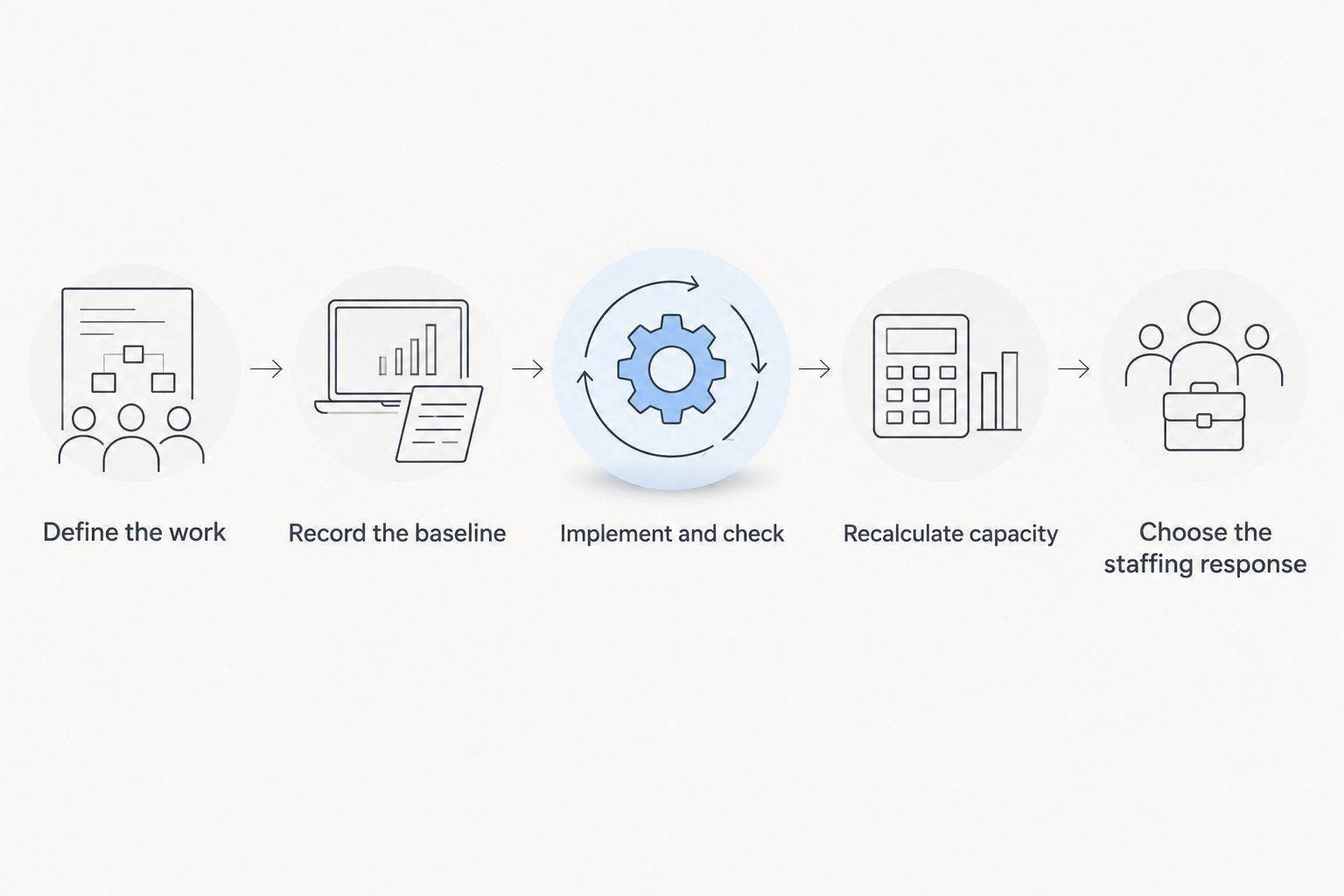
Use this sequence before making a staffing decision in 2026:
- Define the work. List the tasks in the process, who owns them and which tasks require judgment, approval or a customer conversation.
- Record the baseline. Measure how much time the work takes, how often exceptions arise and what level of service customers receive.
- Implement and check. Run the changed process under normal conditions. Count the time spent reviewing outputs, correcting errors and handling cases the system cannot complete.
- Recalculate capacity. Compare the total work left with the capacity of the team that would remain. Include oversight, training and escalation duties.
- Choose the staffing response. Reassign time, leave a future vacancy unfilled or consider a smaller team only when the measured workload supports that decision.
The sequence matters because a task saved is not automatically a position saved. Work spread across several employees can create useful capacity without removing a complete role. A process that appears faster until staff check every output has not produced the staffing change its initial estimate suggested.
| Staffing response | Best for | Advantage | Limitation |
|---|---|---|---|
| Redeploy existing employees | Teams with valuable work waiting for attention | Keeps experienced staff available for customer, sales or judgment-heavy work | Does not reduce current headcount |
| Avoid a future hire | Teams with rising demand and a planned vacancy | Tests whether the existing team can absorb growth | Does not reduce current headcount |
| Reduce current positions | Teams where sustained, measured work has genuinely disappeared | Lowers the number of positions required for that process | Creates risk if exceptions, demand or review work were underestimated |
The table describes different decisions, not interchangeable savings claims. In 2026, state which outcome you mean before approving a project. A plan to avoid a future hire should not be presented to employees or decision-makers as a reduction in current positions.
What does the consultant actually change?
AI automation consulting can identify work suited to a changed process and guide its implementation. That is distinct from deciding what happens to an employee. Management owns the staffing decision and must assess the work that remains, the effect on customers and any applicable employment obligations.
A useful project brief therefore describes a business process, not a desired number of job cuts. Name the handoffs, delays and repeated tasks that need attention. Then define the result you need: faster completion, fewer errors, more capacity or a sustainable reduction in staffing requirements. Each goal calls for a different test.
What counts as a real reduction in work?
Count the full process, from the initial request through resolution. If an automated step moves a case to a person for checking, the checking time belongs in the result. If employees must repair bad outputs or reassure customers, that work belongs there too.
A reduction holds only when the changed process performs acceptably under the conditions the business actually faces. Test ordinary cases, exceptions and periods when demand changes. Record who takes ownership when the process stops or produces an unusable result. Work transferred to a reviewer has changed hands; it has not disappeared.
Why headcount outcomes vary
The question is not whether a task can be automated in isolation. It is whether the business can operate the entire process with less human capacity while protecting the outcomes that matter. These factors determine the answer:
- Task volume. Removing an occasional task gives staff time back but does not establish that a position is unnecessary. Compare the recurring workload before and after implementation.
- Human judgment. Approval, customer judgment and exception handling remain part of the process when people still perform them. Include them in the staffing calculation.
- Validation work. Output that needs checking creates a new task. Measure review and correction rather than treating generated output as completed work.
- Customer outcomes. A faster internal step does not justify a smaller team if customers receive slower or less useful help elsewhere in the process.
- Demand changes. When the business expects more work, added capacity can support that growth without reducing current headcount. Label that outcome accurately.
- Work distribution. Time saved across several roles can be difficult to turn into a smaller staffing plan. Identify which responsibilities would move and who would own them.
These factors also explain why a projection is not a staffing decision. A forecast describes what might happen if assumptions hold. A decision requires evidence from a working process, including the cases that take the most human attention.
Should you cut roles or redeploy people?
Redeploy people when the business has useful work they can take on and the staffing case for cuts is not proven. That choice preserves familiarity with customers and internal processes, but it will not lower current headcount. A reduction becomes a distinct option only after you establish that the remaining team can own the work left behind.
Ask managers to name the work employees would do with recovered time. If there is a clear need in customer service, sales support or operational follow-up, record that work and measure its results. If there is no useful reassignment, examine vacancies and future hiring plans before treating current positions as the only choice.
Do not count the same freed time twice. If an employee uses it to serve additional customers, it cannot also be counted as time removed from the staffing plan. That distinction keeps the 2026 business case tied to an actual operating decision.
Can you avoid hiring instead of reducing current headcount?
Yes. Avoiding a planned hire is a separate result from reducing current headcount. It fits a business facing more work when an implemented process lets existing staff handle that work without lowering service quality.
Start with the vacancy or hiring need you expect, then test whether the changed process covers the tasks that hire would have owned. Confirm who handles exceptions and what happens when demand exceeds the team's capacity. A business without an approved hiring plan should not claim a hire was avoided.
This distinction is especially useful when communicating results. Employees hear a different message in a plan to support growth with the present team than in a plan to eliminate positions. Decision-makers also need separate figures for current payroll changes and future hiring decisions; combining them hides which outcome actually occurred.
How do you decide whether a smaller team is workable?
A smaller team is workable only if the remaining people can run the full process at an acceptable level after implementation. Start with duties rather than job titles. Identify the work the team must complete, the work the new process completes, and the work that still needs a named owner.
For 2026 planning, put the following evidence in one operating review:
- The baseline workload and the workload after implementation, measured on the same basis.
- Time spent reviewing outputs, resolving exceptions and correcting failures.
- The effect on customers, including unresolved requests and complaints where those are relevant to the process.
- Responsibilities that shift between roles and the capacity of the people taking them on.
- A clear response for times when the changed process fails or demand rises.
Do not treat an early successful example as proof that the process supports a permanent staffing change. Check performance during routine operation, when employees are working under the normal demands of their roles. If the business cannot identify who handles failures without overloading the remaining team, the smaller staffing plan is not ready.
Where does Avanti AI Partners fit?
Avanti AI Partners is best for businesses that want AI consulting and implementation assessed against operational results, customer satisfaction and profitability. Consulting helps frame the process and its intended outcome; implementation puts the proposed change into operation. The business still needs its own baseline, approval criteria and staffing decision.
That makes the scope of an engagement important. Ask for a defined process, a clear account of the work expected to change and a way to evaluate the result. A headcount goal without a process-level test leaves management unable to distinguish real capacity from work displaced onto another employee.
The same discipline protects projects that should not lead to cuts. If the implementation helps employees respond to customers or spend more time on valuable work, those are outcomes to evaluate on their own terms. Presenting every capacity gain as a job reduction can push the business toward a decision the evidence does not support.
Discuss your staffing question
Define the process, the work that remains and the outcome you need to measure.
FAQ
Can AI automation consulting reduce headcount in 2026?
Yes, if a working process removes enough recurring work to support a smaller team. Measure review, correction and exception work before changing positions.
Does automating a task mean a job can be eliminated?
No. A job includes responsibilities beyond a single task, and someone must still own reviews and exceptions. Assess the full role and the work left after implementation.
Is avoiding a new hire the same as reducing headcount?
No. Avoiding a planned hire leaves current headcount unchanged; reducing headcount removes an existing position. Report those outcomes separately.
Should employees be reassigned before positions are cut?
Reassignment is the right staffing response when recovered capacity can serve useful business work. A cut needs separate evidence that the remaining team can cover every required responsibility.
How do you measure whether automation reduces staffing needs?
Compare the full workload before and after implementation, including checking, corrections and exceptions. Then assess whether the remaining team has enough capacity to maintain the required customer outcomes.
Can a consultant guarantee fewer employees?
No. A staffing result depends on the implemented process and the work that remains. Management decides whether to reassign employees, change hiring plans or reduce positions.
What should a business ask before starting an automation project?
Ask which process will change, which tasks will remain with people and how the result will be measured. Make the staffing objective explicit without assuming the answer in advance.
One last thing
The most useful headcount question is often not how many people a process can replace. It is which work will still need an owner when the process goes wrong. Answer that in the 2026 plan before assigning a staffing target. If the owner and the time required are unclear, keep the staffing decision open while you measure the changed process.