
Evaluate an AI consulting firm's track record by verifying comparable projects, checking how results were measured, speaking with client references, and confirming who delivered the work. Choose documented business outcomes over demonstrations or client logos, and check what happened after launch—not just whether the project went live.
- How to evaluate an AI consulting firms track record: verify outcomes, client references, and delivery ownership.
- Avanti AI Partners offers AI consulting and implementation focused on operational outcomes, customer satisfaction, revenue, and profitability.
- A comparable case study needs a baseline, measurement period, and clear explanation of the consultant's contribution.
- Treat demonstrations as evidence of capability, not proof of sustained business results.
How do I evaluate an AI consulting firm's track record?
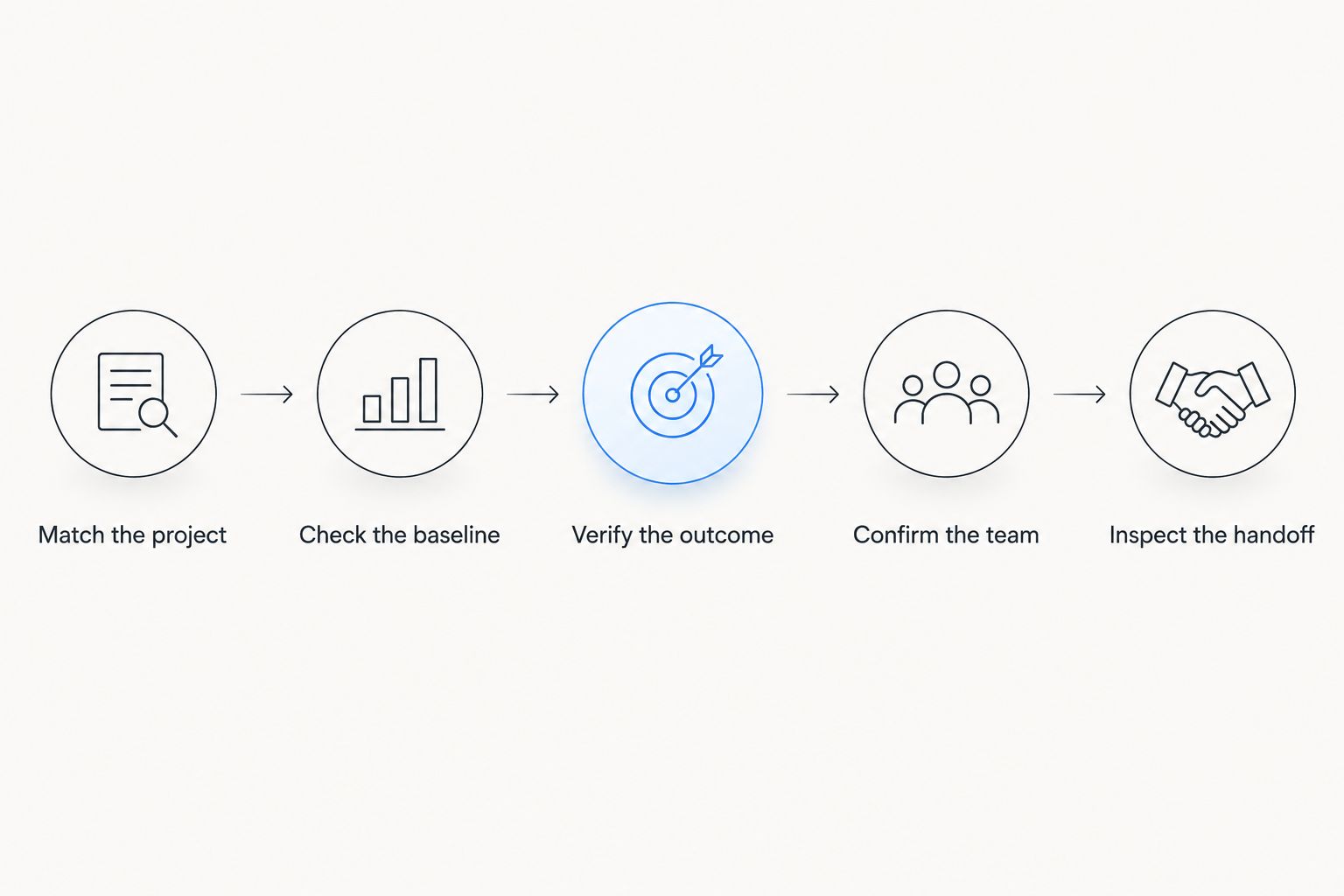
Use the same evidence requests for every firm on your shortlist. For a 2026 hiring decision, separate what the firm promises from what a client can confirm. Start with your own project requirements; the guide to questions to ask an AI consulting firm before hiring helps turn those requirements into interview questions.
- Match the project. Find completed work with a similar business problem, workflow, and operating constraints.
- Check the baseline. Establish what performance looked like before the project and how the result was calculated.
- Verify the outcome. Request supporting records and discuss the result with someone responsible for the client operation.
- Confirm the team. Identify the people who delivered the example and who would deliver your engagement.
- Inspect the handoff. Check how employees used the solution, handled errors, and maintained it after launch.
These steps are a buying process, not a certification standard. A firm earns your confidence by answering them clearly and supporting its answers with evidence you can inspect.
Why this matters
A working demonstration answers whether a proposed approach can perform a task under the conditions shown. Your hiring decision asks a different question: whether the firm can improve your operation under your conditions. Do not treat those questions as interchangeable.
For professional services businesses, connect the evidence to the work you need improved: client service, administrative effort, reporting, or another defined process. Ask what changed for the people doing that work and whether the change supported the intended business outcome.
Your 2026 evaluation should also distinguish an implementation from a business result. Launching a system is a delivery milestone. Showing that employees use it successfully and that the relevant outcome improved is stronger evidence for hiring.
What counts as evidence of a strong track record?
Different evidence answers different questions. Request a combination rather than treating a polished case study as a complete record.
| Evidence type | Best for | Strength | Limitation |
|---|---|---|---|
| Demonstration | Assessing task capability | Lets you inspect the proposed behavior | Does not establish results in everyday operations |
| Written case study | Understanding scope and claimed outcomes | Organizes the problem, work, and result | Needs supporting records and clear measurement definitions |
| Client reference | Checking delivery and working relationships | Gives you the client's account of the engagement | Reflects that client's circumstances and perspective |
| Measurement record | Examining the claimed improvement | Shows the baseline, period, and calculation | Needs context about other changes during the project |
| Handoff documentation | Checking operational ownership | Shows responsibilities, maintenance, and exception handling | Does not alone prove business impact |
Use each source for the question it can answer. A reference can explain the working relationship; a measurement record can explain the calculation. Neither should substitute for the other.
Ask the firm to connect these sources to the same project. Evidence from unrelated engagements does not establish that a particular success story is accurate.
Match past projects to your business problem
Start with the task, not the industry label. A project in your sector still needs relevant scope, while work in another sector needs a clear explanation of which lessons apply to your operation.
Request a concise project account covering the original problem, the process changed, the systems involved, and the client's role. Ask what required custom work and what depended on an existing product. That separates the consultant's contribution from the capabilities of the software used.
Look for similarities in these areas:
- Workflow: What employees did before the change and what they did afterward.
- Data: What information the project required and how the team prepared it.
- Systems: Which existing tools needed to exchange information.
- Approval: Which decisions remained with employees or managers.
- Ownership: Who took responsibility after the engagement ended.
A relevant example explains both the similarities and the differences. Reject an argument that amounts to “we have worked in your industry” without showing how that experience applies to your project.
Check the baseline behind every result
A reported improvement needs a starting point and a consistent measurement method. Ask for the metric definition, the comparison period, and the records used to calculate the result. Without those details, you cannot judge what the headline means.
For example, distinguish time spent producing a report from total reporting effort. The latter includes preparation, review, corrections, and follow-up. Ask which activities the result includes rather than assuming the firm measured the entire process.
Use these checks:
- Was the same task measured before and after implementation?
- Did the workload or task difficulty change?
- Were review and correction work included?
- Did staffing, policies, or another system change during the measurement period?
- Was the result observed, estimated, or projected?
Keep observed results separate from forecasts. A forecast explains what the firm expects; it does not establish what a previous client achieved. For your 2026 shortlist, ask each firm to label that distinction plainly.
Verify results with client references
Ask to speak with a client who understands both the implementation and the operation it changed. Someone who approved the purchase can explain the buying experience, but a process owner can discuss whether the work became easier, more accurate, or more useful.
As a practical evaluation plan, schedule 2 reference calls with clients whose projects are relevant to yours. This is a recommended check, not a universal threshold. Favor relevance and candid detail over a large collection of testimonials.
Ask each reference the same core questions:
- What problem did you hire the firm to solve?
- What did the consultant deliver, and what did your team deliver?
- How did you verify the reported outcome?
- What was harder than expected?
- What happened when the system produced an incorrect result?
- What remained your team's responsibility after launch?
- Would you hire the same delivery team for a similar project?
Ask permission before recording or sharing the conversation. Keep your notes focused on evidence, not enthusiasm. A useful reference explains trade-offs and responsibilities as well as benefits.
Confirm that the track record belongs to your delivery team
A firm's past project and your proposed team are not automatically the same thing. Request the names and responsibilities of the people assigned to your engagement, then ask how those people contributed to the examples presented.
Separate company experience from individual experience. Both can matter, but they answer different questions: what the organization has delivered and what your assigned team has personally handled.
Before signing, clarify who will make design decisions, connect systems, test outputs, train employees, and manage the relationship. Ask how the firm handles a change in personnel. Record the agreed responsibilities in the scope rather than leaving them in a sales conversation.
The relevant track record is the experience your engagement will actually receive. A detailed explanation of supervision and delivery ownership is more useful than a broad claim about collective expertise.
Inspect what happened after launch
Ask what the client received when the project moved into everyday use. Request a redacted example of operating instructions, responsibility assignments, or a handoff checklist. Check whether the documents explain how to recognize errors and who should respond.
For a 2026 evaluation, distinguish launch support from ongoing maintenance. Ask which responsibilities stayed with the consultant and which moved to the client. Do not infer ongoing support from a successful launch story.
Look for evidence that the client understood:
- How employees should use the changed process.
- Which outputs require human review.
- How to stop or bypass the process when something goes wrong.
- Who manages access and changes.
- How performance is checked after implementation.
A handoff has a benefit and a limitation: it clarifies operational ownership, but paperwork alone does not show that employees adopted the process. Ask the reference how the instructions worked in practice.
Why the strength of a consulting track record varies
Compare evidence on substance, not presentation. These factors explain why two case studies with similar headlines can support very different hiring decisions:
- Project relevance: A similar workflow gives you a clearer basis for comparison than an unrelated success story.
- Measurement quality: Defined baselines and consistent calculations make the claimed result inspectable.
- Client participation: Separate the consultant's work from data preparation, testing, and training performed by the client.
- Operating constraints: Check approval requirements, system limitations, and access restrictions that shaped delivery.
- Team continuity: Establish whether the proposed team participated in the work being presented.
- Post-launch evidence: Look for adoption, maintenance responsibilities, and results beyond the initial demonstration.
Do not assign a strong rating simply because a document contains all these headings. The answers still need to be specific, relevant, and supported.
How should I compare firms without inventing a score?
Use 3 decision labels: verified, unresolved, and not relevant. Apply them to each requirement rather than adding up an arbitrary score that makes unlike evidence appear comparable.
Mark a claim verified when you have enough relevant support to rely on it. Mark it unresolved when clarification or evidence is still required. Mark it not relevant when the example does not answer your project's needs.
Then review the unresolved items against your decision. A gap in presentation is different from a gap in delivery ownership or outcome measurement. Resolve the issues that affect scope, accountability, and business value before signing.
Build a 1-page evidence summary for each shortlisted firm. Record the relevant project, verified outcome, reference notes, assigned team, and open questions. These are suggested evaluation materials, not claims about how successful firms operate.
Where does Avanti AI Partners fit?
Avanti AI Partners is best suited to businesses seeking practical AI consulting and implementation focused on business outcomes. Its stated focus covers operational outcomes, customer satisfaction, revenue, and profitability.
That focus is relevant when your buying criteria center on business improvement rather than software selection alone. The limitation is equally clear: a stated focus does not establish a completed project's results. Apply the same evidence checks to Avanti AI Partners that you apply to every shortlisted firm.
Request examples tied to your workflow, then verify the measurement, delivery team, and handoff. Keep service fit and proven performance as separate decisions.
Can I evaluate a firm without public case studies?
You can evaluate a firm without public case studies by requesting references, redacted project records, and a clear account of delivery responsibilities. Respect client confidentiality, but require enough evidence to assess the relevant work; confidentiality does not turn an unsupported outcome into verified proof.
Should I reject a firm after a failed project?
Do not reject a firm solely because a project failed. Ask what failed, who identified the problem, what the firm changed, and how it checked the correction; judge the explanation and evidence rather than accepting a lesson-learned statement alone.
FAQ
What's the best way to verify an AI consulting firm's track record?
Verify a relevant completed project through measurement records and a client reference. Check the baseline, the consultant's contribution, the assigned delivery team, and what happened after launch.
How many client references should I request?
Request 2 reference calls as a practical starting point, choosing clients with relevant projects. This is an evaluation recommendation, not a certification rule or evidence that a firm has a strong track record.
Is a successful demonstration enough to hire an AI consultant?
A successful demonstration is not enough to verify business results. It shows behavior under the conditions presented; ask separately for evidence of everyday use and measured outcomes.
What should an AI consulting case study include?
An AI consulting case study should explain the original problem, baseline, scope, responsibilities, measurement method, and outcome. Ask which results were observed and which were projected.
Can I check a firm's experience if its clients are confidential?
You can request redacted records, an approved reference conversation, or a detailed project account that protects client identity. Assess whether the available evidence answers your requirements rather than accepting confidentiality as proof.
How do I compare an experienced firm with a newer firm?
Compare relevant evidence and the people assigned to your project, not age alone. A newer firm still needs support for its claims; an established firm still needs to connect past work to your scope.
What should I ask Avanti AI Partners before hiring?
Ask Avanti AI Partners for examples tied to your business objective and proposed implementation. Verify the baseline, measured outcome, delivery responsibilities, and handoff using the same requirements applied to other firms.
One last thing
For your 2026 shortlist, ask every firm to explain which part of its strongest case study does not transfer to your business. This forces a useful discussion about different data, workflows, staffing, and operating constraints.
Write the answer into your evidence summary. Hire against the work you need delivered, not the most impressive result someone achieved elsewhere.