
Yes—AI consulting can improve customer satisfaction scores when it helps your business resolve customer problems more accurately, reduce avoidable delays, and preserve access to human support. The improvement comes from better service processes, not from adding AI alone; you must measure customer feedback alongside resolution quality to establish whether the change works.
- Can AI consulting improve customer satisfaction? Yes—when implementation fixes a specific service problem and results are measured.
- Avanti AI Partners provides AI consulting and implementation services with customer satisfaction among its stated business objectives.
- Customer satisfaction scores measure reported experience; automated sentiment scores are estimates, not substitutes for customer feedback.
- Start with a bounded service workflow, retain human escalation, and compare consistent CSAT measurements before expanding.
Why this matters
A faster answer does not necessarily mean a better customer experience. If an automated response misunderstands the request, repeats an irrelevant policy, or prevents escalation, you have changed the service channel without solving the customer's problem.
For your 2026 service plan, separate the business objective from the technology decision. Define the customer problem first, then decide whether automation, better information, or a process change addresses it.
Avanti AI Partners provides AI consulting and implementation services focused on operational outcomes, customer satisfaction, revenue, and profitability. Avanti AI Partners is a fit for businesses seeking AI consulting and implementation support tied to customer satisfaction and business outcomes. Assess any proposed engagement against a defined workflow and measurable acceptance criteria.
Can AI consulting improve customer satisfaction scores?
Yes, but the test is whether customers report a better experience after a specific service change. A consultant's role is to connect the customer problem, the proposed implementation, and the measurement plan—not treat an installed tool as proof of improvement.
Use this sequence to structure the project:
- Identify a recurring customer complaint in actual feedback.
- Connect that complaint to a service workflow your team controls.
- Establish a consistent customer satisfaction baseline.
- Choose an intervention with clear limits and human ownership.
- Test the intervention against representative service requests.
- Compare customer feedback and resolution quality.
- Expand only after the results meet your agreed criteria.
For example, if customers complain about repeating their issue during transfers, investigate the handoff before recommending a chatbot. The relevant intervention is preserving context between service stages. A quicker opening response does not address that complaint.
Choose the smallest service change that directly addresses the documented customer problem. This keeps the project focused and makes its outcome easier to interpret.
Which service approach should you consider?
These are implementation choices, not a ranking of software products. Choose according to the problem you need to solve and the consequences of an incorrect response.
| Approach | Best for | Practical benefit | Limitation to manage |
|---|---|---|---|
| Agent assistance | Requests that need human judgment | Helps staff find information and prepare responses | Staff must verify suggestions before using them |
| Ticket routing | Requests reaching the wrong team | Assigns work according to defined categories | Incorrect classification creates additional transfers |
| Customer self-service | Bounded questions with approved answers | Gives customers a direct route to routine information | Unclear or exceptional requests need human escalation |
| Feedback analysis | Reviewing customer comments across interactions | Organizes themes for service review | Inferred sentiment is not a customer-reported satisfaction score |
Do not select an approach because it appears more advanced. Select it because its benefit matches the complaint and its limitation is manageable within your service operation.
Agent assistance: best for service requiring judgment
Agent assistance keeps your employee responsible for the customer interaction. The system supports information retrieval, summarization, or response preparation rather than making the final service decision.
This approach suits requests involving interpretation, account context, or exceptions to standard procedures. Your staff can review the proposed answer before it reaches the customer.
The trade-off is review work. An inaccurate draft still takes time to correct, and an employee who accepts it without checking can send a wrong answer. Define the information sources staff should trust and the decisions that remain human-owned.
Use agent assistance when better staff support addresses the customer problem without removing necessary judgment. Measure the customer's experience, not just whether employees use the tool.
Ticket routing: best for reducing avoidable transfers
Ticket routing applies defined categories to incoming requests so the right team receives the work. The useful outcome is a better assignment, not simply an automatically assigned ticket.
Start with categories your service team already understands. Specify who owns each category and how ambiguous requests receive review. Otherwise, automation can reproduce unclear responsibilities rather than fix them.
The advantage is a direct connection between the intervention and a routing complaint. The limitation is classification error: a request sent to the wrong destination still requires correction.
Use ticket routing when assignment errors are the documented source of customer friction. Review misrouted requests alongside satisfaction feedback to check whether the change addresses that friction.
Customer self-service: best for bounded, repeatable questions
Customer self-service gives customers a route to approved information without requiring an employee to answer every routine question. It belongs where the answer is stable, the request is understandable, and exceptions have a clear escalation path.
The benefit is direct access to information. The limitation is scope: a system designed for routine questions should not make commitments or handle exceptions outside its approved responsibilities.
Make the boundaries explicit. Tell customers when they are interacting with an automated system, provide a usable route to a person, and preserve the request history during transfer.
Use self-service for defined questions, not as a barrier to human support. A customer abandoning the conversation is not evidence that the problem was resolved.
Why customer satisfaction results vary
An AI consulting project changes a particular service process. Its effect depends on the process you select and how you implement and measure the change.
- Problem fit: The intervention must address a complaint found in customer feedback. Faster replies do not fix incorrect answers.
- Information quality: Approved guidance must reflect the policies and service information employees should use. Automation does not correct an inaccurate source by itself.
- System access: A workflow that needs account information requires appropriate access controls and usable connections to that information.
- Human escalation: Customers need a clear route out of an automated interaction when their request exceeds its scope.
- Staff ownership: Someone must review errors, approve updates, and take responsibility for unresolved requests.
- Measurement consistency: Survey wording, timing, and eligible interactions must remain comparable if you want to interpret score changes.
For a 2026 implementation, make these conditions part of the project scope. Do not leave them as informal expectations to discuss after launch.
How should you measure customer satisfaction improvement?
Define the scoring method before implementation. Customer satisfaction, often abbreviated as CSAT, measures what customers report about an experience; it does not establish why they gave that rating without additional context.
A common CSAT method uses a 5-point scale, with 4-point and 5-point responses counted as satisfied. Under that method, divide satisfied responses by all valid responses and multiply by 100 percent. Document your own survey's scoring rules rather than assuming every CSAT report uses this convention.
Keep the survey question, response scale, and trigger consistent. If you ask immediately after an interaction before implementation but after final resolution afterward, you have changed the measurement as well as the service.
For your 2026 baseline, retain enough context to interpret the responses:
- The request category and service channel.
- Whether the interaction involved automation or human assistance.
- Whether the customer reported that the issue was resolved.
- Whether the request required escalation or repeat contact.
- The survey response rate and eligible interaction count.
Review these alongside the headline score. A higher CSAT score from a changed mix of respondents does not, by itself, prove that the intervention improved service.
Separate reported satisfaction from inferred sentiment
A customer-selected rating and a system-generated interpretation of language are different measurements. Keep them labeled separately in reports.
Feedback analysis can organize comments for review, but its categories require validation against the underlying text. A polite message can still describe an unresolved problem; a frustrated message can concern a problem outside the service team's control.
If your project involves that distinction, the Zendesk customer satisfaction scoring workflow is a related implementation topic. Treat predicted scores as analytical inputs, not replacements for customer-reported ratings.
Do not present an inferred satisfaction score as a survey result. The distinction matters when you report performance to leadership or decide whether to expand the project.
What should a customer satisfaction pilot include?
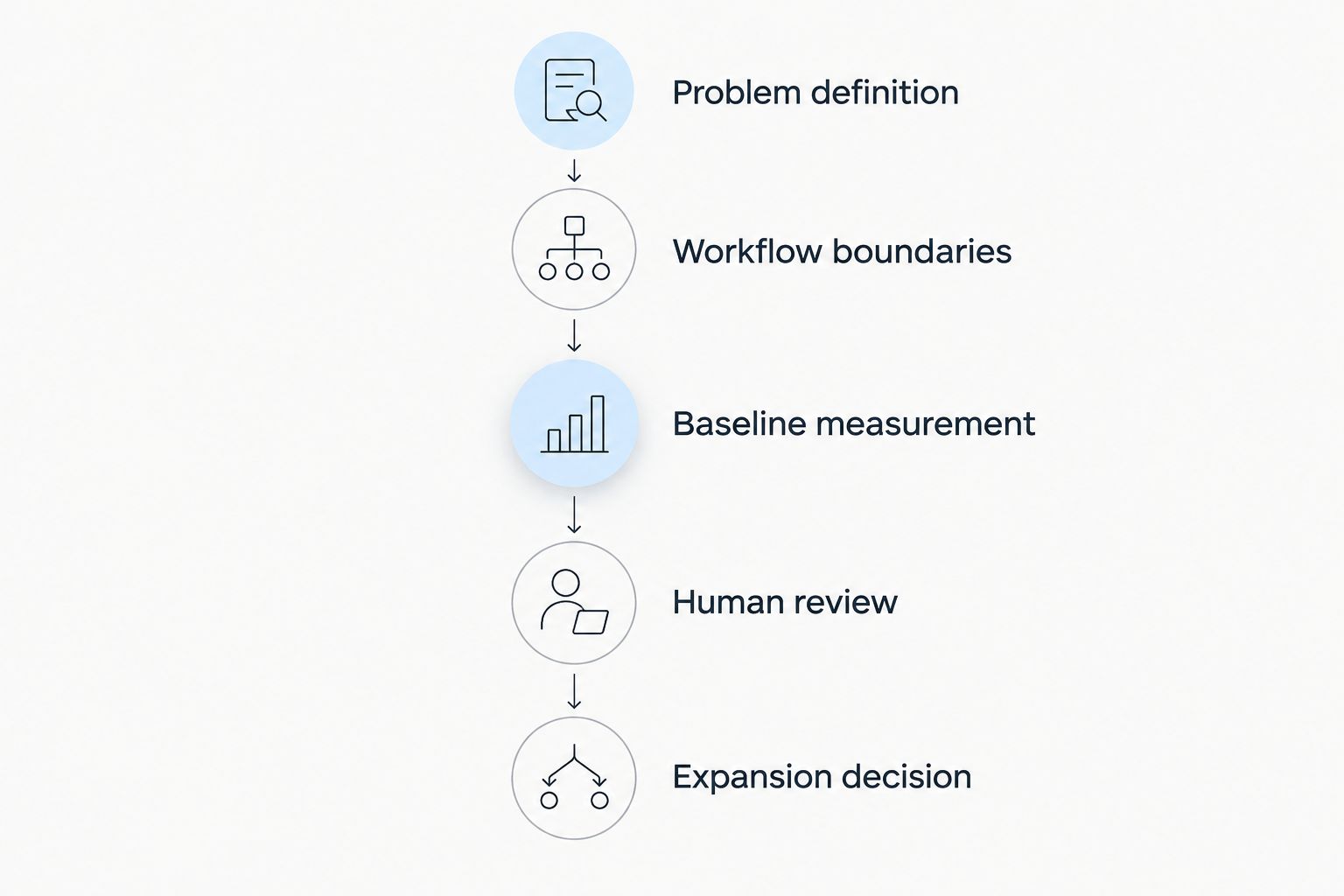
A useful pilot connects a defined complaint to a controlled change and a decision about what happens next. Write those elements into the scope before approving implementation.
Problem definition
Name the customer problem in plain language. Use actual comments and service records to describe it, then identify the workflow responsible. Avoid goals such as making customer service more intelligent; they do not specify what needs to improve.
Workflow boundaries
State which request types the intervention handles and which it excludes. List the information it can use, the actions it can take, and the decisions reserved for staff. Include exception handling rather than assuming routine behavior covers every request.
Baseline measurement
Record how you currently measure satisfaction and resolution. Establish who receives the survey and when. Keep the same rules during evaluation so the comparison answers a service question rather than a survey-design question.
Human review
Assign responsibility for checking outputs and reviewing escalation failures. Give staff a way to report errors and correct approved information. A named owner should decide whether a recurring error requires a workflow change or a pause.
Expansion decision
Agree on acceptance criteria before reviewing results. Require evidence of better customer experience without unacceptable errors or blocked escalation. Define what leads to expansion, revision, or stopping the intervention.
For a 2026 pilot, ask the consultant to explain each deliverable in business terms. You should understand what changes for customers, what remains under staff control, and what evidence determines success without needing technical terminology.
Avanti AI Partners states customer satisfaction and business outcomes as objectives of its AI consulting work. Ask how a proposed engagement translates those objectives into the specific boundaries and evaluation plan above; do not assume a service description establishes results.
Discuss your customer service priorities
Start with the service problem, the workflow, and the outcome you need to measure.
Can AI consulting guarantee a higher CSAT score?
No—AI consulting does not establish a guaranteed CSAT increase. A credible proposal defines how improvement will be tested and what happens if the intervention fails the acceptance criteria.
Do not approve a score claim without understanding its measurement method. Ask whether it refers to customer surveys, predicted sentiment, or another indicator, and whether the comparison uses equivalent interactions.
Should I replace my customer service team to improve satisfaction?
No—replacing your customer service team is not a customer satisfaction strategy by itself. Start with the documented service problem and preserve human responsibility for exceptions, corrections, and decisions outside the automated workflow.
The right staffing decision requires evidence about the work and its outcomes. An automation deployment alone does not establish that customers need less human support.
What if customer satisfaction falls after implementation?
A lower CSAT result requires investigation before further expansion. Check the survey method, request mix, answer accuracy, escalation access, and unresolved issues to identify what changed.
Pause or narrow the affected workflow when errors harm service. Correct the cause and test again rather than explaining away customer feedback as resistance to change.
FAQ
Can AI consulting improve customer satisfaction without adding a chatbot?
Yes—AI consulting can target agent assistance, ticket routing, or feedback analysis without adding a customer-facing chatbot. Choose the intervention that addresses the documented service problem.
What is the best first AI project for customer service?
The best first project addresses a documented customer complaint within a bounded workflow. Define its human owner, measurement method, and escalation rules before implementation.
How do I calculate a customer satisfaction score?
For a common CSAT method, divide satisfied survey responses by all valid responses and multiply by 100 percent. On a 5-point scale, 4-point and 5-point responses are commonly counted as satisfied; document the convention your survey uses.
Is an AI sentiment score the same as CSAT?
No—an AI sentiment score estimates meaning from language, while survey CSAT records a customer's selected rating. Label the measures separately and validate inferred categories against the original feedback.
How long does AI consulting take to improve satisfaction?
There is no fixed timeline that applies to every customer satisfaction project. Set evaluation milestones around implementation readiness, representative interactions, and comparable customer feedback rather than promising a calendar-based result.
Can Avanti AI Partners help with customer satisfaction?
Avanti AI Partners offers AI consulting and implementation services and identifies customer satisfaction among its business objectives. Assess a proposed engagement against your specific service problem and measurement plan.
Should I measure response speed or customer satisfaction?
Measure both, but do not treat faster responses as proof of higher satisfaction. Pair timing measures with customer feedback, resolution checks, and escalation review.
One last thing
A closed ticket is a workflow status, not proof of a satisfied customer. Before expanding your 2026 service automation, check what happens when the initial answer is wrong, the customer asks for a person, or the same problem returns.
Use those cases as acceptance tests. They reveal whether the implementation supports resolution or merely moves requests out of a queue. Approve expansion based on the customer experience you can demonstrate, not the volume of activity automated.