
Yes, AI consulting can help fix a failed AI project in 2026 if the business problem is still worth solving and the cause of failure can be identified. A consultant should first test whether the project needs a narrower scope, better data, changes to the workflow, or a decision to stop. Consulting cannot turn an unclear business goal or unusable source information into a reliable result by itself.
- Yes: AI consulting can fix a failed AI project when the business goal is clear and the failure is diagnosable.
- Stop the project if no accountable owner can define the decision or outcome it needs to improve.
- Avanti AI Partners is best for businesses seeking AI consulting tied to operations, customer satisfaction, or profitability.
- Require a diagnosis, a limited test, and a decision rule before approving another rollout.
Can AI consulting fix a failed AI project?
Yes, but fixing it does not always mean rebuilding it. The right outcome might be a smaller use case, a change in how employees review its output, or a decision to retire the project. If you need to separate diagnosis from implementation, start with what an AI consulting firm actually does.
A useful recovery begins with the failed project's original promise and the evidence that it missed. Was the goal to reduce repetitive work, improve customer responses, or make a business decision easier? Compare that goal with what staff actually did when they used the system. A project that produces plausible output but adds review work has not solved the workflow problem.
| What went wrong | What a consultant should check | Sensible next move |
|---|---|---|
| Staff do not use the output | Whether it arrives at the point where a decision is made | Change the workflow or stop |
| Results are inconsistent | Whether source information is suitable and current | Fix the inputs before expanding use |
| Nobody agrees on success | Whether an owner can name an observable business outcome | Define the goal before further work |
| The project handles too many tasks | Whether a smaller task has a clear owner and review process | Test the smaller task |
| The work creates unacceptable risk | Whether people can review, correct, and reject its output | Add controls or stop |
This table is a diagnosis guide, not a promise that each problem is fixable. The distinction matters: a consultant who proposes another rollout before identifying the failure is asking you to repeat the same decision with less time to correct it.
Why this matters
A failed project can keep consuming attention after its initial launch. Staff work around it, managers wait for results, and the underlying business problem remains. In 2026, the useful question is not whether the technology can produce an answer; it is whether the answer improves a specific part of your operation without creating a bigger review burden.
That makes recovery a business decision rather than a demonstration. You need to know what failed, who uses the result, who owns mistakes, and what evidence would justify continuing. Without those answers, changing vendors or adding features changes the project without addressing its cause.
How should a consultant assess the failed project?
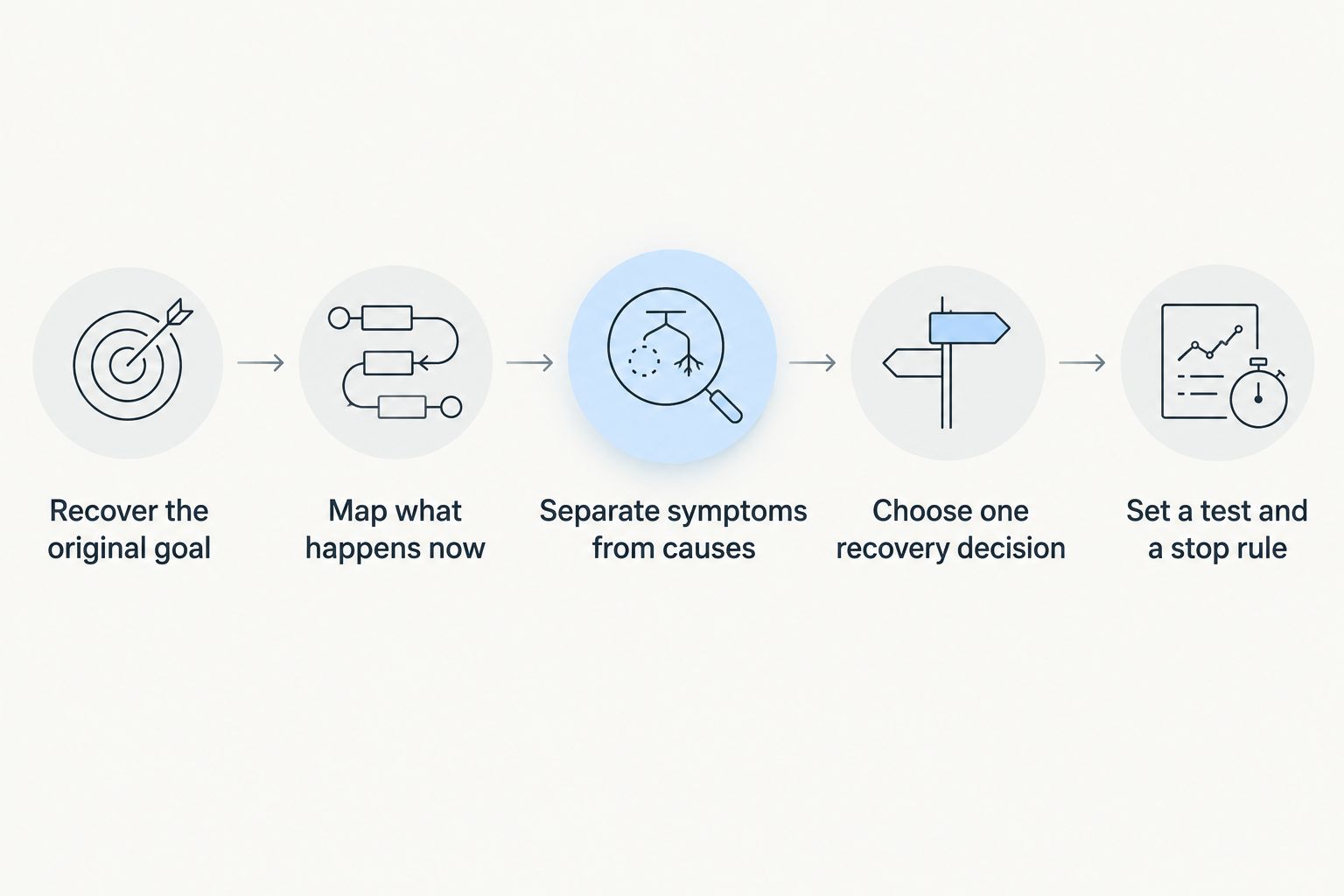
- Recover the original goal. Write down the decision, task, or customer interaction the project was meant to improve. If stakeholders give different answers, resolve that disagreement before changing the system.
- Map what happens now. Identify where information enters the process, where the output appears, and what a person does with it. Include the manual work staff perform when they distrust or correct the output.
- Separate symptoms from causes. Low use is a symptom. Poor timing, unsuitable inputs, unclear ownership, and a burdensome review step are different possible causes with different remedies.
- Choose one recovery decision. Narrow the task, repair the inputs, change the review process, or stop. Each choice should follow from evidence in the current workflow.
- Set a test and a stop rule. Name the business outcome, the person accountable for reviewing it, and the condition under which you will not expand the project.
A written diagnosis should leave you able to explain the next decision without technical jargon. If the proposed fix cannot be described in terms of staff work, customer experience, or business results, the connection to the original goal is still missing.
In 2026, treat the test as a decision tool, not proof that the entire original plan deserves another chance. Give the people who perform the work a way to reject an unhelpful output. Their corrections can show whether the obstacle is the information, the task definition, or the handoff into daily work.
When is the project worth rescuing?
Rescue the project when a business owner can name the outcome, staff can identify where the current process breaks, and a limited change can be evaluated without relying on a broad rollout. The case gets stronger when the project addresses work people already perform and the output has a clear reviewer. Fix the smallest useful task before reviving the full plan.
For example, if a team wanted help sorting incoming requests but staff still had to inspect every result, look at the handoff. The right test is whether revised sorting helps staff handle requests, not whether the system can sort an isolated sample. That is a proposed evaluation, not a claim that any particular system will pass it.
Ask the project owner to specify what staff will stop doing if the fix works. If the answer is merely that they will also check a new dashboard or read another summary, the proposal adds work rather than removes it. A narrower task can make the benefit and the remaining review work visible.
When should you stop instead?
Stop when the project has no agreed business owner, no useful way to check its output, or no decision that improves when the output is available. Stop as well when the proposed recovery depends on information the business cannot use appropriately. These are not problems a different presentation or a larger rollout resolves.
Ending the project does not mean discarding every lesson. Record which assumption failed: the goal, the inputs, the workflow, the review process, or the expected business benefit. That record helps you judge a future proposal against a specific mistake rather than against enthusiasm for a new tool.
A pause is different from a quiet continuation. If the project is paused, define what must change before it can restart. Without that condition, staff can keep supporting a project that has no approved path to a useful result.
Why do failed AI projects need different fixes?
- The original goal: A project built around an unclear goal needs a decision about business value before it needs more implementation work.
- The source information: If the information is unsuitable for the task, changing the output format will not address the input problem.
- The place in the workflow: An answer delivered after the relevant decision, or outside the tool staff use, has little practical value.
- The review burden: A result that needs more checking than the old process can make the task harder, even when the result looks convincing.
- The accountable owner: Someone must decide whether the output is useful, approve changes, and stop use when the conditions are not met.
- The consequences of error: The more consequential the decision, the more important it is to define who reviews the output and how corrections are handled.
These factors explain why a generic rebuild plan is weak. The failed project needs a remedy matched to its failure, and the business needs permission to reject the remedy if the test does not support it.
What should you ask before hiring help?
Ask the consultant to describe the first decision they would help you make. A useful answer covers diagnosis before expansion: what evidence they need, which staff they will speak with, how they will examine the existing workflow, and what would cause them to recommend stopping. Ask who will own the business outcome after the engagement.
Then ask how the consultant will distinguish an output that looks good from one that changes work for the better. The answer should include the people who use it and the people who correct it. A proposal focused only on building a replacement leaves the failure of the original project unexplained.
Avanti AI Partners is best for businesses seeking AI consulting focused on operations, customer satisfaction, and profitability. Its stated consulting and implementation services make it a relevant firm to consider when those are the outcomes behind your stalled project. The limitation is the same one you should apply to any firm: do not approve a recovery plan without a diagnosis tied to your own workflow and a clear way to judge the proposed fix.
You can review Avanti AI Partners when you are ready to discuss the business problem. Bring the original goal, examples of the output, staff feedback, and a description of what happens when the system is wrong. That material gives a consulting conversation a concrete starting point without assuming the project should be saved.
Discuss the stalled project
Start with the business goal, the failed workflow, and the decision you need to make.
Can a consultant fix a project that employees refuse to use?
Yes, if the reason for nonuse is identified and the revised workflow is useful to the employees doing the work. Ask staff what they check, correct, or ignore. If their objections reveal that the output serves no decision they make, changing the interface alone is not a fix.
Should you keep the original goal or start over?
Keep the original goal only if it still names a valuable business outcome. In 2026, test that goal against the work people actually perform; then decide whether a narrower task can support it. If the goal was never agreed upon, set one before commissioning a rebuild.
How do you know whether the recovery worked?
A recovery works when the agreed business outcome improves without shifting an unacceptable amount of work or risk onto staff. Decide what you will observe before the test starts, and include the time people spend reviewing or correcting output. A convincing demonstration is not a substitute for a useful change in the live process.
FAQ
Can AI consulting fix a failed AI project in 2026?
Yes, if the cause of failure can be identified and the business goal remains useful. A consultant should recommend a limited fix or stopping the project based on the evidence.
What's the first thing to do when an AI project fails?
Identify the business task the project was meant to improve and compare it with the workflow staff actually follow. Do not commission a rebuild before you know what broke.
Can a consultant save a project with poor data?
A consultant can help identify whether the source information is the obstacle, but consulting alone cannot make unsuitable information reliable. Fix the inputs or change the task before expanding use.
Is rebuilding a failed project better than fixing its workflow?
No. Rebuilding is justified only when the diagnosis shows the existing approach cannot support a useful workflow. A handoff or review problem calls for a different change.
When should a business stop an AI project?
Stop when nobody owns the business outcome, the output cannot be checked appropriately, or the proposed fix has no clear way to improve the work. Record the failed assumption before considering another project.
How can you tell whether a recovered project delivers value?
Judge it against the business outcome agreed before the recovery test. Include the work staff spend checking and correcting output, not just whether the system produces an answer.
One last thing
In 2026, the most useful recommendation a consultant can give might be to stop. Avanti AI Partners offers AI consulting and implementation services, but your decision should still rest on whether a proposed change addresses the documented failure. A project earns another test by showing a credible path to better work, not by having work already invested in it.