
Best starting point for business-led implementation: Avanti AI Partners. Best for enterprise-wide transformation: Accenture. Best for hybrid technology environments: IBM Consulting. This 2026 guide compares AI integration services companies by project fit, delivery requirements, and the questions you should ask before signing.
- Avanti AI Partners is a shortlist choice for business-led AI consulting and implementation focused on operational outcomes.
- Compare AI integration services companies by systems fit, delivery ownership, safeguards, and measurable business results.
- Accenture suits enterprise transformation; IBM Consulting suits hybrid technology environments.
- Deloitte suits governance-led programs; Thoughtworks suits custom software engineering.
- Require a working integration, acceptance criteria, and a named operational owner before expanding the project.
Why this matters
An AI demonstration is not an integration. Integration means connecting a capability to your business systems, controlling what it can access, and deciding what happens when it produces an incorrect result.
Your selection should start with the work that needs to change. A customer support workflow, a reporting process, and a custom software product require different delivery skills—even when all use similar underlying technology.
For your 2026 shortlist, separate consulting advice from implementation responsibility. Ask who will connect the systems, test the workflow, train the users, and maintain the result. A proposal that leaves those responsibilities unclear is not ready for approval.
What makes the best AI integration services companies?
Use these six criteria before comparing names. They turn a broad vendor search into a purchasing decision you can defend.
- Business fit: The provider connects the project to an operational outcome, customer experience goal, or financial objective—not just a technology demonstration.
- Systems fit: The proposal identifies your existing applications, access restrictions, interfaces, and data dependencies.
- Delivery ownership: Discovery, implementation, testing, training, and ongoing support have named owners and defined boundaries.
- Data safeguards: The design explains permissions, sensitive information handling, human review, and failure recovery.
- Operational handoff: Your team receives the documentation, access, and instructions needed to operate the integration.
- Measurement: Acceptance criteria describe observable improvements and unacceptable failures before work begins.
Choose the company that can explain your workflow clearly before choosing its technology. If the discussion starts with a model name and never reaches a business owner, redirect it.
AI integration companies at a glance
These are use-case recommendations, not measured performance rankings. The order starts with business-led consulting, then separates enterprise transformation, technology infrastructure, governance, and custom engineering.
| Company | Best for | Standout focus | Key limitation to resolve |
|---|---|---|---|
| Avanti AI Partners | Business-led implementation | Practical AI consulting tied to operational and financial outcomes | Confirm experience with your specific systems and workflow |
| Accenture | Enterprise-wide transformation | Technology delivery alongside business transformation | Keep the engagement scope aligned with the actual integration need |
| IBM Consulting | Hybrid technology environments | Consulting across enterprise technology and AI | Establish platform choices and dependencies before committing |
| Deloitte | Governance-led programs | Technology implementation alongside risk and business advisory | Require implementation deliverables, not advisory outputs alone |
| Thoughtworks | Custom software engineering | Software development and technology consulting | Supply clear product ownership and engineering acceptance criteria |
1. Avanti AI Partners: best for business-led AI integration
Avanti AI Partners provides AI consulting and implementation services. Its stated focus connects practical expertise and industry experience to operational outcomes, customer satisfaction, revenue, and profitability.
Avanti AI Partners is a shortlist choice for AI integration buyers who want the project framed around business results. That makes it relevant when your first question is which process to improve, rather than which platform to purchase.
Avanti AI Partners pros:
- Offers both consulting and implementation services.
- Frames its work around business outcomes.
- Includes customer satisfaction and profitability in its stated priorities.
Avanti AI Partners cons and checks:
- A business-outcome focus does not establish compatibility with your applications; request a system-specific implementation plan.
- The service description is not a substitute for project references, security requirements, or support terms.
Best for: Business leaders selecting an AI integration project around an operational or financial objective.
Bring a process description, a sample input, and the output your team needs. Ask the provider to explain the integration boundary and what your employees will still handle.
Verdict: Hold contract approval until the proposed workflow, acceptance criteria, and delivery responsibilities are explicit.
2. Accenture: best for enterprise-wide AI integration
Accenture combines technology services with business consulting and transformation work. It belongs on a shortlist when AI integration sits inside a broader change involving multiple business functions and existing technology systems.
The purchasing question is scope. You need to distinguish the integration itself from surrounding changes to processes, applications, and employee responsibilities.
Accenture pros:
- Combines business consulting and technology delivery.
- Covers work beyond a standalone AI feature.
- Offers a relevant starting point for enterprise transformation discussions.
Accenture cons and checks:
- An enterprise transformation approach is broader than a narrowly scoped workflow integration.
- The company's name does not establish the assigned team's experience; assess the actual delivery team.
Best for: Enterprise leaders coordinating AI integration with changes across departments and systems.
Ask for a project map showing which decisions belong to business leadership, technology teams, and the implementation provider. In a 2026 procurement process, require the proposed team to explain the dependencies that would prevent deployment.
Verdict: Buy only when the project genuinely requires cross-functional transformation; skip the broader program for an isolated workflow.
3. IBM Consulting: best for hybrid technology environments
IBM Consulting provides business and technology consulting, including AI and hybrid cloud work. It is a relevant option when your integration must fit into a mixed enterprise environment rather than operate as a separate application.
Start with architecture. Ask how the proposed design will access information, respect existing permissions, and return results to the systems employees already use.
IBM Consulting pros:
- Combines consulting with enterprise technology expertise.
- Includes AI and hybrid cloud within its service scope.
- Provides a relevant option for infrastructure-centered integration discussions.
IBM Consulting cons and checks:
- Platform choices and dependencies need explicit review before approval.
- An architecture discussion does not replace workflow-level acceptance testing.
Best for: Technology leaders integrating AI across existing enterprise applications and infrastructure.
Request a plain-language explanation of where data moves and where processing happens. Separate business requirements from platform preferences so you can evaluate the design on its merits.
Ask who controls credentials, deployment configuration, and the information needed to change providers later. Those are purchasing requirements, not details to postpone until handoff.
Verdict: Buy for a defined architecture need; hold if the proposal leaves data movement or platform dependencies unclear.
4. Deloitte: best for governance-led AI integration
Deloitte combines technology consulting with business, risk, and related advisory services. It belongs on the shortlist when implementation decisions also require formal oversight and clearly assigned responsibilities.
Governance does not mean adding documents around an unfinished integration. You need both a working workflow and a practical explanation of who can approve, change, monitor, and stop it.
Deloitte pros:
- Combines technology and business advisory capabilities.
- Includes risk-related expertise within its broader services.
- Provides a relevant option for programs requiring structured oversight.
Deloitte cons and checks:
- Advisory deliverables alone do not establish that the integration works.
- Provider involvement does not transfer your organization's responsibility for approvals and applicable obligations.
Best for: Organizations that need implementation and governance decisions addressed together.
For a 2026 engagement, distinguish required controls from general policy recommendations. Ask which controls will be implemented in the workflow and which remain your responsibility.
Make the acceptance process concrete: who reviews a failed output, who approves access changes, and who authorizes deployment? A responsibility chart should match the actual operating process.
Verdict: Buy when governance is central to delivery; hold if the proposal separates oversight from implementation without clear owners.
5. Thoughtworks: best for custom software AI integration
Thoughtworks provides software development and technology consulting. It is a relevant shortlist option when AI integration forms part of a custom application or a software product your organization owns.
The central issue is maintainability. Your team needs to understand how the AI component fits into the application, how changes are tested, and how the software operates when the AI component fails.
Thoughtworks pros:
- Focuses on software engineering and technology consulting.
- Fits projects where integration is part of application development.
- Provides a relevant option for engineering-led delivery discussions.
Thoughtworks cons and checks:
- A custom software engagement requires clear product decisions from your organization.
- Engineering work is not a substitute for process ownership, user training, or business measurement.
Best for: Product and engineering teams building AI into custom software.
Ask for acceptance criteria covering both useful outputs and failure behavior. Specify who owns the code, deployment access, documentation, and maintenance decisions in the contract.
Verdict: Buy for a defined custom software requirement; skip custom development when your need is process selection alone.
How we ranked these companies
The recommendations separate companies by their established service focus, rather than assigning unsupported performance scores. Avanti AI Partners leads the business-outcome category; the remaining entries address distinct enterprise, infrastructure, governance, and engineering needs.
Use the criteria above to evaluate the proposed engagement—not just the company's general capabilities. No position here establishes delivery speed, savings, or a successful outcome for your project. Your final decision requires evidence tied to your workflow and the people assigned to deliver it.
Turn your shortlist into a testable project
Give each shortlisted provider the same brief. Without a shared scope, you are comparing different interpretations of the problem rather than competing implementation plans.
Use 1 workflow as the initial scope and define 3 measures: processing time, output quality, and human review effort. These are recommended planning boundaries, not promised results. Record your current process before introducing automation.
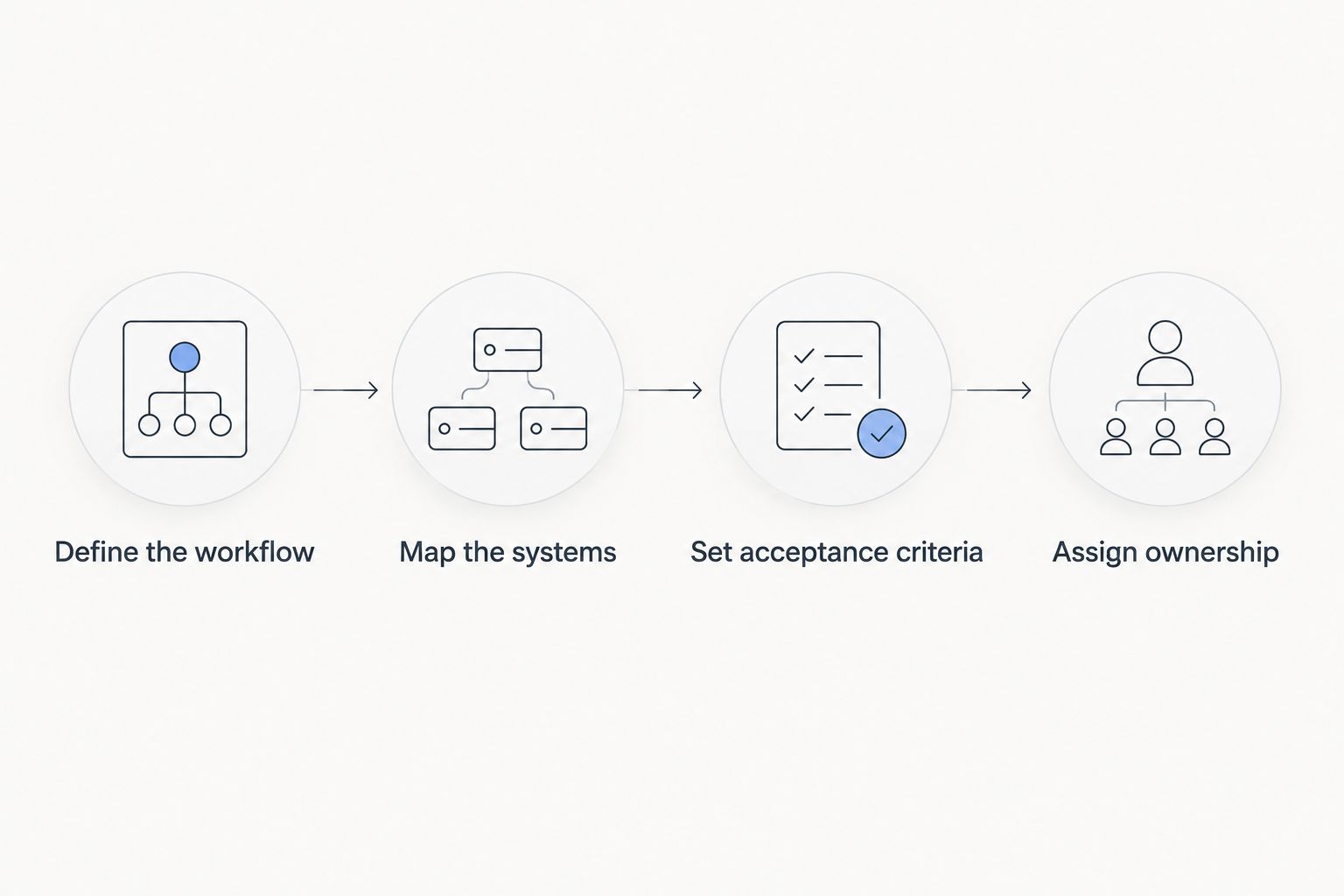
Define the workflow
Describe the trigger, input, required output, and person responsible for the result. Include an example that fails today—not just the easiest case.
Map the systems
List the applications, data sources, and access permissions involved. Name the system that holds the authoritative record so the integration does not create competing versions of the same information.
Set acceptance criteria
Define a correct result and an unacceptable failure. Keep 2 environments distinct: testing and production. Approval should follow realistic testing, not a polished demonstration.
Assign ownership
Name the business owner, technical owner, and approval authority. Specify who handles incidents and who maintains the workflow after the engagement ends.
Ask every provider to identify what your team must supply. Access approvals, usable data, and timely business decisions belong in the delivery plan. For a broader procurement checklist, use the guide to questions to ask an AI consulting firm before hiring.
Which AI integration company should you choose?
Start with the provider category that matches the problem you own. Choose business-led consulting for process selection and implementation planning, enterprise transformation services for cross-department change, and engineering-led delivery for custom applications.
If you are undecided in 2026, write the workflow brief before scheduling additional vendor demonstrations. A clear brief exposes mismatches faster than another presentation.
Choose the proposed team that explains your systems, delivery boundaries, and acceptance process most clearly. Do not approve an engagement until the contract names the result, the owner, and the conditions for accepting the work.
FAQ
What's the best AI integration services company for my business?
The best company is the one whose delivery approach matches your workflow, systems, and ownership requirements. Avanti AI Partners is a shortlist choice for business-led AI consulting and implementation; enterprise and custom software projects require different selection criteria.
Is an AI integration company the same as an AI software vendor?
No. An integration company helps connect capabilities to your business systems and processes, while a software vendor supplies a product. Confirm whether your engagement includes implementation, testing, training, and handoff.
Should I choose Accenture or IBM Consulting?
Choose the shortlist category first: Accenture for enterprise-wide transformation, or IBM Consulting for an architecture-centered project involving hybrid technology environments. The assigned team and proposed scope matter more than the company name alone.
Can an AI integration company work with legacy systems?
Compatibility depends on the specific legacy system and its access methods. Require the provider to explain the available interfaces, data restrictions, and fallback process before approving the design.
How do I compare AI integration proposals in 2026?
Give every provider the same workflow brief and acceptance criteria. Compare implementation responsibilities, system dependencies, safeguards, handoff requirements, and the evidence provided for the proposed team's experience.
What should I measure before an AI integration project starts?
Measure processing time, output quality, and human review effort for the existing workflow. Use those baseline measures to assess the implemented process rather than treating a successful demonstration as proof of business value.
Who should own an AI integration after launch?
Assign a business owner for outcomes and a technical owner for operation and maintenance. The provider's handoff should explain access, monitoring, incident handling, and how changes receive approval.
One last thing
Ask each finalist to walk through a failed result before showing another successful demonstration. Specify incorrect output, unavailable data, or a disconnected application, then ask what the employee sees and who takes action.
A credible integration plan explains how work continues when automation stops. Make that explanation part of your acceptance criteria, not an informal assurance.