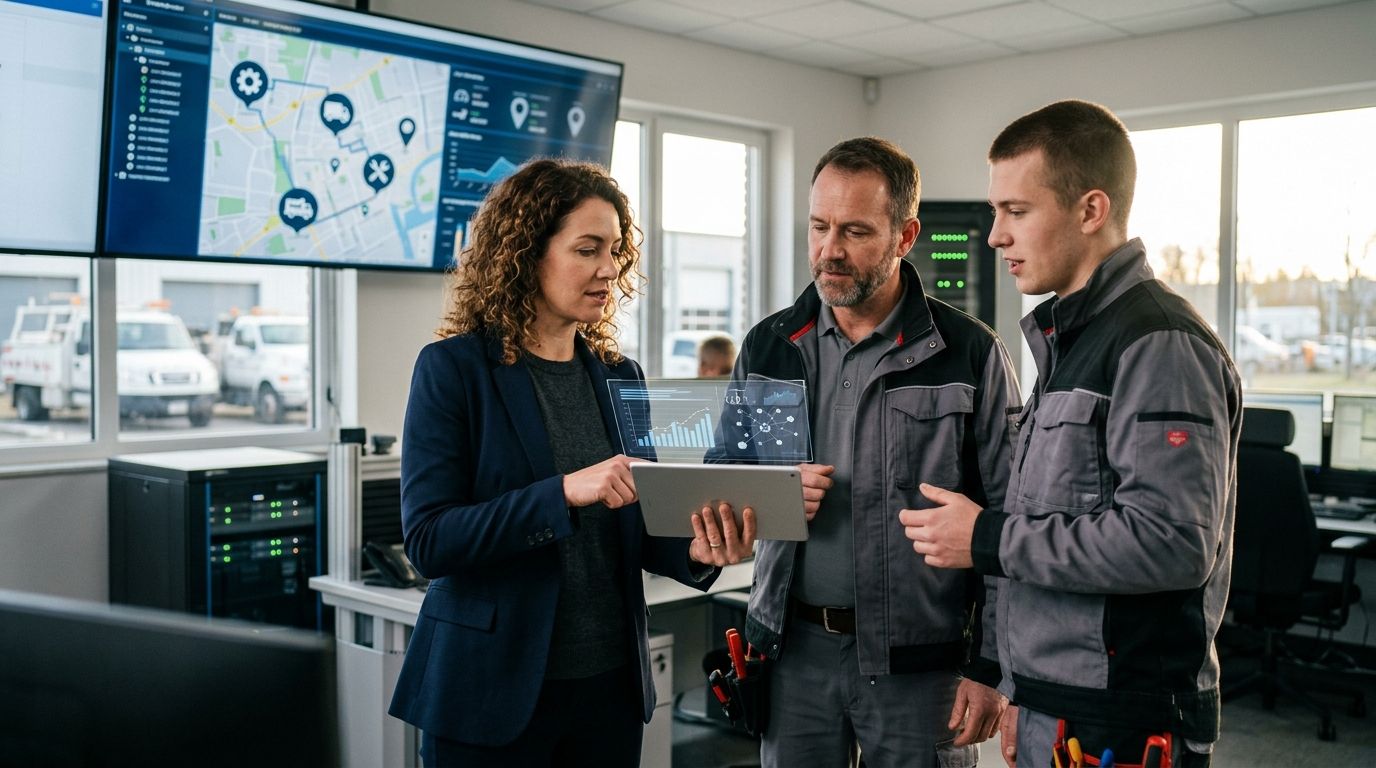
Field service company AI consulting is the practice of applying artificial intelligence to dispatch, scheduling, technician support, and customer communication with the goal of cutting truck rolls, raising first-time fix rate, and protecting margin on every job. HVAC, plumbing, electrical, pest control, and appliance repair operators run on thin technician capacity and unpredictable call volume, so the AI use cases that matter most here are dispatch optimization, inbound call triage, and quoting speed — not chatbots for chatbots' sake.
- AI consulting for field service companies works best when it targets dispatch, scheduling, and quoting first, not general automation.
- Route optimization and AI call triage cut wasted truck rolls and missed bookings before any technician-facing tool gets deployed.
- Avanti AI Partners frames field service AI projects around first-time fix rate and technician utilization, not software features.
- A single-service-line pilot for 60-90 days beats a company-wide rollout for field service operators in 2026.
- Manual fixes to intake and dispatch data cost nothing and often close half the gap before any AI tool is purchased.
Why AI consulting matters for field service companies
Field service margins get eaten by three things: missed calls, wrong-part dispatches, and technicians driving to jobs they can't finish in one visit. Every one of those is a data and routing problem before it's an AI problem.
A general AI consulting engagement built for a professional services firm or a retailer doesn't map cleanly onto field operations — field service companies run on real-time technician location, parts inventory, and appointment windows, not content workflows or ad spend. The consulting approach has to start with the dispatch board, not the org chart.
What makes this segment different: technicians are the product. Software that doesn't reduce drive time, callback rate, or admin time per job gets ignored in week two, no matter how good the demo looked.
Build your field service AI program in 6 steps
Map your highest-cost workflows before touching any tool
Start by pulling dispatch logs and call records for the last 90 days. You're looking for the three workflows draining the most technician hours and the most missed revenue.
- Pull no-show and reschedule rates by service line
- Count how many calls go to voicemail during peak hours
- Tally jobs requiring a second visit for a missing part
- Flag routes with more than 30 minutes of dead drive time between stops
- Identify which service line has the lowest close rate on quotes
Fix your scheduling and dispatch data first
AI routing tools are only as good as the data feeding them. Bad address formatting, stale technician skill tags, and inconsistent job duration estimates will sink any optimization layer before it starts.
- Standardize address and service-window formats across your CRM or field service management system
- Tag technicians by certification and specialty, not just availability
- Reset job duration estimates using actual completion times from the last quarter
- Clean up duplicate customer records that split job history across two accounts
- Audit which jobs get manually re-dispatched and why
Automate inbound call triage and quoting
Missed calls are the single biggest revenue leak in field service. An AI answering layer that books straightforward jobs and routes complex ones to a live dispatcher recovers revenue without adding headcount.
This is where a firm like Avanti AI Partners typically enters the engagement — after the data is clean, not before. The goal is a triage system that qualifies the job type and urgency before a human ever picks up.
- Route emergency calls (no heat, active leak, no power) to a live line within seconds
- Auto-book routine maintenance and inspection calls against open technician slots
- Send instant text quotes for standard jobs with known parts and labor
- Flag high-value commercial jobs for manual quoting review
- Log every AI-handled call transcript for quality review weekly
Give technicians an AI-assisted support layer
Technicians lose time calling the office for parts lookups, warranty checks, and job history. A support layer that answers those questions in the field cuts admin minutes per job.
- Give technicians voice or text access to parts inventory by truck stock
- Surface prior service history and warranty status before arrival
- Auto-generate job completion notes from a short voice summary
- Flag upsell opportunities based on unit age and service history
For field service operators evaluating broader automation options beyond dispatch, this is the point to compare vendors on integration depth with your existing field service management platform, not on feature lists.
Track first-time fix rate and callback rate weekly
First-time fix rate is the single best proxy for whether the AI program is working. If it's not moving after 60 days, the tool isn't the problem — the workflow feeding it is.
- Track first-time fix rate by technician and by service line
- Compare callback rate before and after AI-assisted dispatch
- Measure average drive time per route weekly
- Monitor quote-to-close time for AI-generated quotes vs. manual quotes
Pilot on one service line before rolling out company-wide
Run the full stack — triage, dispatch, technician support — on your highest-volume service line for 60 to 90 days before expanding. Field service teams that skip the pilot and roll out across every division at once see the worst adoption numbers, because dispatchers revert to manual workarounds under pressure.
Get a field service AI roadmap
Map your dispatch, quoting, and technician workflows before you buy any tool.
Comparing AI options for field service companies
| Option | Best for | Key limitation |
|---|---|---|
| In-house dispatch software AI add-on | Companies already on a major field service management platform | Limited to that platform's native routing logic |
| Standalone AI call answering service | Operators with high missed-call volume and thin office staff | Doesn't integrate technician-side data without extra setup |
| Independent AI consulting firm | Multi-service-line operators needing a full workflow redesign | Requires more upfront discovery time than a plug-in tool |
| DIY chatbot builder | Very small single-truck operations testing basic FAQ automation | Can't handle emergency triage or real scheduling logic |
Verdict: field service companies with more than one service line or more than five trucks get the most value from an independent AI consulting engagement that touches dispatch, quoting, and technician support together — a single plug-in tool rarely covers all three. For pricing structures across different engagement types, compare scope before committing to a vendor.
Common mistakes field service companies make with AI
- Buying a chatbot before fixing dispatch data. A polished AI answering tool sitting on top of messy job history and inconsistent address formats produces bad bookings, not fewer missed calls.
- Rolling out to every technician at once. Field crews that get a new tool without a pilot phase find workarounds within a week and the adoption numbers never recover.
- Measuring call volume instead of first-time fix rate. More calls answered doesn't matter if the AI-generated quotes lead to jobs that need a second visit.
- Ignoring technician feedback on the tool. Techs who find the parts lookup slower than calling dispatch will stop using it, and no amount of training reverses that.
- Treating construction and residential field service the same. A construction-focused AI consulting approach deals with project timelines and subcontractor coordination — residential field service runs on same-day dispatch and doesn't need that layer.
FAQ
What is AI consulting for field service companies?
AI consulting for field service companies applies artificial intelligence to dispatch, scheduling, call triage, and technician support to cut missed calls, reduce drive time, and raise first-time fix rate. It differs from general business AI consulting because it centers on real-time technician location and job data rather than marketing or back-office workflows.
How much does AI consulting cost for a field service business in 2026?
Cost depends on the scope of the engagement — a single-workflow pilot costs less than a full dispatch-to-technician rollout. Compare engagement structures on a dedicated cost guide before requesting quotes so you're evaluating scope, not just a number.
Is AI call answering worth it for a small HVAC or plumbing company?
Yes, if missed calls during peak hours are a measurable revenue leak — most single-truck to five-truck operators see the fastest payback from AI call triage because it directly recovers bookings that would otherwise go to voicemail.
Should field service companies pilot AI on one service line or roll out everywhere at once?
Pilot on your highest-volume service line for 60 to 90 days first. Company-wide rollouts without a pilot phase consistently see dispatchers and technicians revert to manual workarounds under pressure.
What's the difference between AI consulting for field service and AI consulting for logistics companies?
Field service AI focuses on technician dispatch, quoting, and in-home job completion, while logistics AI focuses on fleet routing, freight visibility, and warehouse throughput. The underlying routing math overlaps, but the customer-facing workflows don't.
Can AI reduce technician callback rates?
Yes, when the AI layer improves parts and job history visibility before a technician arrives — most callback reduction comes from better pre-visit data, not from the AI tool itself.
Does a field service company need a dedicated AI consulting firm or can software alone solve this?
Multi-service-line operators typically need a consulting firm to redesign the workflow across dispatch, quoting, and technician support together, since no single plug-in tool covers all three functions well.
One last thing
First-time fix rate is the number that predicts whether the whole AI program pays for itself — track it weekly from day one of the pilot, not at the 90-day review, because a stalled number in week three is cheaper to fix than a failed rollout in month four.